Aptly Assistant brings decision rights into Microsoft Teams, for people and AI agents
Most approvers never open the system that governs their authority. They work in Microsoft Teams, in email and in the ERP they already use, or they act from memory. Aptly Assistant, now live in the Microsoft Marketplace, puts the answer where the decision is made: what you can approve, up to what limit, and who granted it.
Why authority governance breaks down mid-task
Authority governance breaks down when the rules live somewhere people don't work. Approvers act from memory, the gap surfaces in an audit months later, and AI agents can now make the same unauthorized commitment.
The delegation of authority (DOA) that should govern the next approval usually sits in a policy PDF, a spreadsheet or a system nobody opens mid-task. Keeping that record current is heavy work on its own. At a Fortune 1000 manufacturer and Aptly client, senior roles had been spending as much as 50% of their time keeping authority current.
AI agents raise the cost of that gap. Gartner expects 40% of enterprise applications to be integrated with task-specific AI agents by the end of 2026, up from less than 5% in 2025. It also predicts that more than 40% of agentic AI projects will be canceled by the end of 2027, citing escalating costs, unclear business value or inadequate risk controls. An agent that does not know its limits can make the commitment a person would have caught.
Regulators are describing the same record. Article 26(2) of the EU AI Act requires deployers of high-risk AI to assign human oversight to people with “the necessary competence, training and authority.” Those obligations now apply from December 2027 for standalone systems and August 2028 for systems built into products. Singapore's Model AI Governance Framework for Agentic AI, launched in January 2026, calls for bounding what agents can do and defining checkpoints where human approval is required.
What Aptly Assistant does in Microsoft Teams today
Aptly Assistant is Aptly's Microsoft Teams app. It answers in plain language what a person can approve and up to what limit, cites the governing record, and keeps the authority model itself read-only.
Aptly Assistant is free to add for any Aptly client. In production today, it:
- Answers what a person can approve, and up to what limit, in plain language
- Draws answers only from the governed records finance, legal, procurement and compliance already rely on, never from a general model's own knowledge
- Cites every answer: the decision, the delegation, the limit and who granted it
- Traces any authority back through its full chain to where it originated
- Shows which of a person's authorities are about to expire
- Answers org-wide questions with decisions and published limits rather than naming individuals
- Approves, issues or revokes authority when the person chooses to act, with the same citation trail
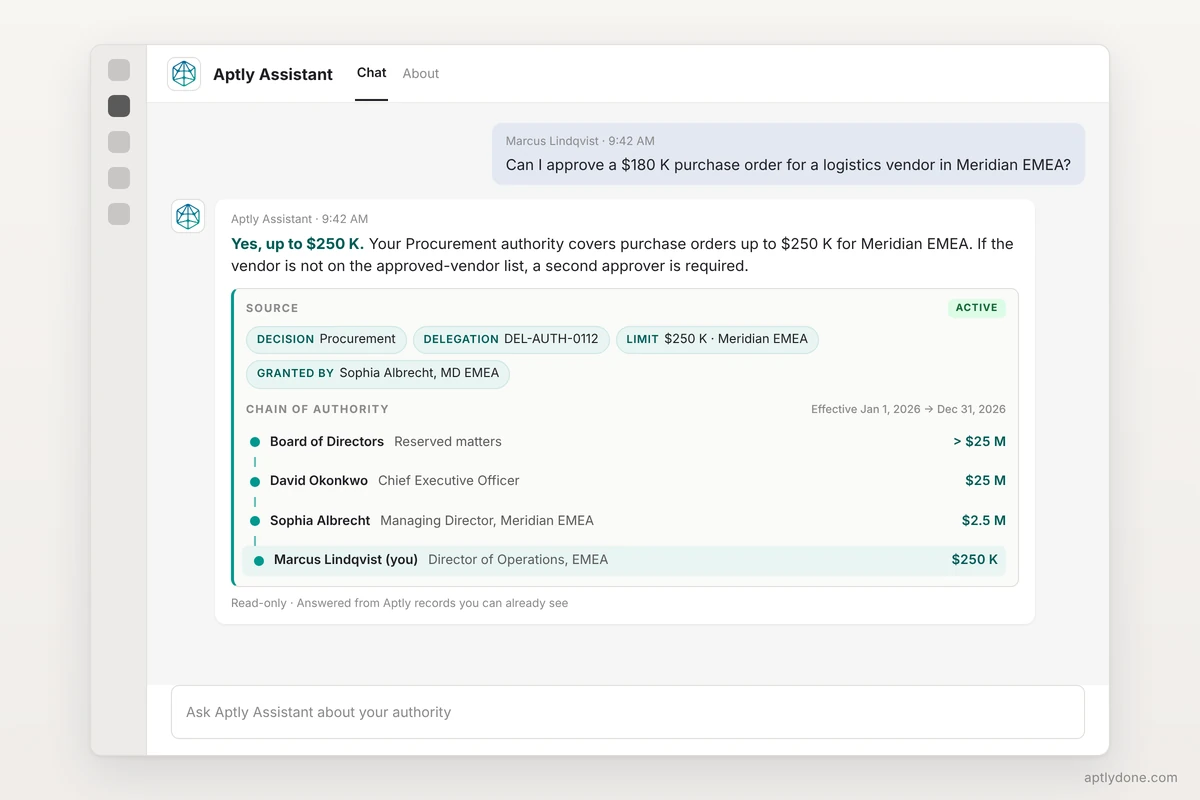
The controls behind those answers are specific.
Keeping the model read-only is deliberate. The assistant earns trust by answering correctly, citing its sources and staying inside each user's own permissions, and any change to authority is the user's explicit act, never the model's.
One governed layer, many surfaces
Aptly Assistant is the first client of Aptly Intelligence, a reasoning layer over Aptly's governed record. Built on the Model Context Protocol, it lets every new surface inherit the same permissions and citations.
Aptly describes Aptly Intelligence as the understanding layer across the Aptly platform. It reasons over the one governed record every Aptly product writes to, syncs with and enforces, rather than sitting on a single web page as a feature.
The Model Context Protocol (MCP) is the open standard Anthropic introduced in late 2024 for connecting AI models and agents to external tools and governed data. An MCP server exposes a system's data once, in a structured and permissioned way, and any compatible client connects under the same rules. In December 2025, Anthropic donated MCP to the Agentic AI Foundation under the Linux Foundation, and Microsoft made MCP generally available in Copilot Studio in 2025.
Aptly's MCP server uses the same governed toolset as Aptly Assistant, with access scoped through user-issued tokens, so clients can connect MCP-compatible models under their own control. A fully Azure-hosted MCP server for Microsoft Copilot and Copilot Studio is on the near-term roadmap.
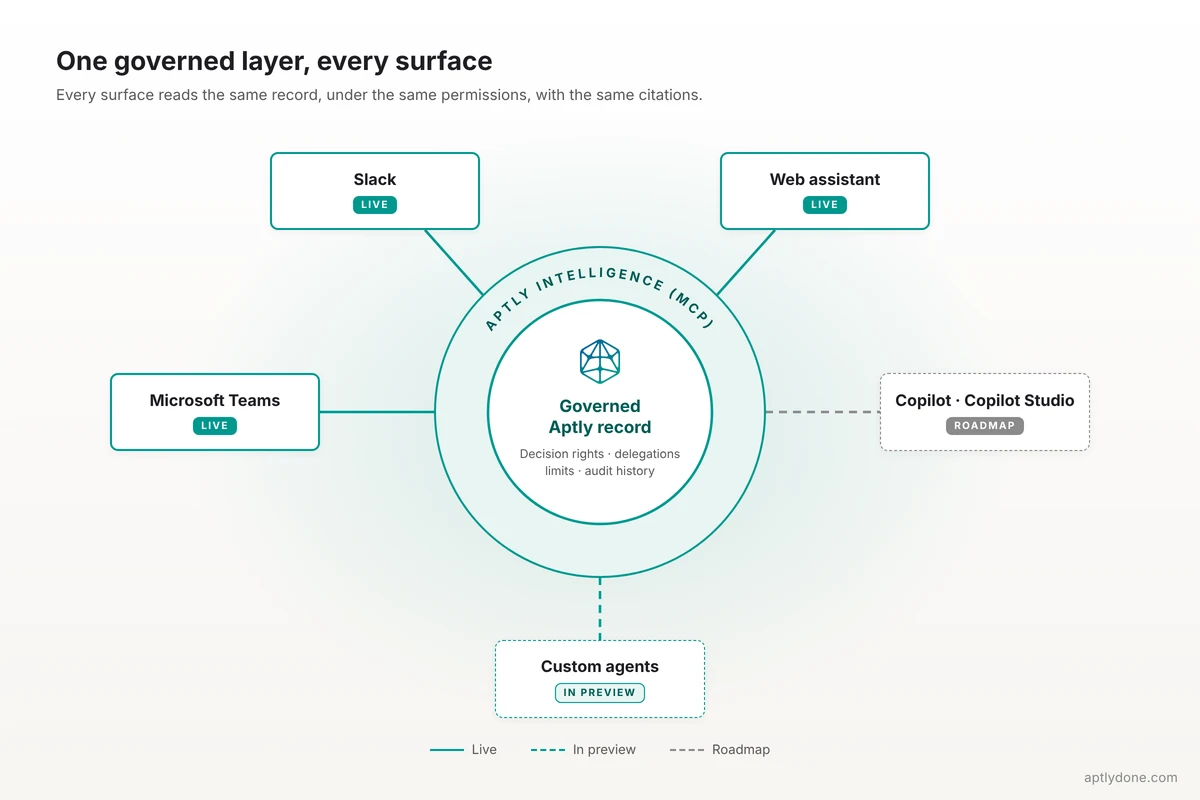
The practical effect: Aptly builds one governed context layer instead of a separate integration for every model and channel. Teams, Slack and a web assistant are live today. Custom agents a client deploys connect the same way, in preview, and can be required to clear the same authority check as a person before the underlying system call runs. Copilot and Copilot Studio follow when the hosted MCP server ships.
Beyond answers: insight, separation of duties and action
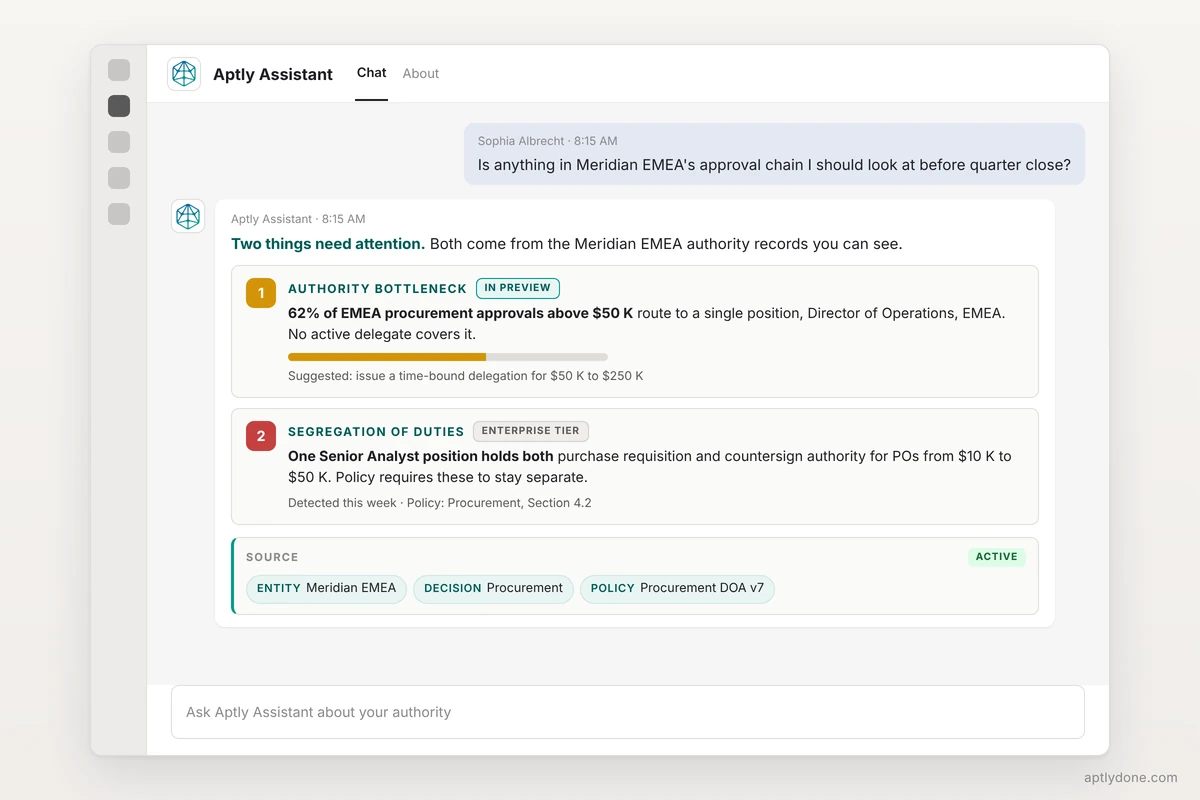
Three capabilities extend the layer: authority bottleneck insight, now in preview; continuous segregation-of-duties analysis, available in the Enterprise tier; and approving, issuing or revoking authority directly from the conversation, available today.
Bottleneck insight turns what used to be an audit finding into something a team resolves on its own schedule. Segregation-of-duties analysis means a conflict is caught the week it appears, not the quarter it gets reviewed.
In Aptly Assistant, both come back as answers to a plain question, with the same citations.
Action is the most significant step, and it runs under the same controls as every answer:
- The authorization check sits in the request path, so an out-of-authority action never executes rather than being flagged afterward
- Every act is attributed to its actor, and a machine actor is also tied to the accountable human whose delegation it derives from
- For machine actors, the system fails closed: an evaluation that cannot complete is treated as a denial
- A denied act can be escalated to the accountable human and released as a linked, attributable approval, never silently overridden
- Suspending a person's delegation stops every machine action that derives authority from them at the very next request
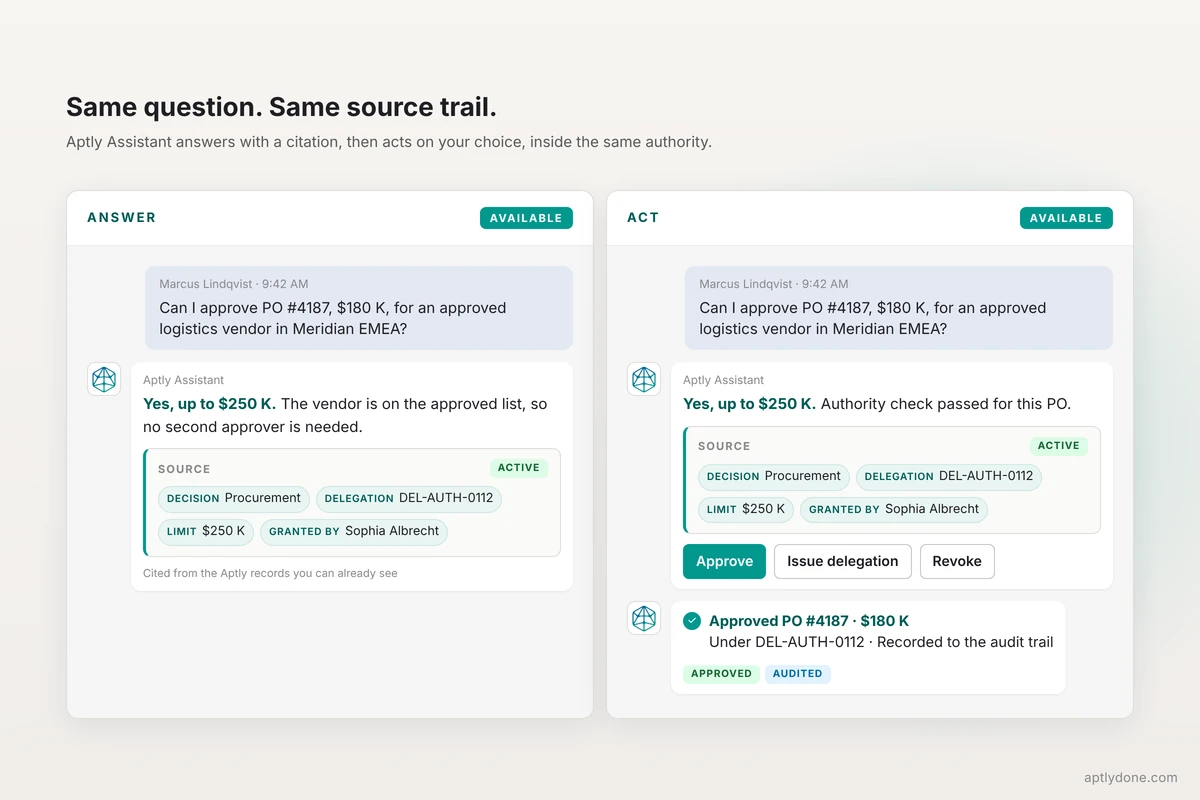
That is the step from telling people and agents what they may do to enforcing it for both.
Aptly Assistant is free for every Aptly client in the Microsoft Marketplace. See Aptly in your environment.
References
- Gartner. “Gartner Predicts 40% of Enterprise Apps Will Feature Task-Specific AI Agents by 2026, Up from Less Than 5% in 2025.” August 2025.
- Gartner. “Gartner Predicts Over 40% of Agentic AI Projects Will Be Canceled by End of 2027.” June 2025.
- EU AI Act. “Article 26: Obligations of Deployers of High-Risk AI Systems.”
- Danish Standards. “Digital Omnibus for AI approved.” July 2026.
- Singapore Ministry of Digital Development and Information. “Singapore Launches New Model AI Governance Framework for Agentic AI.” January 2026.
- Anthropic. “Donating the Model Context Protocol and establishing the Agentic AI Foundation.” December 2025.
- Microsoft. “Model Context Protocol (MCP) is now generally available in Microsoft Copilot Studio.” 2025.