When was the last time you could prove that what SAP, Oracle, Workday, and NetSuite actually enforce still matches the approval matrix your board signed off? After every reorg, leaver, and new entity, the two drift apart, and the gap surfaces as over-entitled approvers, orphaned delegations, and segregation-of-duties conflicts at audit. Aptly holds the approved matrix as the single source of truth, syncs it to every system, and flags drift the day it appears.
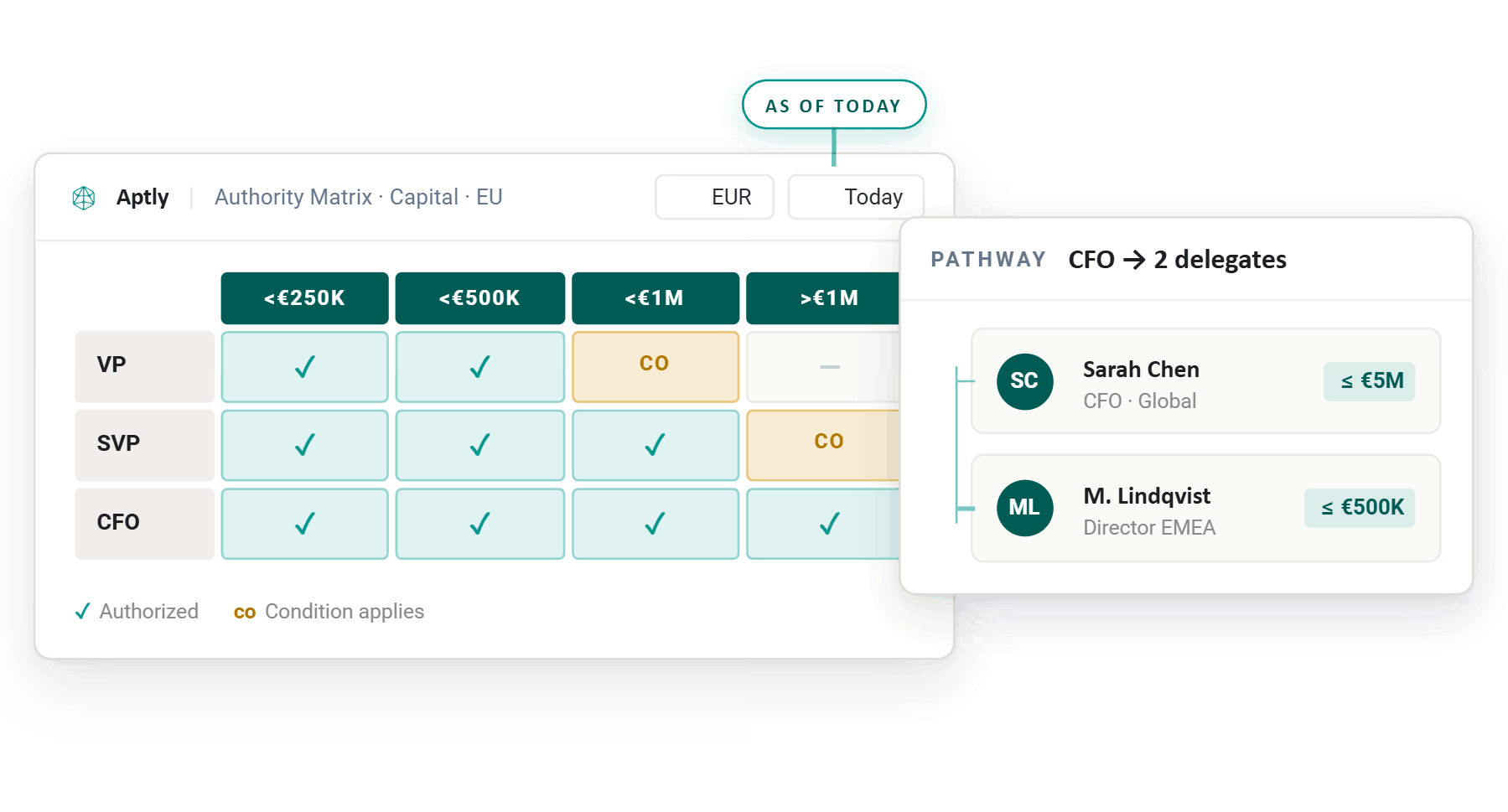
Most enterprises can produce an approved approval matrix. Far fewer can prove that what their ERPs and apps enforce still matches it today, after the last reorg, for every approver. Authority is approved once, in the boardroom, then configured separately in every system, and the two fall out of step the moment the org chart changes.
The matrix is approved; the systems drift. The board signs off on limits and approvers, but SAP release strategies, Oracle and NetSuite approval rules, Workday business processes, and a dozen apps each enforce their own copy. After a reorg, a departure, or a new entity, enforced reality and approved policy quietly diverge.
Drift is silent until audit. Over-entitled approvers keep limits they were never granted, orphaned delegations outlive the people who held them, and segregation-of-duties conflicts form where one person can both create and approve. None of it announces itself; it surfaces when an auditor samples the period.
You maintain the same matrix many times, by hand. Every system is configured on its own, so a single change to the approved matrix means re-keying it across each ERP, app, and identity group, and trusting that nothing was missed.
~90%
EY and the Society for Corporate Governance found that nearly 90% of organizations have a delegation-of-authority policy, yet the report noted their format, content, and governance vary widely. Having an approved matrix is rarely the problem. Keeping every system aligned to it is.
Aptly sits between your identity systems (Okta, Microsoft Entra ID, SailPoint) and your execution systems (SAP, Oracle, NetSuite, Workday, ServiceNow) as the single source of truth for who can approve, sign, and commit on behalf of the enterprise. Identity governs who can log in; your ERP routes transactions; Aptly governs decision authority, the approval matrix itself, and keeps it aligned with what every system enforces.
This is a different layer from the tools you already run. Approval-workflow and AP-automation tools route a transaction inside one system. Identity-governance and access-risk tools (SAP GRC, Pathlock, Saviynt) govern which technical entitlements a user holds. Aptly governs the board-approved decision rights both should reflect, and detects where the enforced configuration has drifted from the approved policy. It complements those systems rather than replacing them.
When enforced authority no longer matches approved authority, the control your auditors test has failed, whether or not anything has gone wrong yet.
After a Q2 reorg at Meridian Industries, an operations director's SAP profile quietly inherited authority to approve capital commitments up to $1M, four times the $250K limit the board had delegated to that role.
The gap closed before it reached the audit. When the SOX, APRA CPS 230, and UK Provision 29 reviews came, the evidence showed the limit had been corrected, when, and by whom. No reconstruction. No surprises.
Bring your approval matrix and the systems that enforce it. We'll show you where they've drifted, using your own authority data.