How Optimizing Decision Rights Drives Better Business Outcomes
Most organizations have decision rights frameworks — or believe they do. The reality, as research consistently shows, is that unclear, inconsistent, or outdated decision authority is one of the biggest hidden drags on organizational performance. Revenue growth slows. Talent disengages. Execution stalls. And in most cases, nobody has explicitly identified the decision rights problem as the root cause.
If you're looking for a high-leverage improvement to your organization's performance and agility, decision rights optimization is worth a close look.
What Are Decision Rights and Why Do They Matter?
Decision rights define which individuals and roles have the authority to make specific decisions — and under what conditions, at what financial thresholds, and through what process.
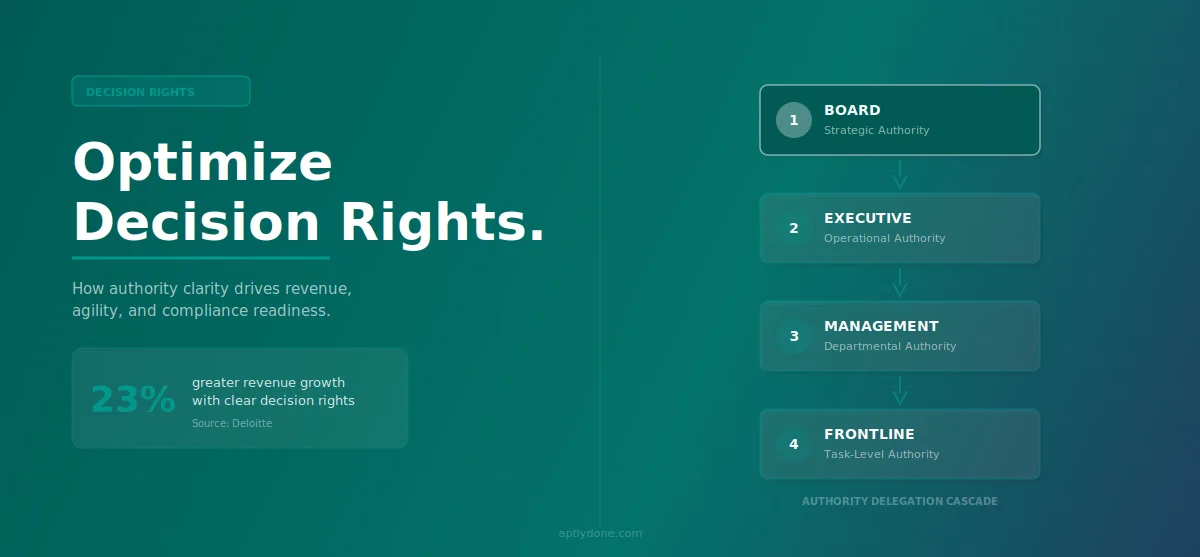
Definition: Decision rights are the formal (or informal) structures that govern who can make what decisions, at what level, and within what constraints in an organization. They shape how authority flows from board to executive to manager to frontline, and they directly determine how quickly and accurately decisions get made.
When decision rights are well-designed, they enable organizational agility: the right person makes the right call without unnecessary escalation. When they're unclear or outdated, they create the opposite — approvals stack up, accountability diffuses, and decisions get made by whoever has the energy to push through the bureaucracy rather than whoever has the right authority and information.
For large, complex enterprises, decision rights are inseparable from how the organization governs itself. They underpin delegation of authority frameworks, authority matrix structures, signatory management, and compliance readiness. Getting them right is foundational governance work, not administrative overhead.
The Real Cost of Poor Decision Rights
When decision rights are unclear, organizations experience delays, conflict, and missed opportunities that rarely appear on a balance sheet but consistently erode competitive position.
Deloitte's research on organizational design maturity found that companies with clearly defined decision rights — what they term "high organization design maturity" — achieve 23% greater revenue growth over three years compared to peers with poorly defined authority structures. The mechanism is direct: when employees know their authority, they act on it. When they don't, they escalate — adding weeks to decisions that should take hours.
The indirect costs are equally significant. Unclear decision rights cause:
- Decision delays at approval checkpoints where authority is ambiguous
- Accountability gaps when outcomes go wrong and ownership is disputed
- Employee disengagement among high performers who feel over-monitored or under-empowered
- Compliance risk when authority is exercised by people who technically lack it, leaving the organization exposed in audits
West Monroe's Speed Wins 2026 research, based on surveys of hundreds of senior executives, found that excessive approval layers are among the top barriers to organizational speed — and that slowness compounds: each delayed decision creates downstream delays for the teams and projects that depend on it.
Five Attributes of Effective Organizational Decision-Making
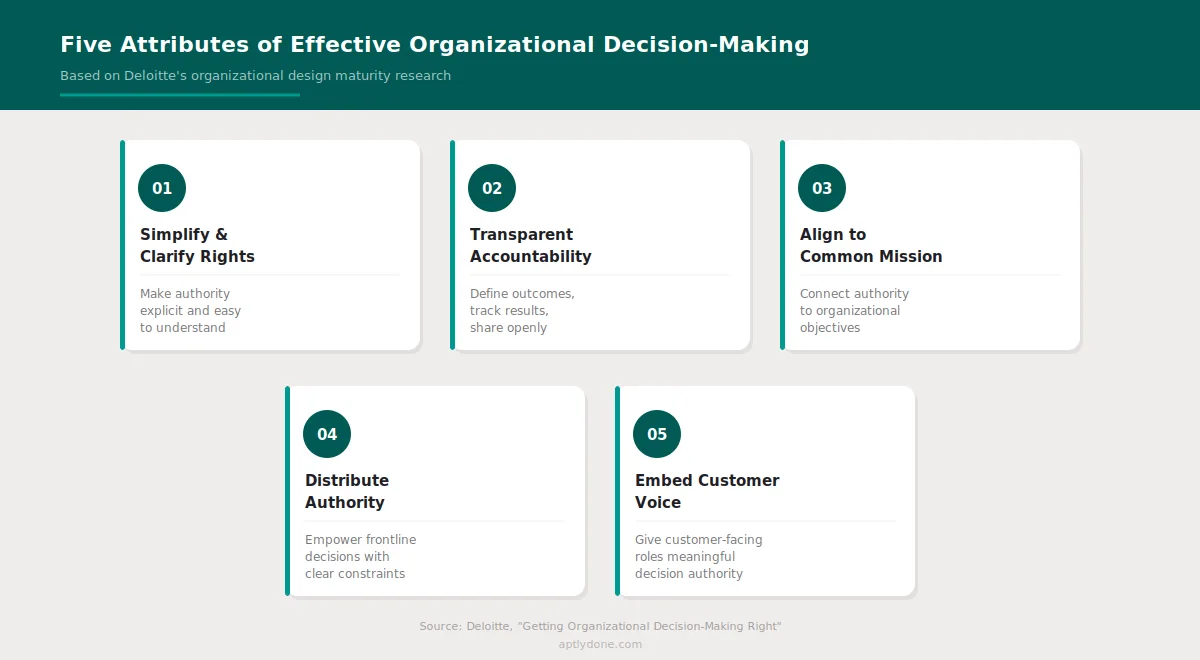
The research is clear on what high-performing decision rights look like in practice. Based on Deloitte's analysis of decision-making maturity, five attributes consistently distinguish organizations that get decision rights right.
- Simplified and clarified decision rights. The most effective frameworks make authority explicit and easy to understand. Tools like RACI matrices and delegation of authority frameworks help define roles and responsibilities in concrete, operational terms — not just in governance policy documents.
- Transparent accountability for decisions made. High-performing organizations pair authority with accountability by defining clear outcomes, tracking decision results, and making that information visible. Authority without accountability is the structural condition for poor governance.
- Alignment to a common mission. Decision-making groups work best when their authority connects clearly to organizational objectives. This means designing decision rights around business outcomes, not just organizational hierarchy.
- Distributed authority to the appropriate level. Frontline workers and managers with routine decision authority respond faster and with better customer context. The key is distributing authority deliberately — with clear constraints — rather than allowing it to drift or remain concentrated at the top by default.
- Customer voice embedded in decision processes. Organizations that give customer-facing roles meaningful decision authority make faster, more relevant decisions. This is especially important in product development, service delivery, and go-to-market execution.
These five attributes aren't abstract principles. They're design criteria for how decision rights should be structured, assigned, and maintained in practice.
Common Decision Rights Mistakes Organizations Make
Most decision rights problems don't originate in bad intentions — they come from governance structures that were built once and never maintained.
Treating decision rights as a policy document, not a living system. When authority structures live in a policy PDF or a static spreadsheet, they drift out of date the moment someone changes roles, a team is restructured, or thresholds become obsolete. Most organizations discover the problem during an audit or a compliance incident — not before.
Conflating decision rights with job titles. Authority should be role-specific and threshold-specific, not assumed from seniority. A VP in one business unit may have authority for capital expenditures up to $500K; a VP in another might hold authority for $50K. Treating decision rights as interchangeable by title is a systematic source of unauthorized decisions.
Designing for the org chart that exists today. Organizational structures change constantly — through growth, M&A, and leadership transitions. Decision rights frameworks designed around current structure without a defined update process become misaligned within months.
Keeping decision rights invisible. A delegation of authority framework only works if people can find it, understand it, and trust that it reflects current reality. If employees regularly have to call someone to confirm their authority, the system has failed.
How Aptly Modernizes Decision Rights Management
Traditional approaches to decision rights management — policies in Word documents, authority matrices in Excel, signatory lists in email chains — create the very problems organizations are trying to solve. They're static, inaccessible, and structurally unable to reflect the complexity of a modern enterprise.
Aptly is a purpose-built delegation of authority management platform that transforms how organizations manage, track, and enforce decision rights. Here's what that looks like in practice:
- A live, searchable authority registry that replaces static policy documents with always-current, role-specific authority records — automatically synced with your HRIS so authority always matches your actual org chart.
- Defined delegation chains with automated workflows that route decisions to the right approval level based on type, amount, and context — eliminating both bottlenecks and unauthorized decisions.
- Audit-ready documentation for every delegation event: who held what authority, when, under what constraints, and what decisions were made within it. SOX audit preparation that used to take days can be completed in hours.
- Signatory management — so authorized signatories are verified, accessible, and current, eliminating the reputational and legal risk of outdated signatory lists. See Aptly Signatory Management.
- Integrations with enterprise systems so authority management connects to the tools your HR, finance, and legal teams already use. See Aptly Integrations.
For organizations still managing decision rights in spreadsheets, the shift to Aptly eliminates the leading source of DOA risk: documentation that doesn't reflect organizational reality. See Solving the Spreadsheet Dependency for Delegation of Authority for more on why spreadsheet-based DOA fails public companies.
See How Aptly Works → Request a Demo →
Frequently Asked Questions
What is the difference between decision rights and delegation of authority?
Decision rights and delegation of authority are closely related but not identical. Decision rights is the broader concept — the framework of who can make what decisions, at what level, under what conditions. Delegation of authority is the formal mechanism through which decision rights are assigned and transferred: a board delegates authority to executives, who delegate to managers, who delegate further down the organization. In practice, most enterprises operationalize their decision rights through a formal delegation of authority framework and matrix.
How do you know if your organization's decision rights are well-defined?
A few signals indicate weak decision rights: frequent escalation of routine decisions, uncertainty about who needs to approve what, audit findings related to unauthorized approvals, and employee frustration with slow decision processes. High-maturity organizations can answer three questions quickly for any given decision: Who has authority? What are the constraints? And where is that documented?
What role does technology play in managing decision rights?
Decision rights management software — like Aptly — plays an increasingly important role as organizations grow in complexity. Manual documentation approaches (spreadsheets, Word documents) are unable to reflect real-time organizational changes, enforce authority constraints in workflows, or generate the audit trails that compliance teams need. Purpose-built platforms connect decision rights to org chart data, automate enforcement, and create visibility that static documents cannot provide.
How does optimizing decision rights connect to AI governance?
As organizations adopt AI agents and automated systems capable of making decisions, traditional human-centered decision rights frameworks need to extend to cover AI-generated actions. Defining which AI systems have what authority — and at what thresholds — is rapidly becoming a governance requirement. See Managing Authority in the Age of Agentic AI for Aptly's perspective on this emerging challenge.