AI agents now act across your enterprise systems: moving data, onboarding vendors, renewing contracts, committing spend. Identity tools answer which systems an agent can reach. They do not answer the question governance turns on: what is the agent authorized to commit the company to, up to what limit, and when must it escalate to a human? That is an authority question, and it governs machine and human decision-makers in one matrix. Aptly governs it, with a full audit trail of every action.
Most enterprises can grant an AI agent access. Far fewer can state, and prove, what that agent is authorized to decide on the company's behalf, up to what limit, and when it must hand off to a human. That gap is where autonomous systems quietly exceed their mandate.
Access is governed; authority is not. Identity and access tools decide which systems an agent can log into. They are silent on the decision the agent then makes inside those systems: the renewal it commits to, the vendor it onboards, the refund it issues. Reachability is not authorization.
Agents act faster than oversight can keep up. A human approver is a natural checkpoint; an agent executing thousands of actions a day is not. Without an enforced limit and a defined escalation point, "the agent did it" becomes the after-the-fact explanation for a commitment no one approved.
Machine and human authority live in separate worlds. The board-approved authority matrix governs people; agent permissions live in code, scattered across tools and teams. No single record answers "who, or what, was authorized to commit us to this, and was it within limits?"
44%
In a 2025 survey of 353 organizations by Dimensional Research for SailPoint, 82% already used AI agents, but only 44% had formal policies in place to govern them. That gap, between deploying agents and governing them, is exactly what an enforced authority layer closes.
Aptly sits between your identity systems (Okta, Microsoft Entra ID, SailPoint) and your execution systems (SAP, Oracle, NetSuite, Workday, ServiceNow) as the single source of truth for who, and what, can approve, sign, and commit on behalf of the enterprise. An AI agent is modeled as a principal in the same authority matrix as your people: scoped to specific decision types, bounded by limits and conditions, required to escalate to a named human above its ceiling, and recorded on every action.
Because Aptly publishes that authority layer over its REST API and an MCP endpoint, across 30+ connected systems, an agent can check in real time whether a proposed action is within its authorized scope before it acts, and the request is recorded against the authority that governs it. The agent does not have to guess at its mandate, and the company does not have to reconstruct it later.
Human oversight of automated decisions, defined limits, and a record of how the system operated are becoming explicit obligations. Aptly maps your agent-authority evidence to the frameworks that ask for it.
Aptly governs the agent's decision authority, not its identity. Machine and non-human identity tools secure the agent's credentials; Aptly complements that layer rather than replacing it. Standards bodies are converging here: NIST opened work on AI-agent identity and authorization in early 2026, and OWASP's 2025 agentic security work names excessive agency, an agent acting beyond its intended scope, as a leading risk.
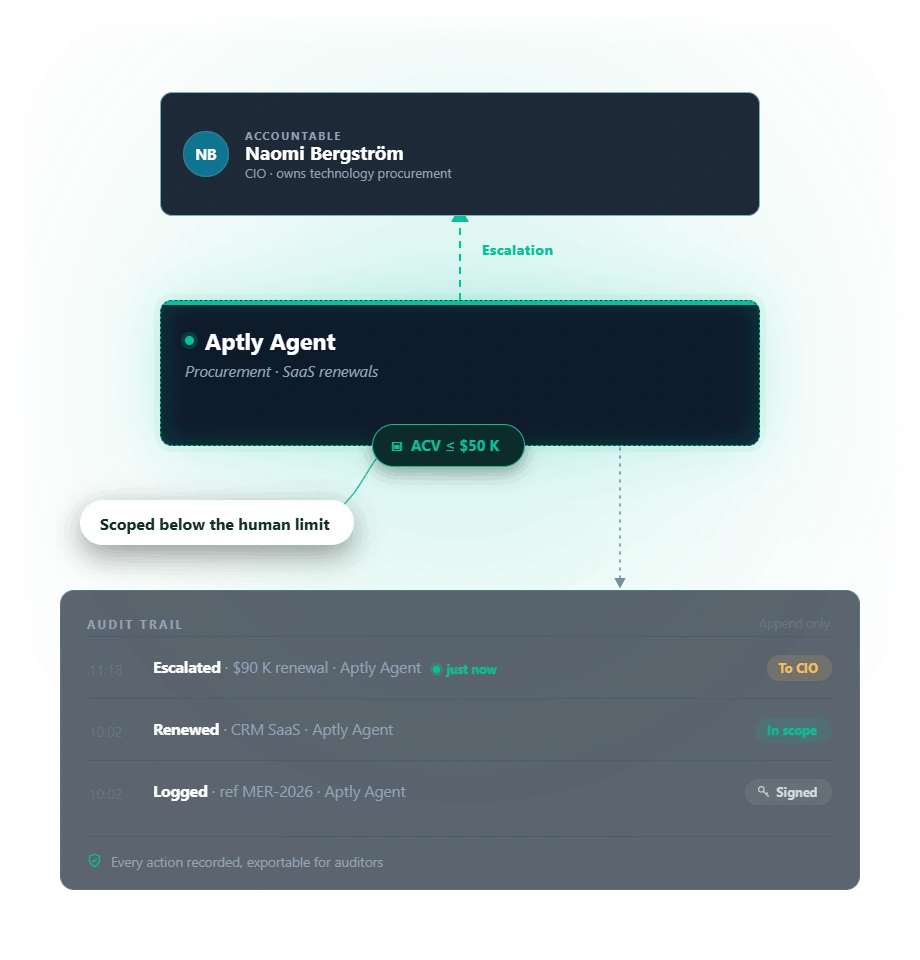
At Meridian Industries, the CIO owns agent onboarding; no agent acts on the company's behalf until its authority is defined in Aptly. The procurement agent the team scoped handles SaaS renewals up to $50K ACV, capped by four standing conditions: no more than a 5% price uplift, terms of 12 months or less, vendors on the approved list, EU only.
The daylight is deliberate. The agent's $50K ceiling sits well below the Director rung ($250K) on Meridian's authority ladder. Both the in-scope renewal and the escalation sit in one audit trail, the same one that governs every person on the matrix.
Bring an agent you are deploying, whether procurement, finance, or operations. We will show you how Aptly scopes its authority, enforces escalation above its limit, and logs every action, on the same matrix as your people.