A delegation of authority (DOA) policy defines who can approve transactions, commit the organization, and make decisions, and within what limits. Aptly replaces the static authority matrix, the spreadsheet register, and the email chain with one live, auditable system that cascades authority from the board to the front line, with approvals, acceptance, and a full audit trail at every level.
Most organizations already have a delegation of authority policy. Almost all of them keep it in a spreadsheet, a slide, or a policy document that is out of date the moment someone changes roles. There is no tracked acceptance, no record of who delegated what to whom, and no way to prove who held authority on a past date. When the organization reorganizes, the matrix breaks quietly, and the gap only surfaces at audit, or after an authorization control failure.
A delegation of authority matrix (DOA matrix) is a structured record of who can approve which decisions, up to what limit, and under what conditions. On paper or in a spreadsheet it drifts out of date. As a living system it stays current, tracks acceptance, and proves who held authority on any date.
In the January 2025 report "The Delegation Edge" from Ernst & Young LLP (EY) and the Society for Corporate Governance, based on a survey of more than 200 Society members, almost 90% of organizations said they have implemented a DOA policy, formal or informal. The same research shows the execution gap: only 40% conduct regular training on policy updates, and 35% cite difficulty tracking and enforcing the policy.
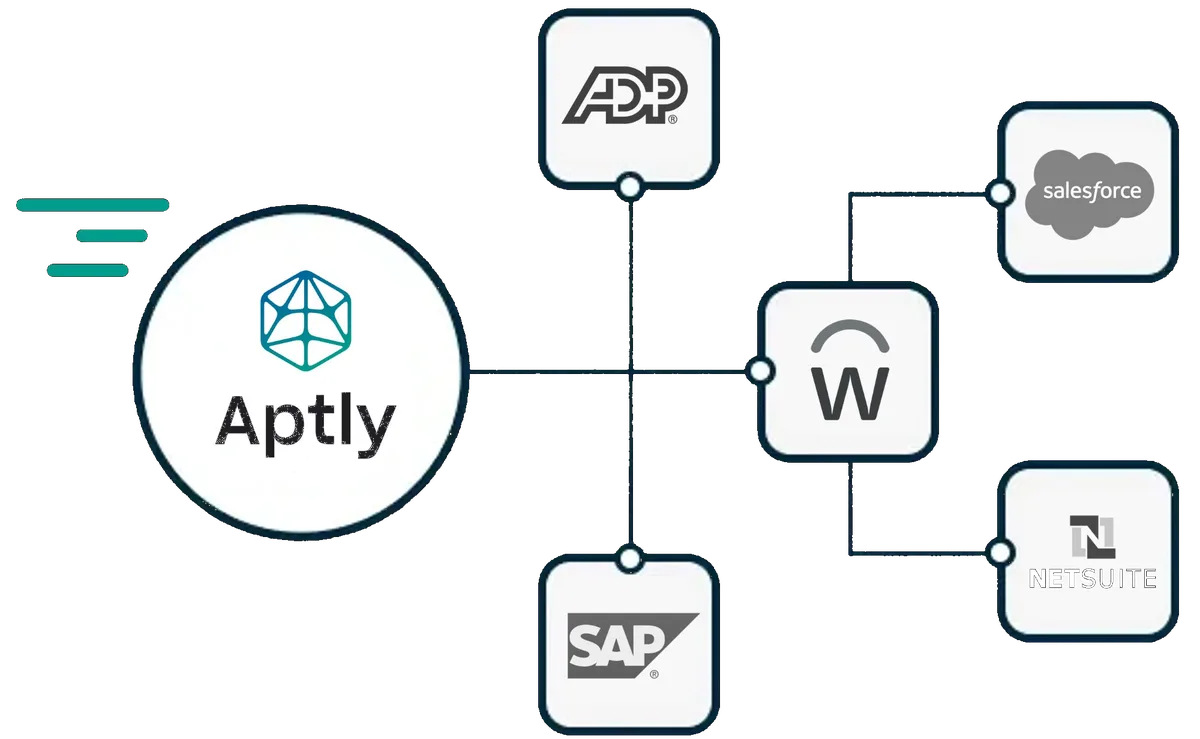
Identity systems answer who you are. Your business systems move the work. Neither one answers what each person is authorized to decide. Aptly is the layer in between, the system of record for delegation of authority, and your delegations, limits, conditions, and acceptance live there as one structured, versioned record.
See how it fits the whole platform →One governed record, from the authority model to the proof. Define it once, keep it current as you change, and prove it on demand.

Map who can approve what, and within which limits.

Delegate down the hierarchy with acceptance and limits intact.

Sync the live record into the systems where work happens.

Reconstruct who held what authority on any date.
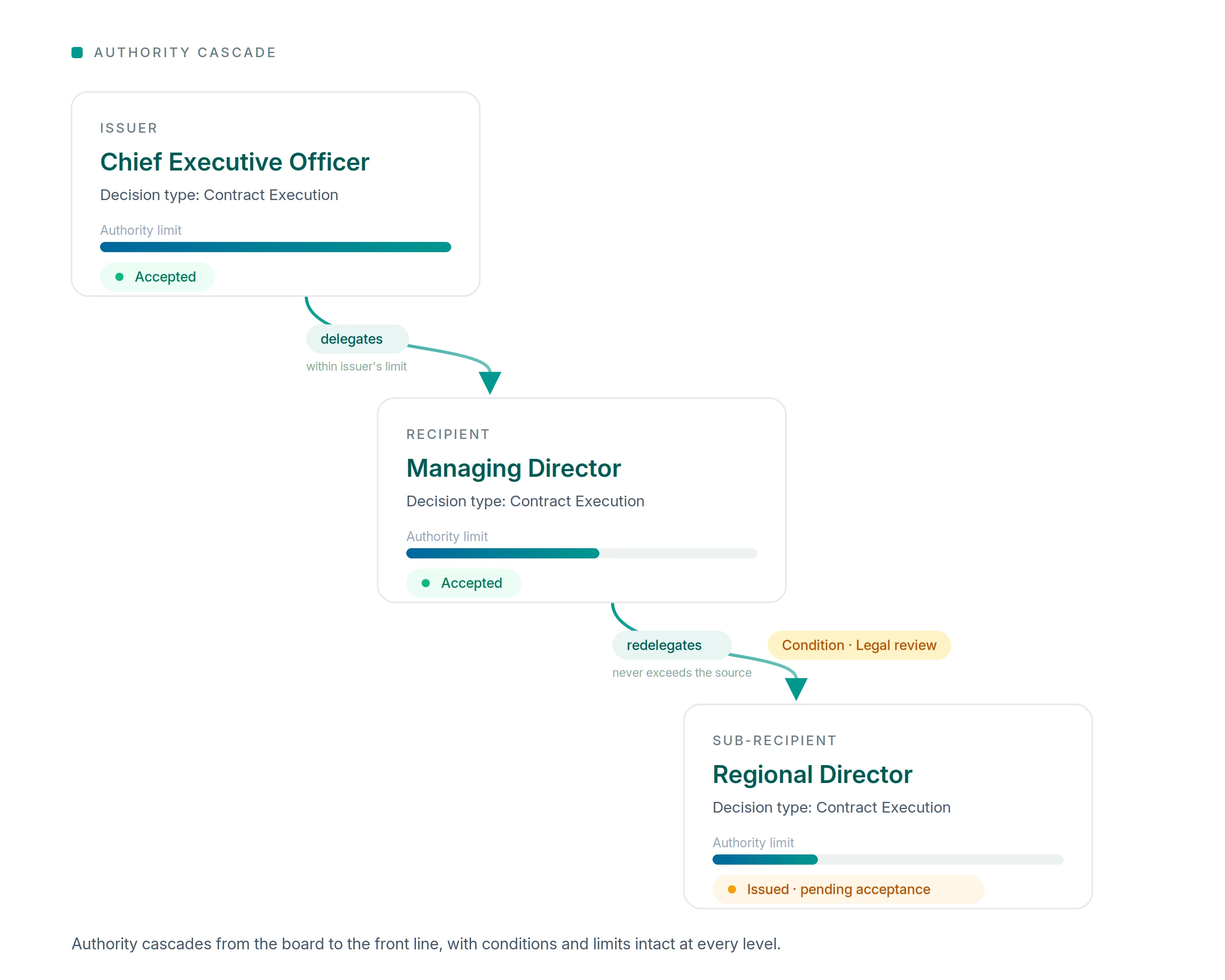
Every delegation follows the same path, with its conditions and limits intact at each step.
When a position changes in your HR or identity system, Aptly can issue the delegations that now apply and revoke the ones that no longer do.
When a position, department, reporting line, or scope changes, affected delegations are flagged as invalid and routed for review, so authority never quietly goes stale.
The features enterprises ask for, from modeling decision rights to automating how authority moves and proving it on demand.
Build the full picture of who can decide what, across every entity.
Put authority in the right hands and move it through the hierarchy under control.
Keep the record current everywhere work happens, and route by it.
Powered by Authority Hub →Keep the record honest and make the evidence a by-product of running it.
Aptly connects to the systems you already run. Personnel and structure data sync in from your human resources information system (HRIS) and identity provider, so a role change triggers a delegation review instead of leaving a stale permission in place. The governed record stays aligned with organizational reality, rather than the last manual update.
At Meridian Industries, the Chief Executive Officer delegates material contract authority to a Managing Director, within a set limit and on the condition that legal has reviewed the contract. The Managing Director accepts, and the authority is live. Eighteen months later, during an audit, the question is simple: who was authorized to commit Meridian to that contract on the day it was signed. Aptly answers it from the record, with the limit, the condition, the acceptance, and the lineage attached. No reconstruction.
In the Association of Certified Fraud Examiners (ACFE) 2024 Report to the Nations, drawn from 1,921 cases across 138 countries, more than half of occupational frauds traced to a lack of internal controls (32%) or an override of existing controls (19%). Delegation of authority is the control that decides who can commit the organization, and Aptly keeps it enforceable and provable.
Delegation of Authority defines and administers decision rights. Three more products extend the same governed record.
Signing on behalf of the organization is a distinct authority type. Keep authorized signatory lists current, validated, and audit-ready, and share them securely with banks and counterparties.
Learn more about Signatory Management →Push delegations into the systems where work executes and route approvals by the governed record, with a built-in workflow builder to shape both.
Learn more about Authority Hub →Ask who can decide what in natural language, wherever work happens, and detect authority risks before they become audit findings.
Learn more about Intelligence →Delegation of authority software is a system for defining and administering who can approve, commit, and decide on behalf of an organization, and within what limits. Aptly replaces the static DOA matrix and spreadsheet register with a live record that tracks issuance and acceptance, cascades authority through the hierarchy, and proves who held authority on any date.
A delegation of authority matrix is a structured record of who can approve which decisions, up to what limit, and under what conditions, across each entity. On paper or in a spreadsheet it drifts out of date the moment roles change. In Aptly it stays current, tracks acceptance, and reconstructs the full authority state for any past date.
A spreadsheet has no version control, no tracked acceptance, no delegation lineage, and no way to prove who held authority on a past date. It breaks on every reorganization. Aptly keeps authority current as your organization changes, records every issuance and acceptance, and makes the full history available for audit without reconstruction.
Enterprise resource planning (ERP) systems enforce approval rules inside one system. No single ERP holds the cross-enterprise view of authority, and most do not verify whether a delegate has equivalent authority. Aptly is the system of record across systems, and Authority Hub syncs the governed record into your ERP so the rules there stay aligned.
Identity systems answer whether you can access a system or click a button. Delegation of authority answers whether you are authorized to make a decision, up to what limit, and who is accountable. Aptly governs the decision, not the door, and sits between your identity provider and the systems where work happens.
Point-in-time recall reconstructs the complete authority state for any past date: who held which authority, at what limit, under what conditions, granted by whom. It replaces the quarterly scramble to rebuild approval history during an audit or litigation hold with a continuous, evidenced record that stands on its own.
Yes. Aptly issues temporary delegations for leave, finite projects, or committees, and expires them on schedule. Redelegation never exceeds its source, and you can restrict who may redelegate to specific roles or direct reports and set the limit at each level. Notifications cover new delegations, revocation, suspension, and upcoming expirations.
Yes. Aptly governs financial authorities, with limits and thresholds in your default currency or any currency by exchange rate, and non-financial authorities such as policy exceptions, hiring, and contract execution. Each decision type carries its own limits, conditions, and responsible, accountable, consulted, and informed (RACI) roles.
When connected human resources and identity systems record a role change, Aptly triggers a delegation review instead of leaving a stale permission in place. Authority Hub keeps the governed record in sync with the systems where work happens, so the matrix reflects organizational reality rather than the last manual update.
New research from Ernst & Young LLP (EY) and the Society for Corporate Governance examines how organizations delegate authority today: near-universal policy adoption alongside real gaps in training, tracking, and enforcement. Read the report to see where the execution gap shows up, and what closing it takes.
Bring your own delegation of authority structure to a working session and see how Aptly digitizes it.
The legal foundation behind entity-level delegations differs sharply from management-level delegations — and the difference shapes governance, audit, and oversight liability.
How Aptly's innovative solution for delegation of authority and signature authority management helps organizations enhance their GRC capabilities
New research from EY and the Society for Corporate Governance finds 29% of organizations rate their DOA frameworks as less than effective. Our white paper examines why — and what to do about it.