Authority Hub is the sync and route layer of the Aptly platform. It keeps the governed authority record current in the systems where work executes, routes requests and approvals by that record, and gives your team a built-in workflow builder to shape both.
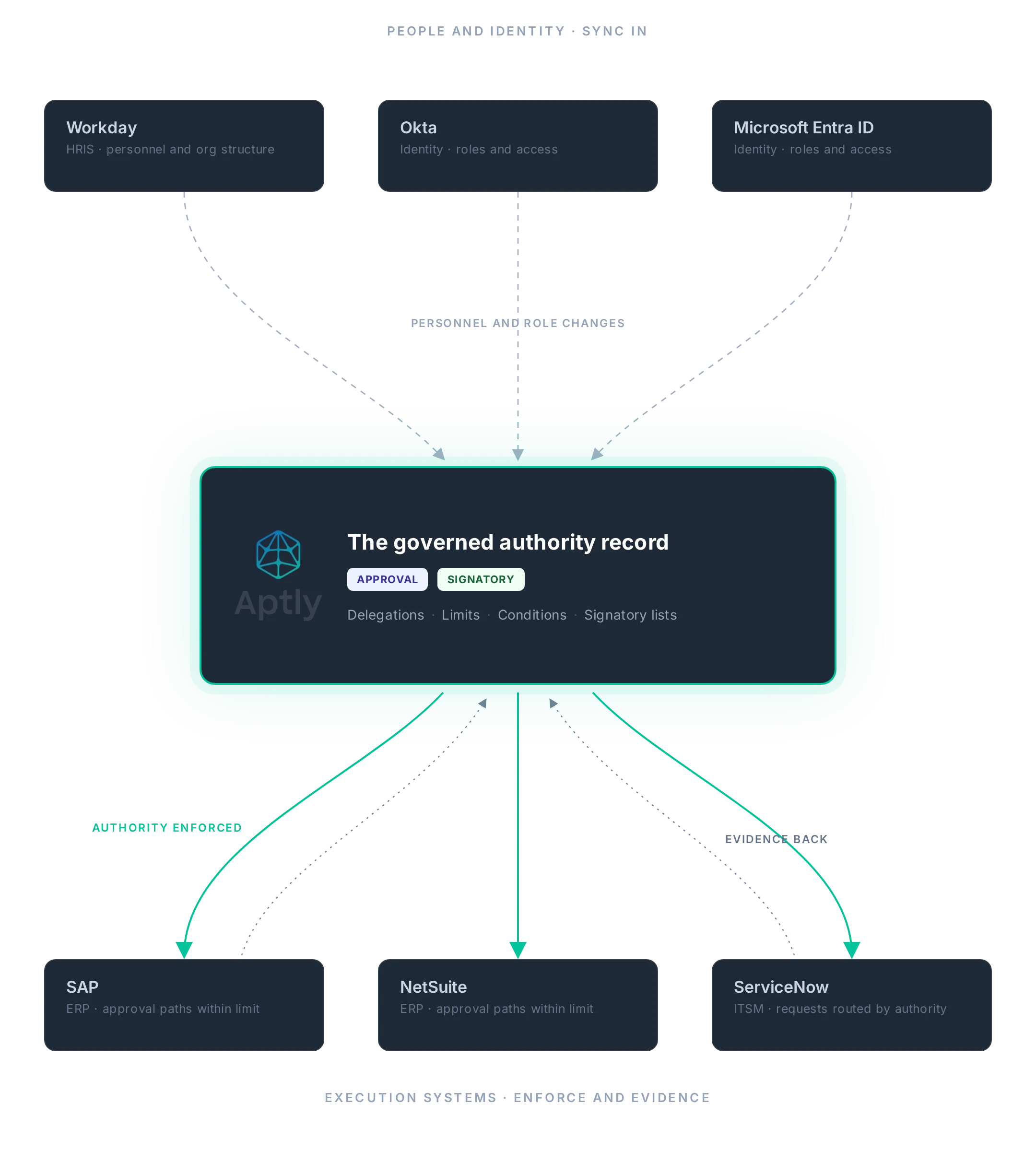
Most systems of record hold the truth and wait to be asked. Authority Hub holds the governed authority record and moves it: out to the human resources information system (HRIS), identity, and enterprise resource planning (ERP) systems where work actually executes, and back again as your organization changes.
The scope is deliberate. Authority is defined in Delegation of Authority and Signatory Management. The connector catalog lives on Integrations. Analysis and detection are the work of Intelligence. Authority Hub does the job between them all: it keeps the record current everywhere, and it routes work by it.
Sync runs in both directions. Outbound, the delegations, signatory lists, and thresholds you govern in Aptly are pushed into the execution systems that act on them, so enforcement happens where commitments are made, not in a document nobody opens. Inbound, personnel and role changes flow in from your HRIS and identity systems, so when someone is promoted, transferred, or departs, the authority record follows reality without a ticket.
Workflow tools route requests by rules someone retyped from a policy document, and those rules drift the moment the policy changes. Authority Hub routes by the governed record: requests and approvals follow the current delegations, limits, and conditions in force today, so a route cannot disagree with policy because the route is the policy.
Every organization's systems and processes are different, so Authority Hub includes a visual workflow builder as a native platform capability. Your team shapes how authority syncs, how requests route, and what happens when the record changes, without writing an integration project into next year's roadmap.
Pre-built connectors cover widely used enterprise systems; the full catalog lives on Integrations. When a connector does not exist for a broadly used system, Aptly builds it. For homegrown systems or systems no longer supported, Aptly assists your team in building the connector you need. And direct API (application programming interface) access is always available: custom code steps inside the builder reach anything the API can, which is the common path for client-specific systems. Customized and homegrown systems are not an edge case here. They are a supported path.

The outbound direction is enforcement: authority flows from the governed record into the systems where commitments are made. The inbound direction is evidence: workflows bring transactions and actions from those systems back into Aptly, where they sit alongside the authorities people actually held when they acted.
What happens to that evidence is a different product's job. Detection analytics, the work of reading across the record and the activity to surface authority risk, belong to Intelligence. Authority Hub moves the data and runs the workflows; Intelligence understands what they mean. Two layers, one record, no overlap.
Authority Hub writes to the same governed backbone as the rest of the platform. Every sync, every routed request, and every workflow run is captured in the audit trail and version history that the whole Aptly record carries, so what moved, when, and under whose authority is never a reconstruction exercise.
The platform behind it carries the same posture as the rest of Aptly: SOC 2 Type II audited controls, ISO 27001 certified information security management, data handling aligned to the GDPR (General Data Protection Regulation), and enterprise-grade hosting on Microsoft Azure. Security documentation, certifications, and subprocessor information are available at trust.aptlydone.com.
At Meridian Industries, a Regional Director's delegation is revised: a new approval limit, effective immediately. The Regional Director accepts the updated delegation in Aptly, and the acceptance is tracked on the record.
From there, Authority Hub does the rest. The revised limit syncs to the ERP the same day, so the approval path for that region reflects the new authority before the next purchase request arrives. A request raised above the limit routes past the Regional Director to the position that holds the authority, within limit, with no manual rework of routing rules. And the consolidated dashboard shows the before and after: which authorities the position held, which it holds now, and when the change took effect.
No tickets to the ERP team. No spreadsheet reconciliation. The record changed, so the systems changed.
Platform
Learn more
Platform
Learn more
Bring your delegation of authority (DOA) matrix and the systems it should govern. We will show you the sync, the routing, and the workflow builder running in your environment, and our team will migrate your existing matrix at no cost.