How to Simplify and Speed Up Approval Processes with Centralized Authority Management
Every large enterprise runs approval processes across dozens of platforms — ERP systems like SAP and Oracle, procurement tools, CRM platforms like Salesforce, ITSM tools like ServiceNow, financial systems, project management applications, and document or legal workflow platforms. Each system routes approvals according to its own configuration. The approvals themselves work. The problem is that nobody can answer a simple question: who actually has the authority to approve what, across all of these systems?
That question — straightforward in theory, nearly impossible in practice — reveals a structural gap in the enterprise technology stack. Identity systems know who you are. Execution systems know where work happens. But no system governs the authority in between: who can approve a $2M purchase order, who can sign a contract on behalf of a subsidiary, who inherits spending authority when a regional VP changes roles. This is the authority gap, and it affects every organization that delegates decision-making across multiple platforms.
Why Do Enterprise Approval Processes Break Down Across Systems?
Enterprise approval processes break down because authority is defined separately in every system, creating inconsistent rules, duplicated configurations, and no unified view of who can approve what.
The scale of enterprise application sprawl makes centralized visibility nearly impossible without a dedicated approach. The MuleSoft 2025 Connectivity Benchmark Report found that the average enterprise uses 897 applications, with organizations deploying AI agents averaging 1,103. Of those hundreds of applications, only 29% are integrated — meaning the vast majority operate as independent silos with their own approval routing, their own authority configurations, and their own version of who can approve what.
Each of these systems manages approval authority differently. An ERP might enforce spending thresholds through role-based configurations. A procurement platform might route purchase orders based on cost center rules. A CRM might restrict deal discount approvals by sales hierarchy. None of these systems share a common authority model, and none reference a central register of who holds what delegated authority across the organization. When a role change happens — a promotion, a reorganization, a departure — each system must be updated independently, if it gets updated at all.
Research published in Harvard Business Review found that knowledge workers toggle between applications approximately 1,200 times per day, losing roughly 9% of their annual work time to context switching alone. For governance and compliance teams responsible for tracking authority across these fragmented systems, the operational burden is even more acute.
What Is the Authority Gap in Enterprise Approval Management?
The authority gap is the disconnect between where approval decisions happen — in dozens of execution systems — and where the authority governing those decisions is defined, tracked, and audited, which in most organizations is nowhere.
Definition: Authority gap — The absence of a centralized, machine-readable system of record for enterprise decision rights, resulting in approval authority that is scattered across spreadsheets, policy documents, email chains, and individual system configurations with no unified governance layer.
Industry research confirms the scope of this problem. A 2025 EY and Society for Corporate Governance survey of 222 corporate governance professionals found that 78% of organizations host their delegation of authority policy on the company intranet — a passive document repository — while only 14% embed their DOA within a dedicated IT system. Just 42% use electronic approval and tracking as a compliance mechanism. Meanwhile, 35% cite difficulty tracking and enforcing their delegation policies, and 28% report that updates and modifications are time-consuming.
An APQC 2024 survey of 311 finance professionals found that 29% of organizations say their delegation of authority policy is not effective — nearly one in three. Fewer than half review their DOA semi-annually; more than a third review on an ad-hoc basis only.
The enterprise technology stack has mature solutions for identity (Okta, Entra ID) and for execution (SAP, Oracle, ServiceNow). What remains unaddressed is the layer in between — the authority layer that governs who can approve, sign, and commit on behalf of the organization. Without a system of record for delegation of authority, every execution system is left to define and enforce authority on its own, creating gaps that widen with every reorganization, acquisition, and system change.
How Does Centralized Authority Management Solve Approval Complexity?
Centralized authority management creates a governed system of record for decision rights that sits between identity and execution layers, defining who can approve what across every connected platform.
The key distinction is this: a centralized authority platform does not replace or replicate the approval workflows running in your ERP, procurement, or ITSM systems. Those workflows continue operating in the systems where work happens. What centralized authority management provides is the governance layer — the authority control plane — that defines, issues, tracks, and audits the decision rights those systems enforce.
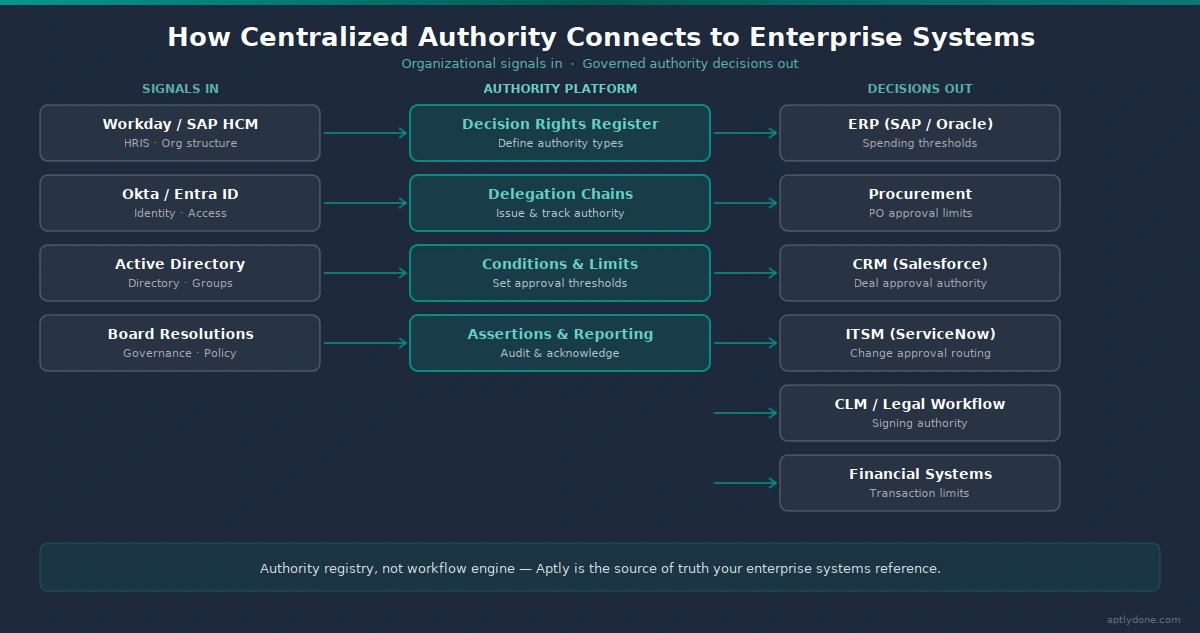
In practice, a platform like Aptly manages the full lifecycle of delegated authority: the formal issuance of decision rights with defined limits and conditions, acceptance and acknowledgement by authority holders, assertions of authority for audit and compliance purposes, and comprehensive reporting on who holds what authority at any point in time. These governed authority records then sync outward to the execution systems — procurement platforms, CRMs, ERP systems, ITSM tools, contract management systems — so that the authority configurations in those systems always reflect the current, approved delegation of authority matrix.
Organizational signals flow inward from HRIS and identity systems. When someone changes roles, gets promoted, or leaves the organization, those changes propagate through the authority platform and cascade to every connected system automatically. This eliminates the manual, system-by-system reconfiguration that causes authority drift and creates compliance exposure. For a deeper look at how this synchronization works, see our guide on keeping delegations in sync across the enterprise.
What Does Fragmented Approval Authority Cost the Enterprise?
Fragmented approval authority costs enterprises measurable revenue, increased fraud exposure, and decision delays that compound across every system where approvals occur.
The financial impact of slow, unclear decision-making is substantial. West Monroe's 2026 "Speed Wins" research, which surveyed 214 C-suite executives and 1,000 managers at companies with at least $250M in revenue, found that organizations lose up to 5% of annual revenue to slow decisions and execution. Nearly half (49%) of C-suite leaders said their company missed a major market opportunity in the previous 12 months, and 56% said competitors beat them to market frequently or occasionally. Managers identified excessive approval layers and unclear decision rights as top bottlenecks — precisely the symptoms of fragmented authority governance.
A McKinsey survey of 1,200 managers found that organizations making decisions quickly are nearly twice as likely to also make high-quality decisions — directly rebutting the assumption that speed trades off against quality. The same research estimated that a typical Fortune 500 company loses approximately $250 million in wages annually to ineffective decision-making processes.
The compliance and fraud risks are equally concrete. The ACFE 2024 Report to the Nations found that 51% of occupational fraud cases resulted from either a lack of internal controls (32%) or an override of existing controls (19%). The median loss per fraud case was $145,000, with 22% of cases involving losses exceeding $1 million. When no system of record governs who has authority to approve transactions, the conditions for both accidental overreach and deliberate fraud multiply across every disconnected platform.
How Does an Authority Control Plane Connect to Enterprise Systems?
An authority control plane integrates with HRIS, ERP, procurement, CRM, ITSM, and contract management systems — receiving organizational data and publishing governed authority decisions to every connected platform.
The integration model follows a clear pattern: identity and organizational signals flow in, governed authority decisions flow out. HRIS platforms like Workday, SAP SuccessFactors, and Oracle HCM provide the organizational structure — who holds which positions, which departments they belong to, and how the reporting hierarchy is configured. The authority platform uses this structure to issue and manage delegated authority according to governance rules defined by the business.
Those governed authorities then sync outward to execution systems where approvals actually occur. An ERP system receives updated approval thresholds when a delegation changes. A procurement platform reflects current spending authority for every authorized approver. A CRM enforces deal approval limits based on the authority register. An ITSM tool like ServiceNow routes change approvals according to delegated authority rather than static configurations. Contract management and legal workflow systems enforce signing authority that matches current, governed delegation records.
The result is a single, auditable source of truth for enterprise authority — an approach that parallels how identity platforms like Okta created a central control plane for system access. The difference is that identity governs who can log in, while authority management governs what they can approve, sign, and commit to once inside. To understand how this model compares to traditional frameworks, see our analysis of DOA vs. approval matrix vs. RACI.
Does a centralized authority platform replace existing approval workflows?
No. A centralized authority platform governs the authority behind approval workflows, not the workflows themselves. Approvals continue running in your ERP, procurement, and ITSM systems. The authority platform ensures those systems always reflect current, governed authority assignments — so the right people are approving the right transactions at the right thresholds, regardless of which system processes the approval.
How does centralized authority management differ from identity and access management?
Identity and access management (IAM) controls who can log in and what systems they can access. Authority management controls what someone is authorized to approve, sign, or commit to once they have access. An IAM system might grant a finance director access to the ERP. An authority management platform defines what spending limits, contract values, and approval thresholds that director can exercise — and ensures those limits are enforced consistently across every connected system.
What happens to approval authority when someone changes roles?
In a centralized authority platform, role changes detected through HRIS integration trigger automatic authority updates. When a manager is promoted to a director role, their approval thresholds update in the authority register and cascade to every connected execution system — ERP, procurement, CRM, ITSM — without manual reconfiguration in each platform. The same applies to departures, lateral moves, and organizational restructuring.
Sources
- MuleSoft/Salesforce. "2025 Connectivity Benchmark Report." January 2025.
- EY and Society for Corporate Governance. "The Delegation Edge: A Guide to Successful Delegation and Authority." January 2025.
- APQC. "The CFO's Guide to an Effective Delegation of Authority Policy." 2024.
- West Monroe. "Speed Wins: Why Fast Decision-Making Is the New Competitive Advantage." 2026.
- McKinsey & Company. "Three Keys to Faster, Better Decisions." May 2019.
- Association of Certified Fraud Examiners. "Occupational Fraud 2024: A Report to the Nations." 2024.
- Harvard Business Review. "How Much Time and Energy Do We Waste Toggling Between Applications?" August 2022.