Use Case · Board Governance

Reserved matters, and the authority that cascades from them.

Your board reserves the decisions that must stay with it: strategy, mergers and acquisitions, capital structure, changes to the company's listing, director appointments, and the group's own delegated-authority levels. Everything else cascades down through committee terms of reference and the management delegation of authority. But when the schedule of matters reserved for the board and the authority beneath it live in separate static PDFs, reviewed once a year, the board cannot readily see that what it reserved was respected and what it delegated was exercised within limits. Aptly makes the reserved matters and the cascade one live system, so the board can prove both, on demand.
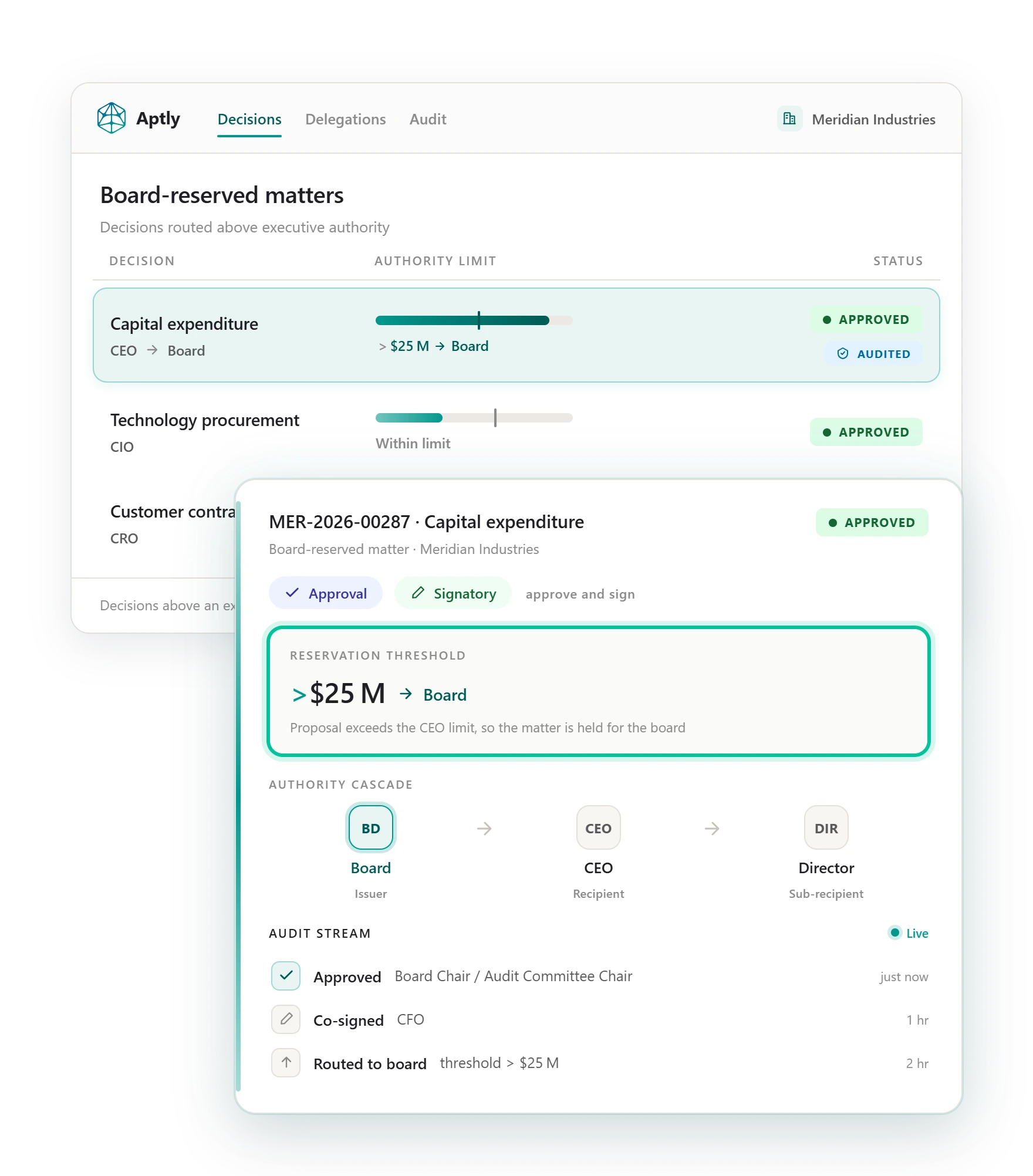
Aptly showing a board-reserved capital decision routed above the CEO limit to the board, with authority cascading down to management and every step recorded.
Security & compliance
SOC 2 Type II
ISO 27001
GDPR
The Gap

A reserved-matters schedule in a PDF can't show you it held.

Most boards can produce a schedule of matters reserved for their decision and a management delegation of authority beneath it. Far fewer can show, on demand, that the two still agree, that nothing reserved was decided below the board, and that delegated authority was exercised within the limits the board set. The schedule says what should happen; the cascade beneath it is where it either holds or quietly fails.

The reserved-matters schedule and the cascade drift apart. The board's schedule and the management delegation of authority (DOA) are written and approved separately, then maintained separately. A reorganization, a new subsidiary, or a leadership change moves the real authority without anyone updating the schedule, and the two diverge until something forces the question.

The thresholds and escalation triggers are imprecise. A static schedule often reserves "major capital expenditure" or "significant acquisitions" without a precise financial threshold or a qualitative escalation trigger, so it is unclear at the front line which decisions must come back to the board and which may proceed below it.

It is reviewed once a year, at best. The schedule is approved, filed, and revisited at the annual governance review, if then. Between reviews, the board has no living view of whether reserved matters were respected and delegated authority stayed within limits, only the document it signed months ago.

~90%

Third-Party Research

In the EY US and Society for Corporate Governance study The Delegation Edge (2025; survey of more than 200 corporate-governance professionals, fielded fall 2024), nearly 90% of organizations had implemented a delegation of authority policy. The challenge was rarely having one. It was training people on the policy, enforcing it, and keeping it updated, and the study recommends the board maintain sufficient oversight of the delegation process itself. That is the exact gap that opens between a schedule that exists and a cascade the board can actually see operating.

Survey-based; EY US / Society for Corporate Governance, 2025.

The fix isn't a better-written PDF or a tighter annual review. It's making the reserved matters and the authority that cascades from them one live system the board can read at any time.

The Authority Layer

Reserved at the top. Cascaded to the front line. Visible to the board.

Aptly sits between your identity systems (Okta, Microsoft Entra ID, SailPoint) and your execution systems (SAP, Oracle, NetSuite, Workday, ServiceNow) as the system of record for who can approve, sign, and commit on behalf of the enterprise. The board reserves the decisions that must stay with it and sets the limits beneath which authority may be delegated; Aptly holds those reserved matters as structured records, cascades the delegated authority down through committee and management levels, and records who held and exercised what, at every level.

Because the reserved matters, the thresholds that route a decision back to the board, the committee delegations, and the management DOA all live in Aptly as structured, versioned records, the board's two questions have a live answer rather than an annual one: was anything reserved decided below us, and did delegated authority stay within the limits we set? When a decision exceeds a delegated limit, the threshold routes it upward to the level that holds the authority, with the escalation recorded. The schedule and the cascade stay in agreement because they are the same system, not two documents maintained by different people.

Identity systems
Who can log in
OktaMicrosoft Entra IDSailPoint
The Authority Layer
Aptly governs who can approve, sign, and commit
Delegations, limits, conditions, and signatories, versioned and evidenced.
Execution systems
Where transactions happen
SAPOracle · NetSuiteWorkday · ServiceNow
Aptly as the authority layer between identity providers and enterprise execution systems, turning the board's reserved matters into authority that cascades to every level.

This is the operational authority layer that turns reserved matters into live, cascading, acceptance-tracked authority, not a board portal, a document repository, or a minutes tool. Keep your board portal for meetings and records; use Aptly for the authority that cascades from what the board decided.

How It Works

From reserved matters to the front line, in four steps.

1
Reserve the matters, with precise thresholds.
Capture the schedule of matters reserved for the board as structured records, each with a precise financial threshold and qualitative escalation trigger, so it is unambiguous which decisions must stay with the board, which sit with a committee, and which may be delegated below.
2
Delegate the rest through a scheme of delegation.
Cascade the authority the board did not reserve through committee terms of reference and the management DOA, with limits, conditions (RACI), and tracked acceptance, so each level holds exactly the authority the board granted it, and no more.
3
Cascade to the front line with tracked acceptance.
Authority flows from the board through executive leadership to every level, with redelegation controlled, limits that cannot exceed the issuer's own, and each recipient's acceptance recorded, so the cascade is real and acknowledged rather than assumed.
4
Give the board living evidence.
When a decision exceeds a delegated limit, the threshold routes it to the level that holds the authority, with the escalation recorded; and at any time, the board can see that reserved matters were respected and delegated authority was exercised within limits, from a live system rather than a static schedule.

Reserve at the top, cascade the rest, and the board gets living evidence that the line held, not a schedule it has to take on faith.

The Platform

The platform behind the cascade.

Delegation of Authority
Available
Hold the schedule of matters reserved for the board and the scheme of delegation beneath it as structured, versioned records (thresholds, conditions, and RACI roles) so reserved authority routes to the board and delegated authority cascades to every level with tracked acceptance.
Learn more →
Authority Hub
Available
Give the board and the corporate secretariat one live view of who holds and exercises authority at every level, kept in sync with the ERP, HRIS, and identity systems where decisions are made through 30+ connectors, with immutable action and audit logs and point-in-time recall of who was authorized on any date.
Learn more →
Signatory Management
Available
Keep authorized signatories, and the resolutions or powers of attorney behind them, in sync with the board's delegations, so who can bind the company always matches what the board approved.
Learn more →
Decision Compass
In Preview
Give the board and the corporate secretariat instant answers on who holds authority for any matter and whether a decision should return to the board, checked against the reserved-matters schedule and the scheme of delegation.
Learn more →
See it run against your own schedule of matters reserved.
Book a Demo
Frameworks

What the board reserves, and is accountable for, under the codes it answers to.

A formal schedule of matters reserved for the board, and a scheme of delegation beneath it, sit at the foundation of corporate governance. Aptly maps the board's reserved authority and its cascade to the codes that expect them:

UK Corporate Governance Code

Maintain a formal schedule of matters reserved for the board.

The Code and its FRC Guidance expect a formal schedule of matters reserved for the board (FRC 2024 Guidance, para. 28); Provision 14 requires board and committee responsibilities to be set out in writing, agreed, and made public. A faithful schedule and scheme of delegation is also how directors evidence acting within their powers and promoting the success of the company (Companies Act 2006, s171 and s172). Aptly holds the schedule and the scheme of delegation beneath it as one live system.
2024 Code + FRC Guidance; the schedule expectation sits in the Guidance, not a numbered Provision. Not legal advice.
UK Code, Provision 29

Declare your material controls are effective.

Boards must declare the effectiveness of their material controls (financial, operational, reporting, and compliance), including the authorization controls that govern who may commit the company.
Applies to financial years beginning on or after 1 Jan 2026; comply-or-explain; no external-auditor attestation.
ASX Principles, Rec 1.1

Disclose what the board reserves and what it delegates.

A listed entity should have and disclose a board charter setting out the respective roles of board and management and the matters expressly reserved to the board and those delegated to management. Aptly holds exactly that split as a live, enforced record.
ASX CGC, 4th edition; if-not-why-not reporting. Where listed in Australia.
King IV

Approve a formal delegation-of-authority policy annually.

The board sets the parameters for the matters reserved for itself and those delegated to management by annually approving a formal delegation of authority policy. Aptly is where that policy becomes operational and current.
King IV, 2016; apply-and-explain. Where reporting in South Africa.
US listed-company governance

Disclose governance guidelines; delegate under written charters.

Listed boards adopt and disclose corporate governance guidelines setting out directors' responsibilities, and delegate to committees and officers under written charters and board-approved authority, retaining oversight of the matters they reserve. Aptly makes that delegated authority live and provable.
NYSE Listed Company Manual §303A.09 and audit-committee oversight under §303A.06; most Nasdaq boards adopt equivalent guidelines. Not legal advice.
And prudential accountability regimes where applicable. Frameworks last verified June 2026.
Check your own reserved-matters schedule against leading practice →

You set the reserved matters once. Each code reads the same live schedule and cascade in its own language.

Proof

What a reserved matter holding looks like.

Meridian Industries' board reserves capital commitments above the CEO's authority for its own decision. When the CEO proposed a $48M new manufacturing line, the commitment exceeded the CEO's $25M authority, so the reserved-matter threshold routed it to the Board rather than letting it proceed below. Under the old way of working, whether that routing happened at all depended on someone remembering what a static schedule said.

“Was anything reserved decided below us, and did delegated authority stay within the limits we set?”
Reserved-matter threshold
The $25M ceiling that routed the $48M commitment to the Board.
Board resolution, co-signed
The Board Chair / Audit Committee Chair signed; the CFO and General Counsel co-signed.
Cascade within limits
Delegated authority below the board stayed within the limits the board set.

Answered from the system, not reconstructed. The threshold that reserved the matter, the resolution, the co-signs, and the cascade below it that stayed within limits were all captured against the live delegation of authority. No minutes to reconcile. No schedule to take on faith.

Illustrative scenario based on Aptly's canonical Meridian Industries dataset. Not a real customer.
FAQ

Questions boards and corporate secretaries ask.

What are matters reserved for the board?
Matters reserved for the board are the decisions a board keeps for its own determination rather than delegating to management: typically strategy, mergers and acquisitions, capital structure, changes to the company's listing, director appointments, and approval of the group's own delegated-authority levels. They are usually set out in a formal "schedule of matters reserved for the board," which the UK Corporate Governance Code expects boards to maintain and which the ASX Principles and King IV frame as the board charter's split between what the board keeps and what it delegates. Everything the board does not reserve is delegated, through committee terms of reference and the management delegation of authority. Aptly holds the reserved matters and the delegated authority beneath them as one live system, so the line between what the board decides and what cascades down is explicit and enforced rather than implied by a document. (A note on terms: US organizations often call this a "board-reserved matters" list or a "delegation of authority policy" rather than a "schedule of matters reserved." Nonprofits, charities, and academy trusts typically use a "scheme of delegation" reserved to trustees or members. And in private-equity and venture deals, "reserved matters" can also mean investor veto rights in a shareholders' agreement, a related but separate construct from a board's own reserved-matters schedule.)
What's the difference between reserved matters and delegated authority?
Reserved matters are the decisions that must stay with the board; delegated authority is everything the board has passed down, within limits, to committees and management. They are two ends of the same structure: the board reserves the strategic decisions and sets the thresholds beneath which authority may be delegated, and the scheme of delegation cascades the rest to the right level. The risk is that the two drift apart, where a decision that should have come back to the board is taken below it, or where delegated authority is exercised beyond its limit. Aptly keeps them in one system, so a decision that exceeds a delegated limit routes back up to the level that holds the authority, and the board can see that the line held.
What is a scheme of delegation?
A scheme of delegation (sometimes called a delegated authority framework) is the structured cascade of authority from the board downward: what each committee may decide under its terms of reference, what executives and managers may approve up to which limits and under which conditions, and what must escalate. It is the operational counterpart to the reserved-matters schedule: the schedule says what the board keeps, and the scheme of delegation says how everything else flows down. Aptly holds the scheme of delegation as structured, versioned records with tracked acceptance at each level, rather than as a static document that ages between reviews.
How often should the schedule of matters reserved for the board be reviewed?
Leading practice is to review it at least annually, and again whenever a major change alters where authority should sit: an acquisition, a new subsidiary, a leadership change, or a regulatory reform. The deeper point is that an annual review of a static document still leaves the board without a current view between reviews. When the reserved matters and the cascade beneath them are a live system, the schedule stays in agreement with the authority actually in force, and the board can see that it held at any time, not only at the annual review.
Isn't this what a board portal does?
No. A board portal manages board meetings, distributes board books, captures minutes, and stores the corporate record, including the reserved-matters schedule as a static document. A legal-entity register maps and exports the authorities and signatories your governance team maintains. Neither cascades the board's delegated authority down to the front line, tracks acceptance at each level, or shows the board that a reserved matter held in practice. Aptly is the operational authority layer beneath the schedule: it makes the reserved matters executable, cascades the delegated authority through committee and management levels, and proves both. Most organizations keep their board portal for meetings and records and add Aptly for the authority that cascades from what the board decided.
Pairs With

Built to work with the rest of your authority program.

Use case

Regulatory Readiness & Compliance
Turn the board's reserved authority and its cascade into audit-ready evidence, including Provision 29 board accountability for controls.

View use case →

Use case

Continuous Authority Assurance
Move from an annual review of the schedule to living evidence that reserved matters held every day.

View use case →

See your reserved matters hold.

Bring your schedule of matters reserved for the board and the delegation of authority beneath it. We'll show you the cascade Aptly makes live, using your authority data.