Every legal entity in your group runs its own authority: its own signatories, its own bank mandates, its own board, its own approval limits, under its own jurisdiction's rules. Maintained separately, in spreadsheets and per-entity policies, the group has no single, real-time answer to the question every regulator and auditor asks in a different way: who can approve, sign, and commit in which entity, under which jurisdiction, and within what limits? Aptly runs one authority model across every entity, respects what is genuinely different about each, and gives the group a single, live, audit-ready view of authority everywhere.
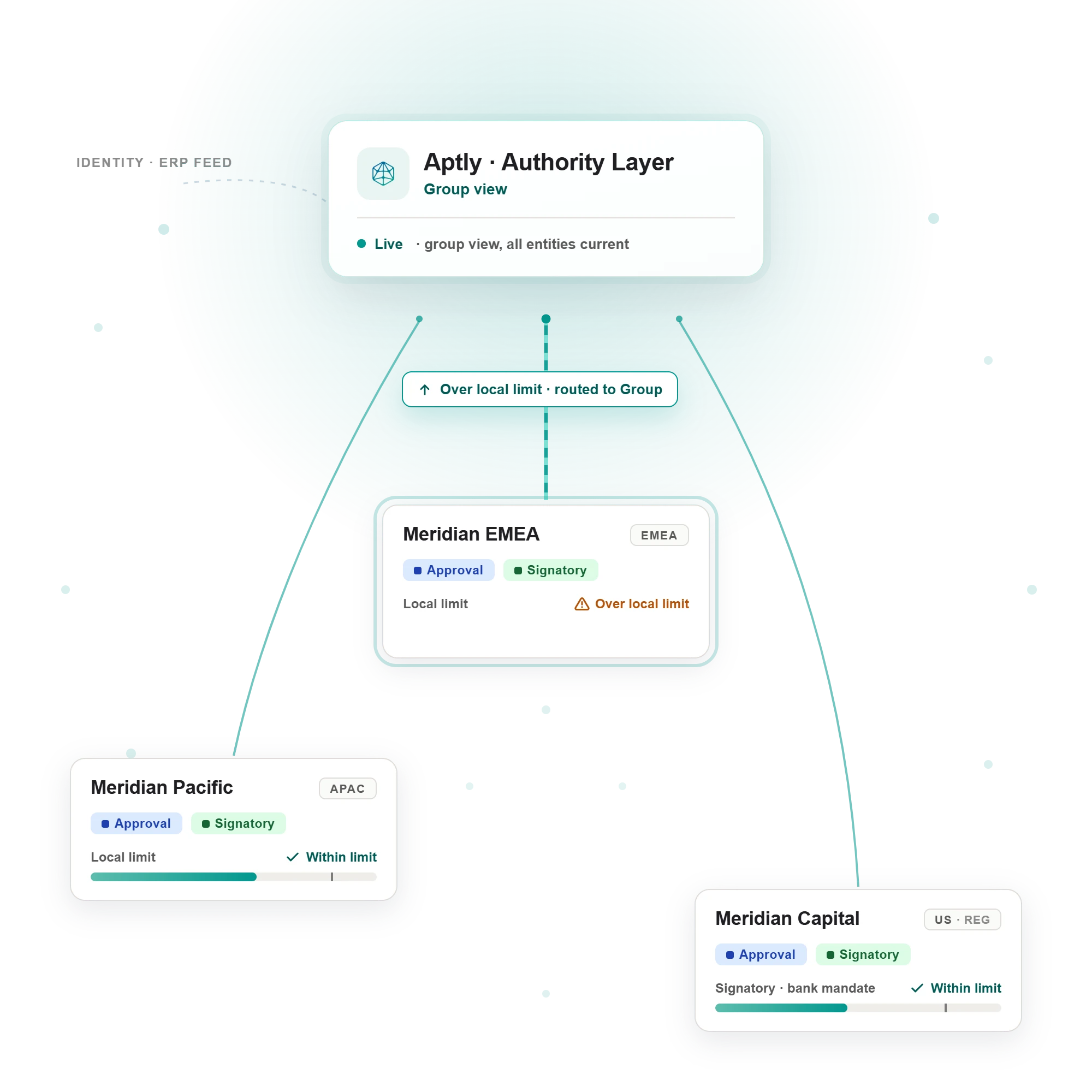
A large enterprise is rarely one company. It is many separate legal entities, each its own legal person with its own board, signatories, bank mandates, and approval limits. Authority is real only at the entity level, where it flows from each entity's statute, charter, bylaws, and board resolutions, yet the group has to operate, report, and prove control as one organization. It is no surprise that in EY's 2025 governance study with the Society for Corporate Governance, the most-cited difficulty with delegation of authority was understanding roles and responsibilities given a complex organizational structure: the multi-entity problem in their own words.
Authority is maintained separately, per entity. Each legal entity keeps its own signatories, bank mandates, board, and approval limits, in its own spreadsheets and its own per-entity policy. There is no single place where the group's authority lives, so reconciling it means collecting documents from every entity and hoping they are current.
There is no single, real-time group view. Ask “who could commit more than a set amount in any entity last quarter, and who actually did,” and the answer is assembled by hand across entities, weeks after the fact. A reorganization, a new subsidiary, or a leaver moves the real authority in one entity without the group's view ever updating.
Cross-border obligations vary by entity, and must be evidenced consistently. Consolidated financial-reporting controls, group-basis prudential rules, downstream-entity accountability, and jurisdiction-specific cyber and supply-chain duties apply differently to different entities. Meeting them one entity at a time, in each jurisdiction's language, multiplies the work and leaves gaps where two entities are governed differently for the same obligation.
116
An analysis of SEC 10-K filings found the largest 100 US public companies reported a median of 116 major subsidiaries (an average of 204). Authority is real only at the entity level, yet the group must operate, report, and prove control as one. That gap between per-entity authority and the group view is what one authority model closes.
Aptly sits between your identity systems (Okta, Microsoft Entra ID, SailPoint) and your execution systems (SAP, Oracle, NetSuite, Workday, ServiceNow) as the system of record for who can approve, sign, and commit on behalf of the enterprise. In a multi-entity group, that means one platform holding each entity's delegation of authority (DOA), signatory lists, and approval limits, while giving the group a single, real-time view across all of them. Each entity can keep its own framework; the group sees the whole.
Because every entity's authority lives in Aptly as structured, versioned records, the group's question has a live answer rather than a per-entity reconstruction: who holds and exercises what, in which entity, under which jurisdiction, within what limits? Entity-level differences are respected, not flattened: a limit in one entity, a signatory in another, a bank mandate in a third, a jurisdiction-specific rule on a fourth, and the same model still rolls up to one view. When a decision exceeds an entity's limit, it routes to the level that holds the authority, with the escalation recorded, whether that level sits inside the entity or up at the group.
This is the operational authority layer that runs one authority model across every entity and jurisdiction, with tracked acceptance. It is not a legal-entity-records repository, a subsidiary-management database, or a per-entity signatory spreadsheet, and it is more than a register that maps, reports on, or archives who holds which authority. Entity-management platforms hold the corporate record (incorporations, registered agents, officers and directors, statutory filings, cap tables, and org charts) as a single source of truth for what each entity is. Some can even map and archive a point-in-time picture of the group's authorities. Aptly is the layer those records assume already exists and stays current: it governs what each entity is authorized to decide, sign, and commit, cascades that authority to the front line with each recipient's acceptance recorded, and keeps it live as roles, limits, and entities change, not as a snapshot that has to be re-mapped. Keep your entity-management system for the corporate record; use Aptly for the live, accepted, self-currenting authority that runs across it.
Many regimes apply not entity by entity but across the group, or differently in each jurisdiction. Aptly maps your authority model to how each one reaches across your structure:
Meridian Industries is a $1.2B group with three subsidiaries (Meridian Pacific, Meridian EMEA, and Meridian Capital), each with its own limits, signatories, and bank mandates, and each under its own jurisdiction's rules. When the Director of Operations at Meridian EMEA moved to execute a $4.2M, 24-month vendor master services agreement, the commitment exceeded the EMEA authority of $250K and 12 months. Under the old way of working, whether anyone caught that depended on a local spreadsheet being current and someone remembering the EMEA limit.
One model, holding differently in each entity where it had to. Visible to the group as a single, current picture rather than three reconciled spreadsheets, and the group General Counsel could see, in one place, who was authorized to bind each entity.
Bring two or three of your entities and the authority each one holds. We'll show you the single, live, audit-ready group view Aptly produces, using your authority data.