Aptly runs structured implementations with a named project manager, your written approval at every stage gate, and your converted authority matrix reconciled against your board-ratified source before it becomes live authority.
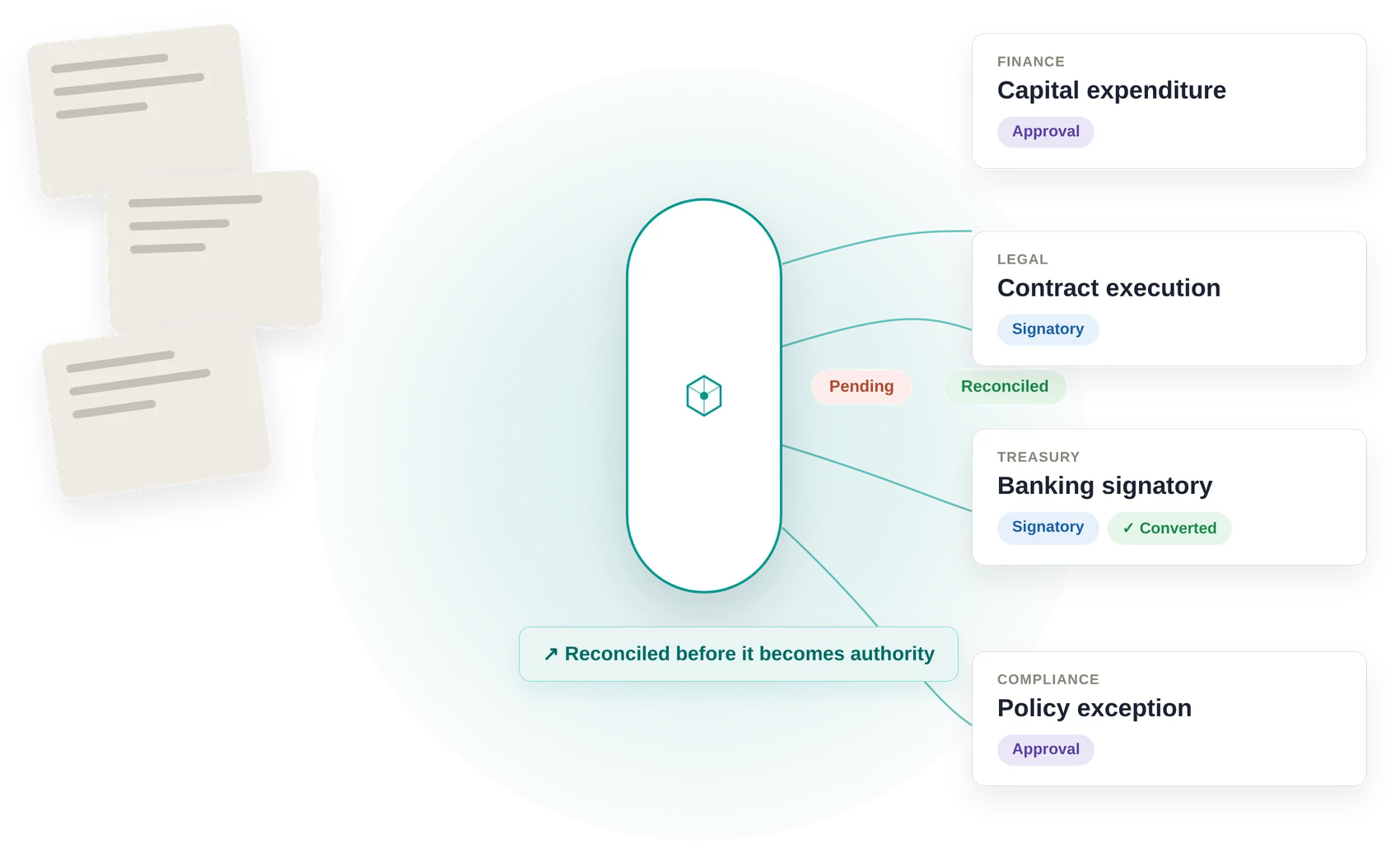
Delegation of authority here means the corporate governance instrument: the matrix of approval limits, signature authority, conditions and reserved matters that your board ratifies and your auditors test. It is not general management delegation of tasks to employees, and it is not the binding authority an insurer grants a coverholder. Aptly implements the governance instrument, converts your existing matrix into it, and keeps it current as your organization changes.
Day 1
audit-ready. Point-in-time recall is available from the first delegation issued, not accumulated over subsequent quarters
5 phases, 5 stage gates
with your written approval required at every one
1 named project manager
accountable for your implementation end to end
99.9% uptime SLA
with service credits and severity-based response times
Aptly's own services are scoped to the thing only the platform owner can be accountable for: that your authority framework is correctly modelled, correctly converted, correctly connected, and provably current.
Translating your decision types, limits, conditions, roles, reserved matters and escalation paths into Aptly's authority model, across the six dimensions the platform governs: Principal, Action, Resource, Condition, Delegation and Escalation. Where no framework exists yet, standing up a working baseline you can test against real decisions.
Converting your existing DOA matrix, signatory lists and delegation records into a validated, reconciled dataset, and proving it matches your source before it becomes live authority.
Tenant setup, HRIS and identity connection, downstream system integration on Aptly's standard connectors, and sandbox validation before anything reaches production.
A structured review of your live framework against your board-ratified policy, identifying drift, gaps, stale delegations and coverage your matrix does not currently reach.
Five phases, each with a defined deliverable and a stage gate you approve in writing before the next begins. Scope varies by engagement; the phases and the gates do not. You control the pace, and nothing advances without your sign-off.
Duration: 2 to 3 weeks
What happens: Kickoff, onboarding workbook, requirements alignment
Your team provides: Stakeholder time, scope alignment
Deliverable at the gate: Approved scope and success criteria
Duration: 2 to 3 weeks
What happens: Authority data transformation, integration planning, HRIS mapping
Your team provides: Source DOA, policies, HRIS access
Deliverable at the gate: Validated authority dataset
Duration: 2 to 4 weeks
What happens: Tenant setup, data import, integration configuration, sandbox validation
Your team provides: Sandbox review, integration credentials
Deliverable at the gate: Tenant configured and integrated
Duration: 2 to 4 weeks
What happens: Testing, training, user acceptance, production sign-off, go or no-go gate
Your team provides: UAT participants, sign-off
Deliverable at the gate: UAT passed and signed off
Duration: Ongoing
What happens: Production deployment, success transition, scheduled business reviews
Your team provides: Business reviews, ongoing relationship
Deliverable at the gate: Audit-ready production tenant
Aptly's services are sold as engagements, not fixed packages, because authority estates are not fixed. Each engagement below states what it covers and what you have at the end of it. Most implementations combine several, and the next sections show how.
A structured review of your authority framework against your board-ratified policy. Available to Aptly customers on any plan.
You have: a gap map of your framework against your policy, covering coverage gaps, stale and expiring delegations, positions holding authority that no longer matches the organization, and decision types your matrix does not currently reach.
Converting your existing DOA matrix, signatory lists and in-force delegations into a validated, reconciled dataset. Runs as a controlled process with a reconciliation step and your sign-off, not as a data import.
You have: a reconciled dataset, a documented list of every difference from your source, and your written approval before it becomes live authority.
The five-phase build. Authority model configuration, tenant setup, HRIS and identity connection, downstream system integration on standard connectors, reporting configuration, sandbox validation, user acceptance testing and go-live.
You have: a configured, integrated, audit-ready production tenant, validated in sandbox and signed off at every gate.
Training built around what each group actually does in Aptly: Issuers who originate delegations, Recipients who accept and act under them, and Administrators who maintain the framework. Delivered as part of an implementation or bought on its own afterwards.
You have: trained administrators, role-appropriate enablement for Issuers and Recipients, and documentation your team keeps.
Engagements can be delivered by Aptly or by a certified implementation partner. Either way they follow the same methodology and the same stage gates.
Not every organization is converting something. In the EY and Society for Corporate Governance survey of 222 corporate-governance professionals, 10% said their organization has no DOA policy at all, and a further 11% described theirs as informal. Plenty more have one on paper that was never operationalised.
Aptly can stand up a working baseline. A framework built from our reference models, your legal entity structure, your existing approval thresholds and your org data, running in your tenant so your team can test it against real decisions rather than debating it in a document.
That gets you something functioning. Designing the framework properly is a different exercise: deciding what your board reserves to itself, setting thresholds that match your risk appetite, aligning Finance, Legal, Risk and Technology on a shared decision taxonomy, and getting the result ratified. That work is led by our implementation partners, who do it for a living, and it usually runs alongside the baseline rather than before it.
In practice the baseline is what makes the design work tractable. It is far easier to argue about a framework you can see operating than one that exists only as a proposal.
Source: EY and the Society for Corporate Governance, "The Delegation Edge," January 2025, 222 respondents.
Three shapes cover most of what we see. Yours will not match one exactly, and the point is not that it should. These exist so you can find the nearest picture of your own situation before you speak to anyone.
Illustrative. Your scope and schedule are confirmed at discovery, before you commit to either.
Two organizations of the same revenue can differ by a factor of several in implementation effort, so a fixed package would be a guess dressed as a commitment. These are the variables that actually move it, and they are what we scope against.
You will be told where you sit against these, with a schedule, before you commit. Not during.
This is not a small point. In Panorama Consulting Group's 2026 ERP Report, drawn from 170 organizations between January 2025 and January 2026, almost a quarter reported their project ran over schedule, and the most common cause was not technology. It was organizational: governance, resistance to change, and process redesign. Those are the variables above, and they are the reason Aptly scopes against your actual authority estate rather than selling a tier.
Source: Panorama Consulting Group, The 2026 ERP Report, 170 respondents, data collected January 2025 to January 2026.
Your team's contribution is business knowledge, not technical build. The single largest predictor of an implementation finishing on schedule is whether the people who own the authority framework are available for the gates.
Loading a DOA matrix into a system is the easy part. Proving that what is now enforcing authority is faithful to what your board ratified is the part auditors ask about. Aptly's conversion runs as a controlled process with a reconciliation step and your sign-off, not as a data import.
Your DOA matrix as it exists today, in whatever shape it exists: workbook, signed delegation document, policy appendix, or several of these that do not fully agree with each other.
Every group, position, decision type, limit, condition and delegation checked against Aptly's authority model for completeness and internal consistency before anything is derived from it.
A decision-by-decision read of the converted output. Authority ceilings derived correctly, conditions and required reviewers placed at the right level, roles attached to the right positions.
A line-by-line comparison of the converted dataset against your source matrix, so that every difference is either an intentional correction with a stated reason or a defect to fix.
A final pre-load pass confirming the dataset is complete, internally consistent and ready to become live authority.
You approve the reconciled matrix. Only then does it become live authority in your tenant.
Every implementation has one named, accountable owner, working with the specialists the scope requires.
A named individual, accountable for your implementation end to end, and the person who holds the stage gates.
Runs the conversion, the structural validation and the reconciliation of your matrix against its source.
Models your authority framework in Aptly and designs the integration approach.
Named to your account at go-live and continuous from there, through business reviews and framework health checks.
Assigned on multi-entity, multi-region and integration-heavy engagements.
An authority framework is only correct on the day it is signed. Organizations reorganise, people leave, limits change, entities are acquired. Ongoing engagement is what keeps the framework current between those events, and audit-ready through them.
Your level of ongoing engagement is set by your subscription plan. Implementation scope is not: it is set by your authority estate, as described above.
Most authority programmes are larger than the platform. Policy redesign, controls remediation, organizational change and multi-region rollout are consulting work, and they are led by firms who do that work for a living. Aptly works inside those programmes.
Framework design
Controls remediation
Organizational change
Multi-region rollout
Authority modelling
Data conversion and reconciliation
Configuration and integration
When a consulting or advisory firm leads your authority programme, Aptly's team supplies the platform-scoped expertise inside it: authority modelling, data conversion and reconciliation, configuration and integration. Your partner leads the framework redesign, the change management and the governance advisory. The stage gates and the sign-off requirements do not change, and Aptly reviews the delivery either way.
If you are already working with a firm you trust, they can be certified to implement Aptly. If you would rather Aptly delivered directly, we do that too. And if you need a partner in a region where you do not have one, we will introduce you.
Aptly is configurable by administrators without developer involvement, and customers make ongoing changes themselves after go-live. For the initial implementation we recommend services in every case, because the work that determines whether the deployment succeeds is not configuration. It is converting an existing DOA matrix faithfully, reconciling it against the board-ratified source, and connecting it to HRIS and identity so authority stays aligned with organizational reality. That is the part worth doing with people who have done it before.
Because authority estates are not fixed, and a published package would be a guess presented as a commitment. Effort is driven by how many legal entities and jurisdictions are in scope, which authority types you need, how many integrations you want, and above all the condition of your existing matrix. What we publish instead is the four engagements we deliver, three illustrative shapes showing how they combine, and the variables that move the total. You get a schedule specific to your estate at discovery, before you commit to anything. What is fixed is the methodology: five phases and five stage gates, on every engagement.
With a baseline. Aptly can stand up a working framework from our reference models plus your legal entity structure, your existing approval thresholds and your org data, so your team can test it against real decisions instead of debating it in a document. Designing the framework properly, which means deciding what your board reserves, calibrating thresholds to your risk appetite, aligning Finance, Legal, Risk and Technology, and securing ratification, is led by our implementation partners. In practice the baseline makes that design work easier, because arguing about a framework you can see operating is far more productive than arguing about a proposal.
Business knowledge, not technical build. Specifically: your source DOA matrix and policies, signatory lists, in-force delegations, HRIS and identity access, a named project owner, UAT participants, and written sign-off at each of the five stage gates. Plan on roughly six to eight hours a week from your project owner during discovery and data preparation. Your team does not configure the tenant, write integrations or build reports.
Yes. Firms can be certified to deliver Aptly implementations, and many of our engagements run that way. Your firm leads the programme and bills you for its services; Aptly bills for the platform and supplies platform-scoped expertise inside their project team. The methodology, the stage gates and the sign-off requirements are identical to an Aptly-delivered implementation, and Aptly reviews partner-led delivery against that methodology. If your firm is not yet certified, we will run them through certification.
Conversion runs as a controlled process, not a data import. Your source is structurally validated, converted, reviewed decision by decision, then reconciled line by line against the original so every difference is either an intentional correction with a stated reason or a defect to fix. You approve the reconciled matrix before it becomes live authority in your tenant. Where your source contradicts itself, the reconciliation surfaces the contradiction for your framework owner to decide rather than resolving it silently.
Aptly's services cover authority modelling, baseline framework establishment, data conversion and reconciliation, configuration, integration on our standard connectors, framework health checks, and role-based training. Redesigning your delegation policy, remediating your control environment, running organizational change management, and multi-year governance advisory are partner-led. Most programmes run both at once, and Aptly's stage gates apply either way.
The same day you go live. Aptly captures the authority record and its full change history from the first delegation issued, so point-in-time recall is available from day one rather than being built up over subsequent quarters. How long until go-live depends on your authority estate, and the shapes and variables above are the honest answer to that. You are given a schedule specific to your estate at discovery, before you commit to it.
Yes. If you have an existing DOA matrix, we will convert it into Aptly and reconcile it against your source at no cost, so you can see your own authority framework running before you decide anything. That happens after a discovery call and under a mutual NDA or evaluation agreement, because your authority data is sensitive and we treat it that way. The authority framework health check is a customer engagement rather than a pre-sales one, and becomes available to you once you are live.
Meet with our team for a walkthrough in your own context. If you already have a DOA matrix, we will convert it into Aptly and reconcile it against your source at no cost, so you can see your own authority framework running before you decide anything. That runs after the discovery call and under a mutual NDA or evaluation agreement, because your authority data is sensitive and we treat it that way. If you do not have a matrix yet, we will show you the baseline instead.