Use Case

Pass audit. Prove control. Across every framework.

Every framework you answer to asks the same question in different words: who was authorized to approve, sign, and commit on our behalf, and can you prove the control operated all year? Aptly turns your delegation of authority into continuous, audit-ready evidence, so the answer is always one export away rather than a quarterly reconstruction.
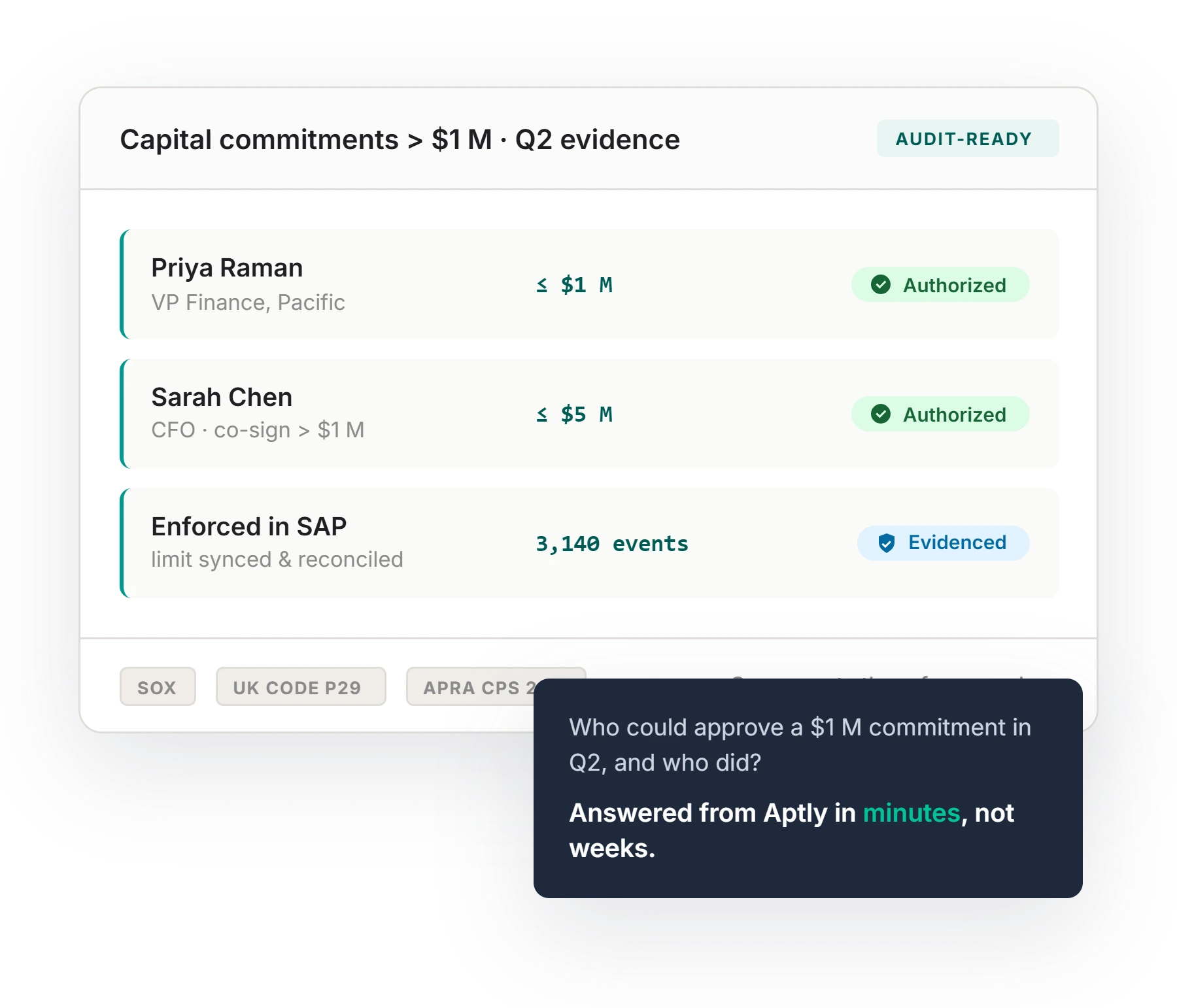
Aptly showing capital-commitment authority for Sarah Chen and Elena Voss with limits enforced in SAP, a timestamped audit trail, and the same evidence mapped to SOX, APRA CPS 230, and the UK Code.
Security & compliance
SOC 2 Type II
ISO 27001 Stage 1
GDPR

Documenting a control isn't the same as proving it worked.

Most enterprises can produce a delegation of authority policy. Far fewer can prove, on demand, that the policy was actually enforced by every system, for every approver, on every day of the reporting period. That gap is where audits stall and findings originate.

The matrix says one thing; the systems do another. Authority is approved by the board and documented in a spreadsheet, but enforced by SAP, Oracle, NetSuite, and a dozen apps that drift apart after every reorg, leaver, and new entity. The control exists on paper and fails in practice.

Evidence is reconstructed, not captured. When the auditor asks who could approve a $2M commitment in Q2, and who actually did, the answer is assembled by hand from emails, screenshots, and memory, weeks after the fact.

Every jurisdiction asks again, differently. SOX, the UK Corporate Governance Code, the EU AI Act, APRA, MAS, and NIS2 each frame the same authorization control in their own language, on their own timeline. Answering them one framework at a time multiplies the work.

Third-Party Research

According to the ACFE 2024 Report to the Nations (1,921 cases analyzed), 51% of occupational losses involved internal controls that were absent or overridden. That is the exact failure mode an enforced, evidenced authority layer is built to close.

Survey-based; ACFE, 2024.

The fix isn't another document. It's making authority a live, evidenced control instead of a static artifact.

The Authority Layer

One authority layer. Evidence for every framework.

Aptly sits between your identity systems (Okta, Microsoft Entra ID, SailPoint) and your execution systems (SAP, Oracle, NetSuite, Workday, ServiceNow) as the single source of truth for who can approve, sign, and commit on behalf of the enterprise. Identity governs who can log in; your ERP routes transactions; Aptly governs decision authority, and records it.

Because every delegation, acceptance, re-delegation, limit, and condition lives in Aptly as a structured, versioned record, the evidence auditors ask for is a by-product of running the business, not a project you launch each quarter. Map it once to the frameworks you answer to, and the same authority layer satisfies all of them.

Identity systems
Who can log in
Okta · Microsoft Entra ID · SailPoint
The Authority Layer
Aptly governs who can approve, sign, and commit
Delegations, limits, conditions, and signatories, versioned and evidenced.
Execution systems
Where transactions happen
SAP · Oracle · NetSuite · Workday · ServiceNow
Audit evidence maps to SOX, the UK Corporate Governance Code, the EU AI Act, APRA, MAS, NIS2, and more.

From policy to proof, in four steps.

1
Define authority once.
Capture the board-approved authority matrix as structured records rather than a spreadsheet: limits, conditions, roles (RACI), and authorized signatories.
2
Sync it to every system.
Push approved authority to your ERPs, apps, and identity systems through pre-built connectors, so what's enforced matches what's approved.
3
Capture evidence as you go.
Every issuance, acceptance, re-delegation, expiry, and change is logged automatically with version history, actor, and timestamp.
4
Produce proof on demand.
Generate audit-ready evidence for any framework, any approver, any period, in seconds.
Four-step flow: define authority, sync to systems, capture evidence continuously, produce audit-ready proof on demand.

The platform behind the proof.

Delegation of Authority
Hold the board-approved authority matrix as structured, versioned records: the control your auditors actually test, with limits, conditions, and tracked acceptance.
Learn more →
Signatory Management
Prove who was authorized to bind the company on any contract, with validated signatory lists kept in sync with your delegations.
Learn more →
Authority Hub
See and track authority across every connected application from one dashboard, with immutable action and audit logs.
Learn more →
Decision Compass
Give approvers instant, policy-aligned answers on who can authorize what, with every guidance request and decision tracked against the delegated authority behind it.
Learn more →
See it run against a framework you answer to.
Book a Demo
Frameworks

One control. Every framework that asks about it.

Authorization limits, segregation of duties, and signatory governance are core controls under each of these regimes. Aptly maps your authority evidence to the frameworks you answer to:

SOX

Prove the control operated, not just that it exists.

Authorization and segregation of duties are core ICFR controls under SOX §302/§404.
PCAOB AS 2201/AS 2101 amendments apply to audits of fiscal years beginning on or after 15 Dec 2026.
UK Gov Code

Declare your material controls are effective.

The UK Corporate Governance Code, Provision 29, requires boards to declare the effectiveness of material controls.
Applies to financial years beginning on or after 1 Jan 2026; comply-or-explain.
EU AI Act

Govern what automated decisions can commit you to.

Authority over what AI-assisted and automated decisions may commit the company to is an oversight control under the EU AI Act.
High-risk obligations phasing in; some areas deferred to 2 Dec 2027 under the 2026 Digital Omnibus; evolving.
APRA CPS 230

Show controls are designed and operating.

APRA CPS 230 requires operational-risk controls to be designed and operating effectively.
Commenced 1 Jul 2025; further requirements 1 Jul 2026.
NIS2

Make management accountable for cyber-risk governance.

Under NIS2, management bodies are personally accountable for governance of cyber-risk controls.
National transposition ongoing; verify per jurisdiction.
Singapore MAS

Allocate senior-manager responsibilities clearly.

MAS guidance holds senior managers accountable for clearly allocated responsibilities.
IAC Guidelines.
NZ FMC / CoFI

Evidence fair-conduct governance.

New Zealand's FMC Act and CoFI require demonstrable governance of fair-conduct programmes.
In full effect since 31 Mar 2025.
FERC / NERC CIP

Control who can authorize critical-infrastructure access.

FERC and NERC CIP mandate personnel access and authorization controls for critical infrastructure.
CIP-004-7; FERC Order No. 907, 2025.
Proof

What audit-ready looks like.

When Meridian Industries' auditors opened the annual ICFR review across SOX, APRA CPS 230, and UK Corporate Governance Code Provision 29, CFO Sarah Chen didn't convene a war room.

“Show us who could approve capital commitments above $1M in Q2, who actually did, and prove the limit was enforced in SAP.”
Versioned authority matrix
The board-approved limits, exactly as they stood in Q2.
Timestamped delegations
Every issuance and acceptance, with actor and time.
Enforced SAP limits
The synced limit, proven in the ERP.

One export, mapped to all three frameworks. Legal lead Elena Voss pulled the matching signatory evidence for the period from the same source. No reconstruction. No surprises.

Illustrative scenario based on Aptly's canonical Meridian Industries dataset.

Questions teams ask before an audit.

How does delegation of authority support SOX compliance?
Authorization limits and segregation of duties are core internal controls over financial reporting. Aptly holds those limits as structured, versioned records and logs every approval, delegation, and acceptance, so §404 evidence that the control operated throughout the period is captured automatically rather than reconstructed.
What's the difference between documenting controls and proving they operated?
A documented control shows intent; an operated control shows evidence. Auditors increasingly want the latter: proof the control worked on every day of the period, for every approver. Aptly captures that evidence continuously, so “show your work” is an export, not a project.
Does Aptly map to frameworks outside the US?
Yes. The same authority layer produces evidence for the UK Corporate Governance Code (Provision 29), APRA CPS 230, Singapore MAS, NIS2, the NZ FMC Act, and others. You map authority once; each framework reads the evidence in its own terms.
How fast can Aptly produce audit evidence?
Because evidence is captured as authority is exercised, you generate it on demand, for any approver, any limit, any period, in seconds, rather than assembling it after the fact.
Is Aptly itself certified?
Aptly is SOC 2 Type II, ISO 27001 (Stage 1), and GDPR compliant, with full version history and action logs on every record.
Pairs with
Continuous Authority Assurance
Move from point-in-time audits to daily, audit-ready proof.
Approval Matrix Management
Keep authorization limits synced to every ERP and app, every day.
Links activate as these Use Case pages publish.

See your authority become audit-ready.

Bring a framework you answer to. We'll show you the evidence Aptly produces for it, using your authority data.