An energy company's authority runs further than any one system can see, from the board's reserved capital decisions, down to the asset teams that approve an AFE within a limit, and out to every joint-venture partner whose consent, vote, or election is required. Approving capital, signing a contract, and making a regulatory filing are different authorities, and they rarely sit with the same person. Yet there is no single, current answer to the question that governs every commitment: who is authorized to approve, elect, sign, and commit on behalf of this company today, and within what limit? Aptly holds that answer as one live system, internally and across every joint venture.
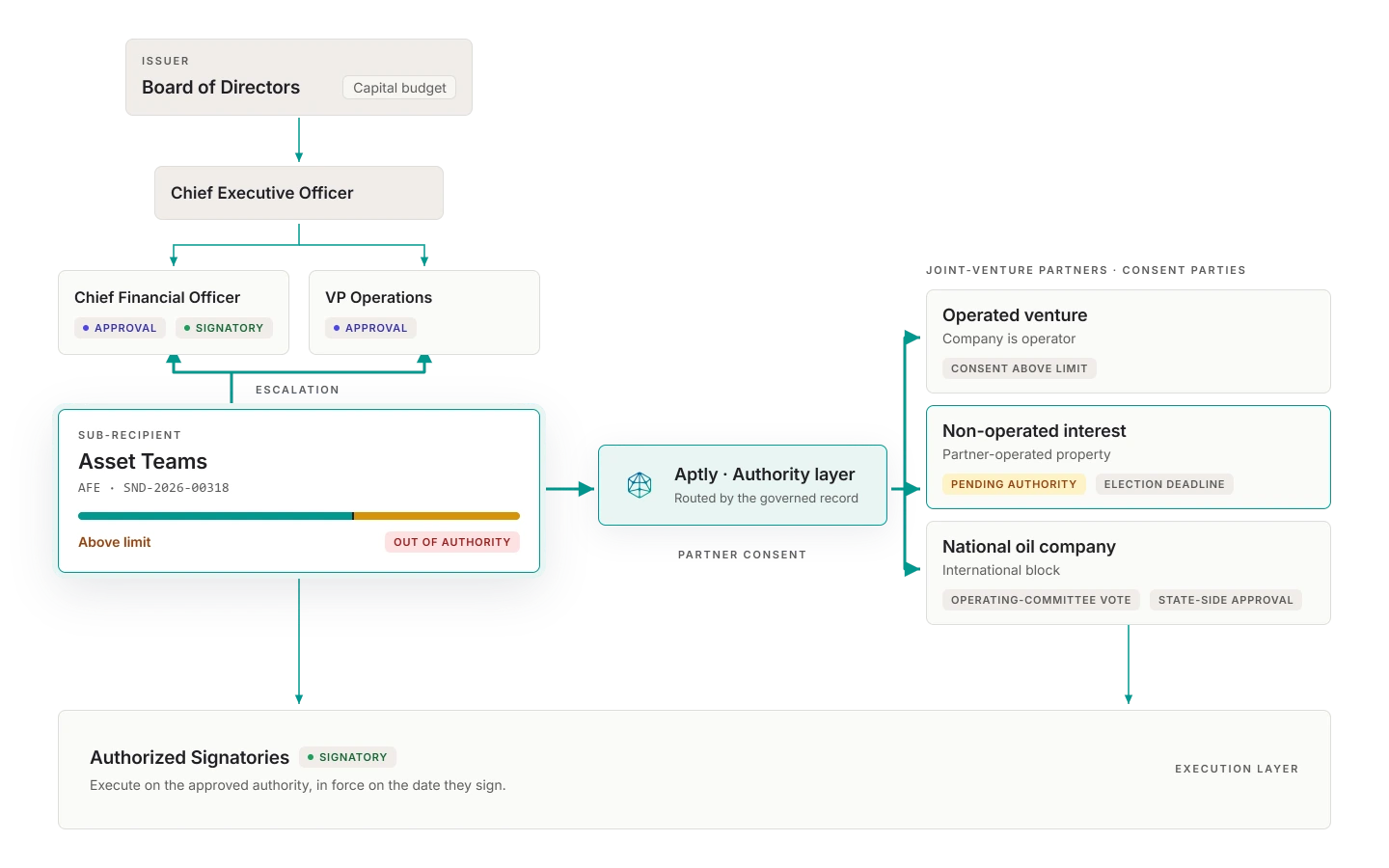
Delegation of authority (DOA) is the formal structure that defines who can approve, sign, and commit on behalf of an operator, up to what limit, and under what conditions. In oil and gas, that structure has to hold across the capital cascade, every operated and non-operated interest, and every joint-venture agreement. The authority is documented carefully, and current nowhere. Energy companies document authority carefully: board resolutions and reserved-matters schedules, an AFE approval matrix by asset and dollar, joint operating agreements with every partner, contracts, and signatory lists for each entity. The problem is not that authority is undefined. It is that it lives across all of those places, held by different functions, shared with different partners, updated on different cycles, and impossible to see as one current picture when an auditor, a partner, or a regulator asks. In more than a quarter of organizations (28%), the delegation of authority does not address who is permitted to sign at all.
The authority types get conflated. AFE approval, operating-committee and joint-operating-agreement election, contract signing, and payment are distinct, and people routinely hold one and not the others. The company finds out someone approved above their limit, signed a contract they could not bind, or missed an election during an audit or a partner dispute, not before.
Joint ventures multiply the exposure in every direction. As operator, you can commit partners only up to the operating agreement's limit; above it you need their consent. As a non-operator, you elect consent or non-consent on a partner's AFE within a deadline, with forfeiture at stake. Internationally it runs through an operating committee and an annual budget, with a national oil company partner clearing its own approval on top. Yet the record of who can approve, elect, and consent is often a spreadsheet and a binder.
The picture is reconstructed, not maintained. When an auditor or regulator asks who was authorized to approve, vote, elect, or sign on a given date, the answer is assembled by hand from resolutions, matrices, and email, long after the fact.
86%
Only 14% of organizations embed delegation of authority within an IT system. The other 86% keep it as a document, most often on the company intranet, where it goes out of date the moment a role changes.A policy on paper is not the same as a live record of who held that authority on a given date. In energy, that drift is expensive: an AFE approved above someone's limit, a partner consent or non-consent election missed on the deadline, or a signature on a midstream contract the signer was not authorized to give, each surfaces in an audit or a partner dispute rather than before the commitment is made.
Between who people are and where the company is committed. Your identity system governs the door: it knows who someone is and what they can log into. Aptly governs the decision once someone is through it. Your accounting, ERP, land, and production systems are where capital gets committed, partners get billed, and contracts get recorded. Neither identity nor those systems knows what a person is authorized to approve, elect, sign, or commit, and up to what limit. That authority lives in board resolutions, the authority matrix, operating agreements, and signatory lists, outside every system that needs it.
Aptly is the authority layer beneath those systems. It holds your delegated authority as a live model: who can approve an AFE, vote an operating committee, sign a contract, or commit funds, for what asset and entity, up to what limit, internally and across every joint venture, with the source instrument attached and each acceptance recorded. Connected to your identity directory and your core systems, it stays current as roles, limits, and partnerships change, so everyone approving, signing, or voting works from what the company actually authorized.
Keep your accounting, land, and joint-venture systems for execution and data. Use Aptly for the live, accepted authority that runs across them, governed and current, not a snapshot that has to be reassembled.
One source of truth, from the board to every partner
Holds authority by charter and bylaws. Reserves the capital budget, major projects, and debt, and delegates the rest.
Receives the board's delegation, then sub-delegates by formal instrument to the executives.
Capital and treasury; capital-commitment authority above the asset-team limit.
The asset teams and capital planning across the operated portfolio.
Approve an AFE within limit, with escalation above it.
Consent to an over-limit AFE where you operate, or elect consent or non-consent on a partner-operated AFE within the deadline. On an international venture, approval runs through an operating committee and the annual work program and budget, and a national oil company partner approves through its own state-side chain.
Named on each entity's bank mandates and operating agreements. The only parties who can bind each entity.
Separate entities and joint ventures, one model
Four capabilities, one system of record. Built for the CFO, general counsel, and internal audit teams accountable for it.
The obligations that make current authority non-negotiable. These obligations do not pause between audits. Each assumes the company can show who was authorized to approve, elect, vote, and sign, internally and across every joint venture, and on what date. The effect is that an audit or a partner query becomes a lookup rather than a reconstruction: the authority that stood on the AFE date is retrievable in its exact form, with the actor and the prior value on every change. Aptly maps your authority model to what each one requires:
An operator runs a domestic development project, holds a non-operated interest in a neighboring property, and co-ventures with a national oil company on an international block under a production sharing contract. An asset team prepares an AFE that exceeds both its delegated limit and the operating agreement's operator limit. In Aptly, the AFE routes up to the VP Operations and CFO, toward the board's reserved matters because it crosses the capital threshold, and outward to the non-operating partner for consent because it exceeds the operating agreement's limit, in one action.
The request routes everywhere at once. On the partner-operated property, an incoming AFE routes to the right approver for a consent or non-consent election within the deadline. On the international block, the work program and budget goes to the operating committee, where the company votes its interest, and the commitment is final only once the national oil company's separate approval has cleared. When the company is audited, when a partner or host government runs a joint-interest audit, and when it files with FERC or reports under SOX, Aptly recalls exactly who held what authority on any date, with the instrument behind it. Reference SND-2026-00318.
Use case
View use case →
Bring the delegation structure for one asset team, one joint venture, or one midstream contract, and the authority each one holds. We will show you the single, current, audit-ready view Aptly produces, using your authority data.