Your firm's authority is real only where it is granted: vested in the board, delegated to the chief executive and executive committee, and cascaded by policy to the CFO, the treasurer, the business-line heads, and the officers on your bank mandates and ISDA documentation. Approving, paying, and signing are different authorities that rarely sit with the same person. Across a holding company, a broker-dealer, and several funding entities, the firm has no single, current answer to the question every auditor, examiner, and counterparty asks: who is authorized to approve, sign, and commit on behalf of this firm today, and within what limits? Aptly holds that answer as one live, audit-ready system across every entity, every mandate, and every counterparty relationship.
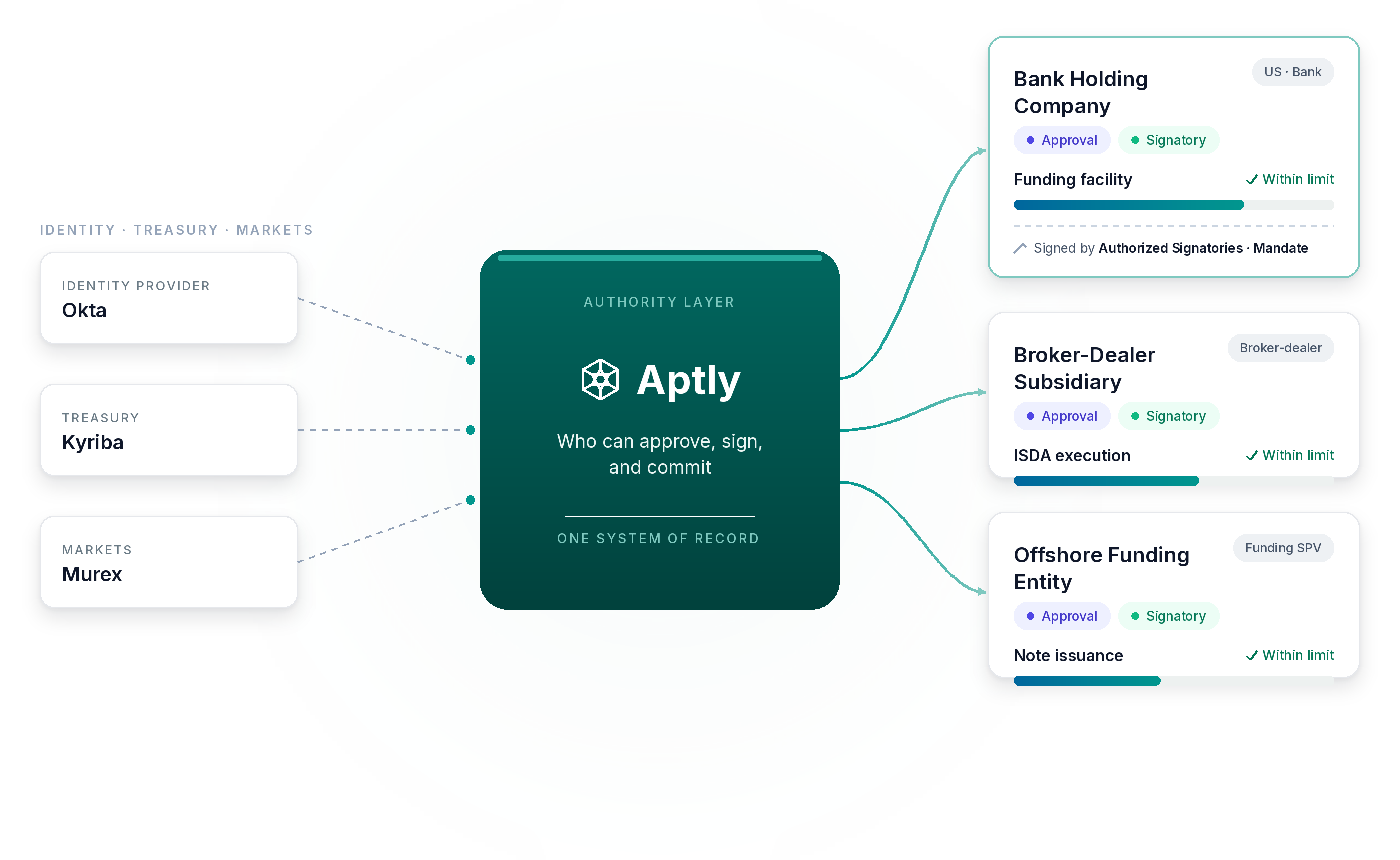
Delegation of authority (DOA) is the formal structure that defines who can approve, sign, and commit on behalf of a financial institution, up to what limit, and under what conditions. In financial services, that structure has to hold across every legal entity, every bank mandate, and every counterparty relationship. The authority is written down everywhere, and current nowhere. Financial services runs on delegated authority, and it documents that authority more carefully than most industries: board and committee charters, treasury and credit policy, signed bank mandates, and authorized-signatory lists on every ISDA. The problem is not that the authority is undefined. The problem is that it lives in dozens of static documents, held by different desks, updated on different cycles, and impossible to see as one current picture at the moment a payment is released or a trade is executed. In more than a quarter of organizations (28%), the delegation of authority does not address who is permitted to sign at all.
Approval, payment, and signing authority get conflated. Approving a hedge within a limit, or releasing a payment against a facility, is not the authority to bind the firm to a counterparty. People act on the wrong one, and the firm discovers it during an examination rather than before the confirmation goes out.
Only certain officers can bind the firm, and not everyone knows who. A trade or facility executed by someone without delegated signing authority is an authorization control failure, and depending on the instrument and jurisdiction the transaction can be challenged or unwound because it was never signed by someone with actual, lawfully delegated authority.
The picture is reconstructed, not maintained. When an examiner or an external auditor asks who was authorized to commit on a given account or counterparty on a given date, the answer is assembled by hand from resolutions, mandate letters, and email, often months after the fact.
86%
Only 14% of organizations embed delegation of authority within an IT system. The other 86% keep it as a document, most often on the company intranet, where it goes out of date the moment a role changes.A policy on paper is not the same as a live record of who held that authority on a given date. In financial services, that drift is expensive: a payment released against a facility past a delegated limit, a trade approved by someone without authority to commit it, or a bank mandate or ISDA signed by an officer the firm had not authorized, each surfaces in an examination rather than before the firm is bound.
Between who people are and where the work happens. Your identity system governs the door: it knows who someone is and what they can log into. Aptly governs the decision once they are through it. Your finance and treasury platforms, your payment and trading systems, and your contract and signing tools are where commitments actually get made. Neither identity nor those systems knows what a person is authorized to decide, approve, or sign on behalf of the firm, and up to what limit. That authority lives in board resolutions and delegations, outside every system that needs it.
Aptly is the authority layer that sits between the two. It holds the firm's delegated authority as a live model: who holds approval and signing authority, up to what limit, under what conditions, with each delegation's source resolution or power of attorney attached and each recipient's acceptance recorded. Connected to your finance and treasury systems and your identity directory, Aptly keeps that authority aligned with organizational reality as roles, limits, and people change, so the desk releasing a payment and the officer about to sign are always working from what the firm actually authorized.
One source of truth, a clear chain of authority
Holds authority by statute, charter, and bylaws. Reserves key matters, delegates the rest.
Receives the board's delegation, then sub-delegates by policy.
Financial commitments and disclosures, within limit.
Bank account mandates and funding and facility authority, within limit.
Trading and hedging within limit, and through it ISDA execution.
Balance-sheet, liquidity, and interest-rate risk decisions, within board-set limits.
Named on the firm's bank mandates and ISDA documentation. The only officers who can bind the firm on accounts and swaps.
Separate legal entities, one model
Four capabilities, one system of record. Built for the CFO, general counsel, and corporate secretary accountable for it.
The obligations that make current authority non-negotiable. These obligations do not all sit in one office, and they do not pause between audits. Each one assumes the firm can show who was authorized to act, and on what date. The effect is that an examination becomes a lookup rather than a reconstruction: the authority that stood on the trade or signature date is retrievable in its exact form, with the actor and the prior value on every change. Aptly maps your authority model to what each one requires:
A trader at Meridian Capital arranges an interest-rate swap to hedge a new funding facility. The business-line head approves the hedge and the limit, and that approval is recorded. The trader prepares to execute under the firm's ISDA Master Agreement. In Aptly, the authority model shows what the business-line head's approval is and is not: it authorizes the hedge within limit, but it is not ISDA signing authority.
Two years later, an examination asks who was authorized on the trade date. Aptly recalls exactly who held signing authority on the swap on the date it was executed, with the delegation behind it, in one place rather than a reconstruction from resolutions and email.
Use case
View use case →
Bring two or three desks or entities and the authority each one holds. We'll show you the single, live, audit-ready view Aptly produces, using your own authority data.