Industry · Higher Education

Delegation of authority for higher education: one live layer from the board to every signing office.

Your institution's authority is real only where it is granted: vested in the board, delegated to the president, and cascaded to the officers, deans, and sponsored-programs officials who can act for it. Contract, payment, and budget authority are not the same, and they rarely sit with the same person. When the foundation, the medical center, and a dozen schools each keep their own version, no one can answer the question every auditor and sponsor asks: who is authorized to approve, sign, and commit on behalf of this institution today, and within what limits? Aptly holds that answer as one live, audit-ready system across every school, every entity, and every sponsored award.
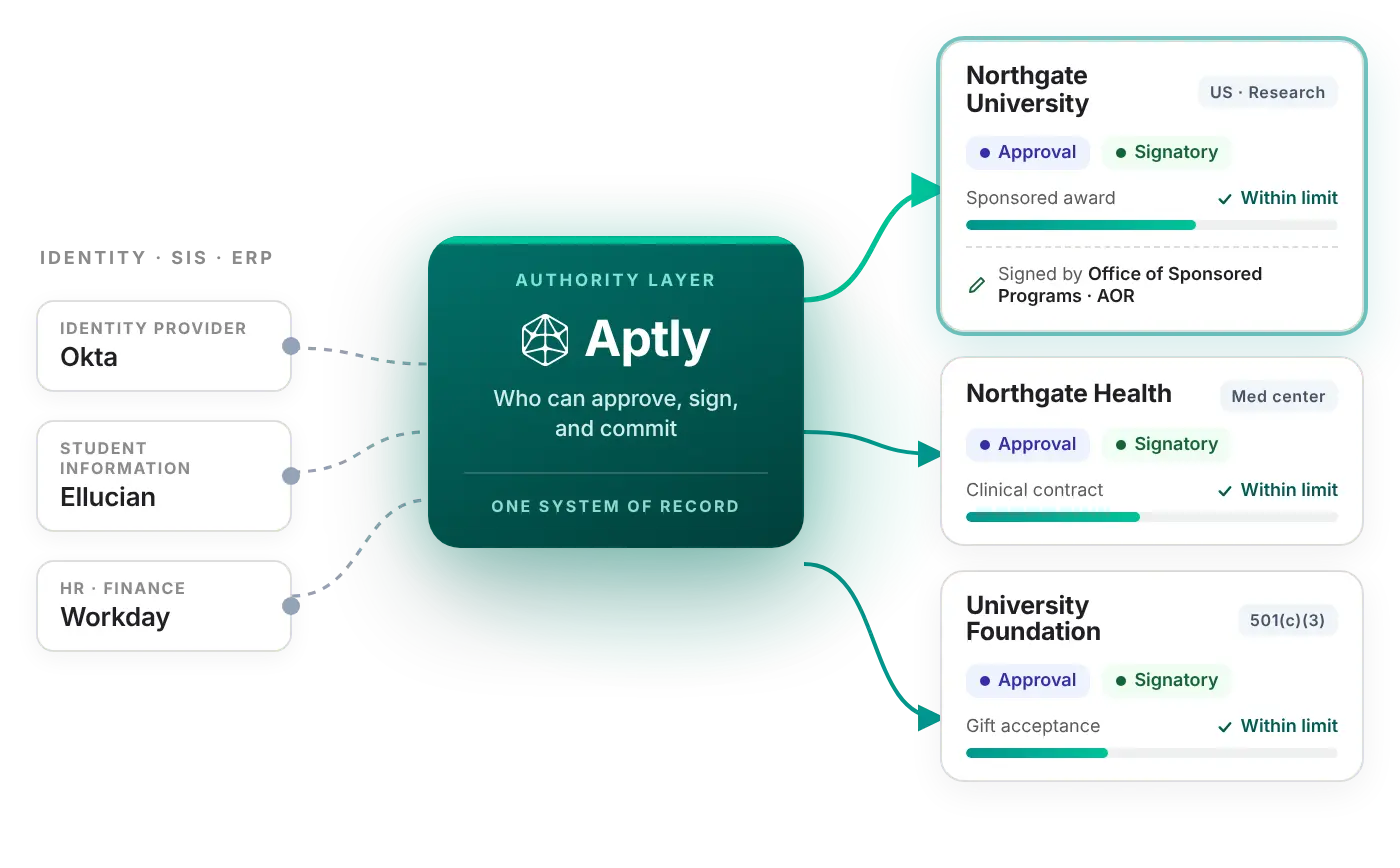
Aptly authority layer linking a university's identity, SIS, and finance systems to Northgate University, Health, and Foundation entities.
Security & compliance
SOC 2 Type II Certified
Multi-Region Hosting
GDPR Compliant
The Gap

Why delegated authority in higher education goes out of date

Delegation of authority (DOA), also called a scheme of delegation or delegated financial authority, is the formal structure that defines who can approve, sign, and commit on behalf of an institution, up to what limit, and under what conditions. Delegated financial authority covers spend limits alone; a DOA also governs signature authority and non-financial decision rights. In higher education, that structure has to hold across every school, the foundation, the medical center, and every sponsored award. The authority is written down everywhere, and current nowhere. Higher education runs on delegated authority, and it documents that authority more carefully than most industries: board bylaws, presidential delegation letters, provost and chief financial officer sub-delegations, and named signing officials for research. The problem is not that the authority is undefined. The problem is that it lives in dozens of static documents, held by different offices, updated on different cycles, and impossible to see as one current picture when it matters. In more than a quarter of organizations (28%), the delegation of authority does not address who is permitted to sign at all.

Contract, payment, and budget authority get conflated. Holding a budget, or the ability to initiate a payment, is not the authority to bind the institution to an agreement. People act on the wrong one, and the institution discovers it during an audit rather than before a signature.

Only certain officials can legally bind the institution, and not everyone knows who. A faculty or staff member who signs a grant, contract, or research agreement without delegated authority can take on personal legal liability, and for a public institution the agreement may not be enforceable at all because it was never signed by someone with actual, lawfully delegated authority.

The picture is reconstructed, not maintained. When a federal sponsor or an external auditor asks who was authorized to commit on a given award on a given date, the answer is assembled by hand from delegation letters and email, often months after the fact.

86%

Still on spreadsheets

Only 14% of organizations embed delegation of authority within an IT system. The other 86% keep it as a document, most often on the company intranet, where it goes out of date the moment a role changes.A policy on paper is not the same as a live record of who held that authority on a given date. In higher education, that drift is expensive: a purchase or sponsored-program commitment approved above a dean's or department's delegated limit, a grant or contract bound by someone without authority to commit the institution, or an agreement signed by an officer the board had not authorized, each surfaces in an audit rather than before the commitment is made.

Source: EY and the Society for Corporate Governance, "The delegation edge" (2024). Survey of 222 corporate governance professionals, September to October 2024.

The fix is not a tidier binder of delegation letters. It is one authority model that holds the board's reserved powers, every delegation beneath them, and the offices authorized to sign, as one live, current record.

The Authority Layer

What your SIS, finance, and grants systems all leave out

Between who people are and where the work happens. Your identity system governs the door: it knows who someone is and what they can log into. Aptly governs the decision once they are through it. Your enterprise systems, the finance and human-capital platform, the grants and research-administration systems, the contract and signing tools, are where commitments actually get made. Neither identity nor those systems knows what a person is authorized to decide, approve, or sign on behalf of the institution, and up to what limit. That authority lives in board resolutions and delegation letters, outside every system that needs it.

Aptly is the authority layer that sits between the two. It holds the institution's delegated authority as a live model: who holds approval and signing authority, for what, up to what limit, under what conditions, with each delegation's source resolution or letter attached and each recipient's acceptance recorded. Connected to your finance and human-capital platform and your identity directory, Aptly keeps that authority aligned with organizational reality as roles, limits, and people change, so the office routing an approval and the person about to sign are always working from what the institution actually authorized.

Identity systems
Who can log in
OktaMicrosoft Entra IDShibboleth
The Authority Layer
Aptly governs who can approve, sign, and commit
Delegations, limits, conditions, and signatories, versioned and evidenced.
Execution systems
Where commitments are made
WorkdayEllucian · OracleHuron · Cayuse
One authority layer between identity and execution, holding the institution's delegations and signatories and showing them as one current view.

Identity proves who someone is. Your finance and grants systems execute the work. Aptly is the system of record for what the institution authorized, kept current.

How It Works

How authority cascades from the board to every signing office

One source of truth, a clear chain of authority

IssuerApproval

Board of Trustees or Regents

Holds authority by statute, charter, and bylaws. Reserves key matters, delegates the rest.

Reserved mattersTuition & FeesBond & DebtReal PropertyTenure & Appointments
RecipientApproval

President or Chancellor

Receives the board's omnibus delegation, then sub-delegates by formal instrument.

Sub-recipientApproval

Provost

Contracts arising from academic operations.

Sub-recipientApproval

Chief Financial Officer

Financial and treasury matters, within limit.

Sub-recipientApproval

Vice President for Research

Research administration, and through it the sponsored-programs signing authority.

Sub-recipientApproval

Deans, directors & department heads

Scoped approval authority within their own areas.

Sub-recipientSignatory

Office of Sponsored Programs

Authorized Organizational Representative. The only office that can bind the institution on grants and research agreements.

Separate legal entities, one model

University FoundationOwn board & signatories
Academic Medical CenterOwn board & signatories
Athletics & AuxiliariesOwn board & signatories
1
Authority starts with the board.
Your governing board, the trustees or regents, holds authority by statute, charter, and bylaws. It reserves a defined set of matters to itself, commonly tuition and fees, debt and bond resolutions, real-property transactions, tenure, and senior executive and head-coach contracts above a set figure, and delegates the rest to the president or chancellor.
2
The president sub-delegates to the people who run the institution.
By formal instrument, often an omnibus delegation, authority flows to the provost for academic contracts, to the chief financial officer for business contracts, deeds, and leases, to the vice president for research, and to the deans, directors, and department heads who hold scoped authority in their own areas.
3
Only certain offices can actually sign.
Through the vice president for research, the sponsored-programs officials, the Authorized Organizational Representatives, are the only people who can bind the institution on grants, cooperative agreements, and research contracts. Accountability stays with the original approver and runs down through every sub-delegation to the final signer, with each recipient's acceptance recorded.
4
One model holds the cascade and the entities together.
The institution is rarely one legal entity. A separately incorporated foundation, a research foundation, an academic medical center, and athletics and auxiliary enterprises each carry their own board, signatories, and bank mandates. Aptly holds reserved matters, every delegation beneath them, the sponsored-programs signing authority, and the per-entity signatory lists in one model that can be shown as it stood on any date.

The board's reserved powers, every delegation beneath them, and the offices authorized to sign, held as one live model that can be shown as it stood on any date.

The Platform

What Aptly governs for colleges and universities

Four capabilities, one system of record. Built for the CFO, general counsel, and board secretary accountable for it.

Delegation of Authority
Available
Define the institution's decision types with limits and conditions, then issue delegations with full lineage, from the board's reserved matters through the president's omnibus delegation to every dean and signing official. Each recipient's acceptance is recorded. When a role changes or a department realigns, Aptly detects the delegations affected, notifies the positions that hold them, and issues or revokes authority automatically rather than letting it carry over silently.
Learn more →
Signatory Management
Available
Maintain authorized signatory lists as a live output of the delegations that produce them, scoped by entity, instrument type, and signing threshold, with the board resolution, presidential letter, or power of attorney behind each authority attached. Who can sign for the university, the foundation, or the medical center always matches what was authorized.
Learn more →
Authority Hub
Available
Sync delegated authority across your identity directory and your finance and human-capital platform, and route approvals by the governed record so a request always reaches the office that actually holds the authority for it.
Learn more →
Intelligence
In Preview
Ask who can approve or sign for a given matter, entity, or award in plain language, and get a grounded answer with the delegation behind it.
Learn more →
See one authority model run across your whole institution.
Schedule a Discovery Call
Frameworks

Which regulations require proof of approval authority in higher education

The obligations that make current authority non-negotiable. These obligations do not all sit in one office, and they do not pause between audits. Each one assumes the institution can show who was authorized to act, and on what date. The effect is that a Single Audit or a sponsor query becomes a lookup rather than a reconstruction: the authority that stood on the award date is retrievable in its exact form, with the actor and the prior value on every change. Aptly maps your authority model to what each one requires:

Uniform Guidance

Evidence who could sign on every federal award.

A Single Audit requires evidence of who was authorized to approve, sign, and commit on federal awards, on the dates in question. Aptly holds that authority as a live model and recalls who held it on any date.
OMB Uniform Guidance, 2 CFR 200; Single Audit threshold $1,000,000 for fiscal years beginning on or after October 1, 2024.
Sponsored awards

Only an Authorized Organizational Representative can bind a sponsored award.

Sponsor certifications are signed only by an Authorized Organizational Representative, and applicable research carries export-control obligations. Aptly holds who that representative is and the delegated authority behind them.
Sponsor award terms and research-security rules (EAR and ITAR); verify per award and program. Subject to change.
Board governance

Apply the board's reserved matters and delegations.

State higher-education statutes and board or regents bylaws define the matters the board reserves to itself and what it delegates. Aptly carries that scheme of delegation from the board through the president to every signing office.
State higher-education statutes and board or regents bylaws; varies by institution type and state.
IRS Form 990

Certify delegation-of-authority records each year.

The annual Form 990 governance disclosure already prompts many institutions to certify that their delegation-of-authority records are current. Aptly makes that a property of the system rather than an annual reconstruction.
IRS Form 990, governance section; applies to tax-exempt institutions.
Financial reporting

Support the controls behind financial reporting.

GASB for public institutions and FASB for private, with internal control over financial reporting that authorization evidence supports. Aptly provides the point-in-time authority evidence those controls rely on.
GASB (public institutions) or FASB (private); ICFR expectations vary by institution.
Frameworks last verified June 2026. Obligations vary by institution type, jurisdiction, and sponsor.
Get the Higher Education Authority Readiness Brief →

You hold one authority model for the institution. Each obligation reads it in its own terms, so an audit or a new sponsor requirement becomes a lookup, not a fresh reconstruction.

Proof

A grant that only one office could sign.

A principal investigator at Northgate University is awarded a $1.4M federal research grant with a subaward to a partner institution. The dean approves the program and the budget, and that approval is recorded. The principal investigator prepares to sign. In Aptly, the authority model shows what the dean's approval is and is not: it commits the school's resources, but it is not signing authority.

“Who is actually authorized to bind the institution to this award, and who only approved it?”
Only one office can sign
Only the Director of the Office of Sponsored Programs, the Authorized Organizational Representative, can bind Northgate University to the award and its subaward.
Authority traced to its source
That signing authority is delegated from the board through the president and the vice president for research, recorded at each step (ref NUS-2026-00318).
Executed against the signatory list
The award and subaward are signed by the authorized official, and the partner subaward is executed against the sponsored-programs signatory list.

Two years later, a Single Audit asks who was authorized on the signing date. Aptly recalls exactly who held signing authority on the award on the date it was signed, with the delegation behind it, in one place rather than a reconstruction from letters and email.

Illustrative scenario on Aptly's Northgate University System dataset.
FAQ

Higher education delegation of authority: common questions

How is this different from our SIS or our finance and grants system?
Your student information system, your finance and grants system, and your HR system each hold part of the picture. None is the system of record for who is authorized to approve, sign, and commit, or the delegation behind it. Aptly sits alongside them as the authority layer: the scheme of delegation from the board through the president to every signing office, the signatory lists, the limits, and the conditions, kept current as roles and awards change. It connects to the systems where the work happens rather than replacing them.
Most institutions capture delegations in signed memos and a spreadsheet, then rebuild the picture each year for the Form 990 governance question or an audit. Aptly holds each delegation as a structured, versioned record instead: the board's reserved matters, what the president sub-delegates to the provost, the CFO, and the deans, and what each office may redelegate. When a role changes or an award starts, the affected delegations and signatory lists are reviewed and updated rather than left to drift, so the current state is a property of the system, not an annual reconstruction.
They are different authorities, and conflating them is a common audit finding. Approving a budget commits the institution's resources to a plan. Approving a payment releases funds against it. Signing a contract or award binds the institution to a counterparty or sponsor, and on a sponsored award only an Authorized Organizational Representative can do that. A dean can approve a program and its budget without holding signing authority for the award. Aptly holds each of these distinctly, with the limit and the delegation behind it, so the right authority is applied at each step and recorded.
Each entity has its own board or governing body, its own officers, and its own signatory lists and bank mandates, often under different rules. Aptly governs them from one platform while keeping each entity's authority its own: who can sign for the university does not carry to the foundation or the medical center unless that entity granted it. Signatory lists live in the same system as the delegations that produce them, scoped by entity, instrument type, and threshold, with the authorizing board resolution or bylaw attached, and can be produced in whatever format a sponsor, bank, or auditor requires.
No. Sponsored awards and the Single Audit make signing authority unavoidable at a research university, but a community college with one foundation and a Form 990 to file faces the same question from the same auditor. Aptly models the same cascade at whatever depth your institution actually has.
Pairs With

Built to work with the rest of your authority program.

Use case

Board Governance
Carry the board's reserved matters and scheme of delegation from the board through the president to every signing office.

View use case →

Use case

Regulatory Readiness & Compliance
Produce audit-ready evidence of who was authorized to sign on every award and contract, on the dates in question.

View use case →

Use case

Continuous Authority Assurance
Move from an annual reconstruction to living evidence that authority held across the institution every day.

View use case →

See your institution's authority as one live system.

Bring two or three offices or entities and the authority each one holds. We'll show you the single, live, audit-ready view Aptly produces, using your own authority data.