Intelligence is the understanding layer across the Aptly platform. It reads everything the Authority Layer knows, so people and AI agents get grounded answers about authority, in the tools they already use.
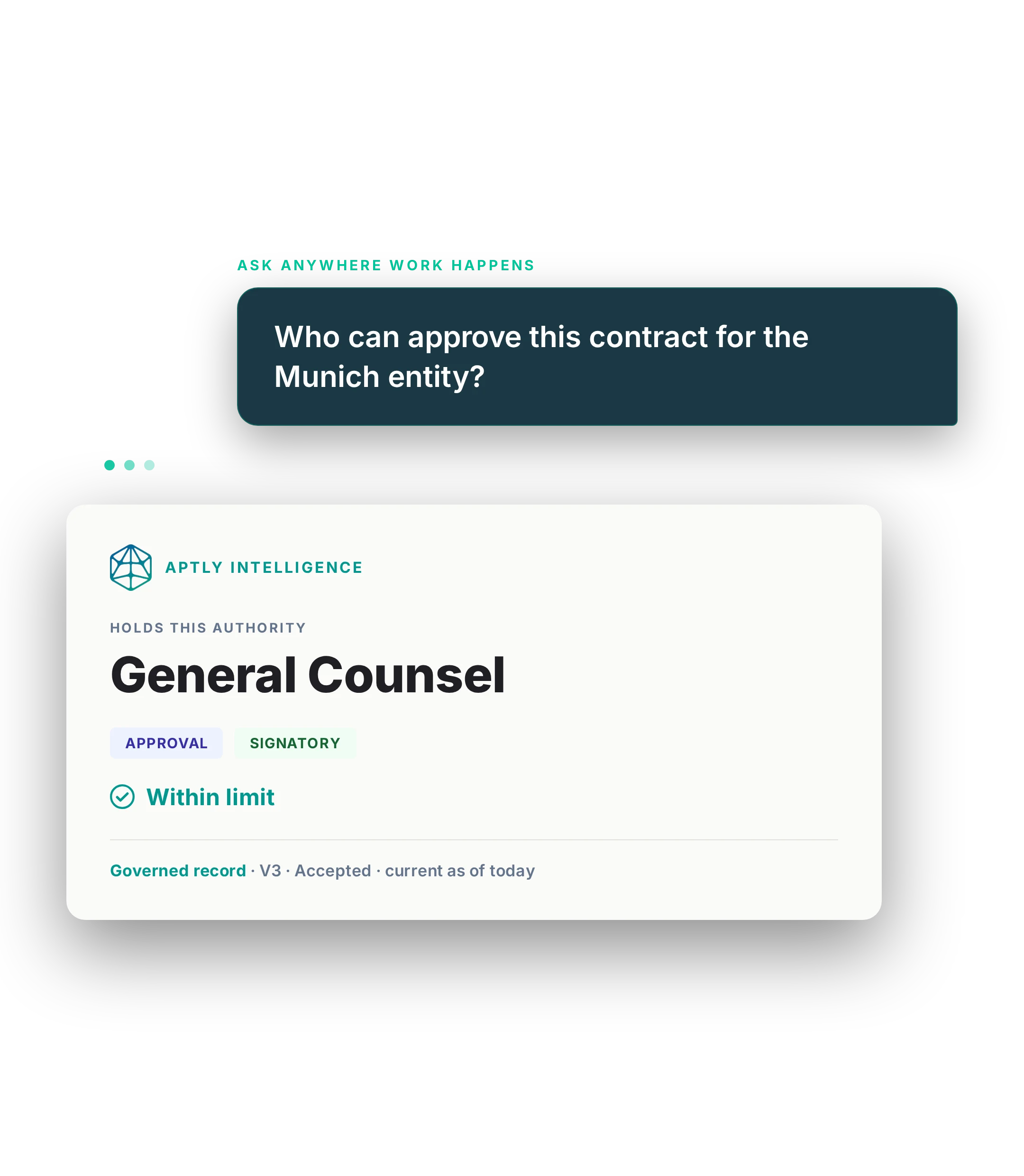
Intelligence is not a chatbot bolted onto a website. It is a layer that reasons over the governed authority record: every delegation, acceptance, limit, condition, authorized signatory, and version that lives in Aptly. When you ask a question, the answer comes from the same record your auditors rely on.
That scope is deliberate. Intelligence understands, guides, and detects. It does not build workflows or route requests, which is the work of Authority Hub. It does not define authority, which happens in Delegation of Authority and Signatory Management. One layer to understand the record that the rest of the platform creates, syncs, and enforces.
Ask in the web application, or ask without leaving Microsoft Teams or Slack. Questions sound like work, not like queries: who can approve a vendor contract for the Singapore entity, whether the Plant Manager can commit above their limit, which authorities a departing Treasury Manager holds today.
Every answer carries its grounding: the position that holds the authority, the limit and conditions that qualify it, the version of the delegation it comes from, and whether that delegation is accepted and current. If the record does not support an answer, Intelligence says so rather than guessing.
Authority questions rarely arrive as questions. They arrive as an email asking for sign-off, a contract opened in a contract lifecycle management (CLM) or e-signature system, a document on screen with a commitment buried in clause seven. Intelligence meets those moments where they happen: proactive prompts in email, guidance inside contract-signing and CLM systems, and Chrome extensions that can analyze documents and screen content against the authority record.
Instead of hunting through a policy library, the person sees the relevant authority, limit, and condition at the moment of decision, with the policy interpretation already done.
Detection analytics read across the record and the systems connected to it, surfacing the patterns that audits find later: transactions that ran outside the approved authority, segregation-of-duties (SoD) conflicts, authority concentrated in too few positions, approval bottlenecks, authorities that contradict each other, and gaps in the delegation of authority (DOA) framework itself.
Each detection links back to the evidence: the record, the version, the transaction. Findings become items your team resolves on its own schedule, not surprises in an audit room.
When an AI agent needs to know whether it may act, Intelligence answers from the same governed record, under the same delegation rules, conditions, and audit trail that apply to your teams. Detection analytics watch agent activity the same way they watch human activity. Human review and override are part of the design, not an afterthought.
Governing agent authority end to end is its own discipline. See how Aptly handles it in Agentic AI Governance.
Every answer Intelligence gives is grounded in the governed authority record: versioned, accepted, and current. It does not improvise policy and it does not answer beyond the record.
Access follows the permissions you already manage in Aptly. A person asking through Intelligence sees what that person is entitled to see, and nothing more. The same boundary applies when an agent asks.
The model is your choice as well. Run Intelligence on the Aptly-managed large language model (LLM), or connect your own model through the Aptly MCP (Model Context Protocol) connector and keep model selection and data flow under your control.
The platform behind it carries the same posture as the rest of Aptly: SOC 2 Type II audited controls, ISO 27001 aligned information security management, data handling aligned to the GDPR (General Data Protection Regulation), and enterprise-grade hosting on Microsoft Azure. Security documentation, certifications, and subprocessor information are available at trust.aptlydone.com.
In preview means the capability is real and maturing: natural-language querying in the web app and in Microsoft Teams and Slack, proactive guidance in email and contract systems, document and screen analysis, insights and reporting, and detection analytics for authority risks. Preview customers work directly with our team as coverage and depth expand.
Delegation of Authority, Signatory Management, and Authority Hub are generally available now. Intelligence reasons over the record those products govern, so the value of the layer grows with the record beneath it.
Platform
Learn more
Platform
Learn more
Bring your delegation of authority (DOA) matrix, your signatory lists, and your hardest authority questions. We will show you what Intelligence can answer in your environment, and our team will migrate your existing matrix at no cost.