Platform · Product Overview

The Authority Layer for the Enterprise

Aptly is the system of record for delegation of authority (DOA), signatory management, and decision rights, for your people and your processes. It sits between the systems that prove who you are and the systems where work happens, and answers the question neither one does: what are you authorized to decide? 
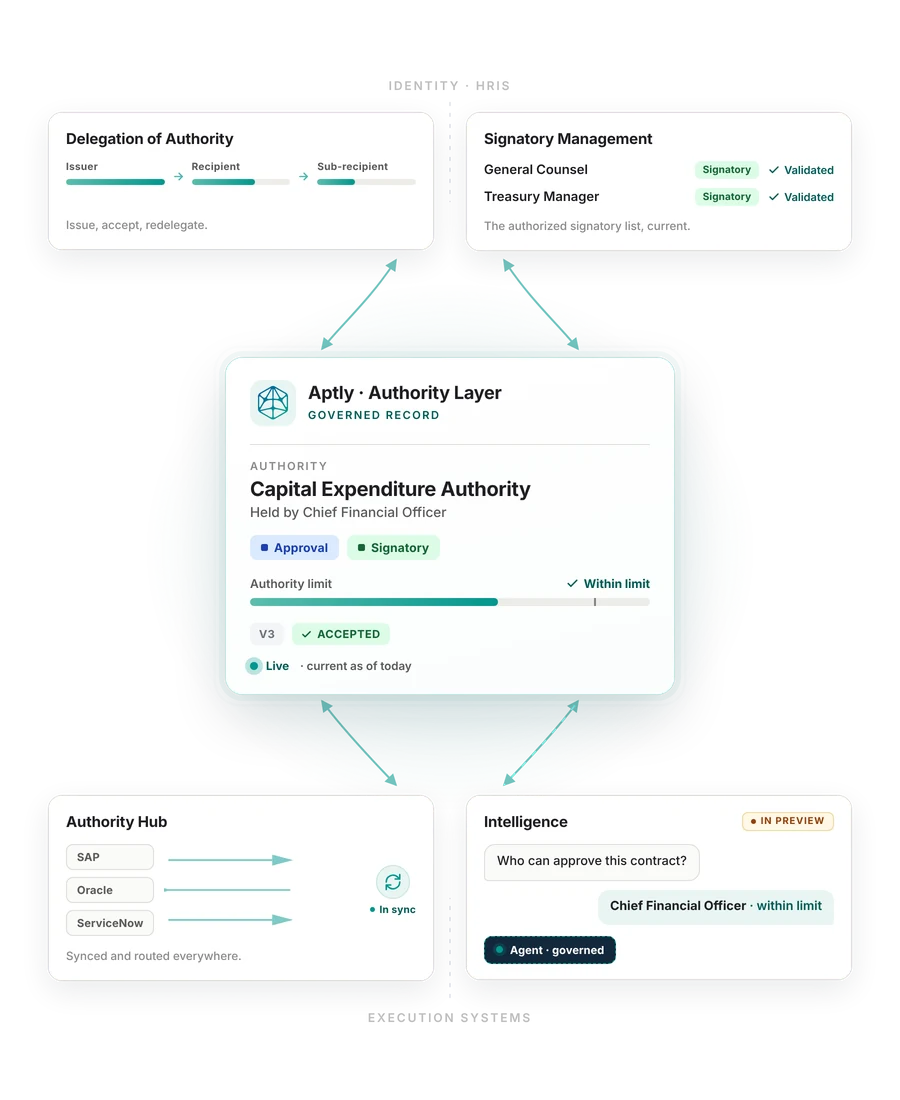
Aptly Authority Layer: one governed authority record connected to Delegation of Authority, Signatory Management, Authority Hub, and Intelligence.
Security & compliance
SOC 2 Type II
ISO 27001
GDPR
The Authority Layer

Identity proves who you are. Aptly governs what you may decide.

Identity systems answer who you are. Your business systems move the work. Neither one answers what each person or agent is authorized to decide. Aptly is the layer in between: Okta, Microsoft Entra ID, SailPoint, and Workday flow in from above; SAP, Oracle, NetSuite, ServiceNow, contract lifecycle management (CLM), and e-signature systems execute below. Aptly governs the decision rights that connect them, in one continuous, auditable record.

Every delegation, acceptance, redelegation, limit, condition, and authorized signatory lives in Aptly as a structured, versioned record. The shared backbone behind every product is the same: a continuous audit trail, full version history, and authority standards that apply to people and AI agents alike.

Identity systems
Who you are
OktaMicrosoft Entra IDSailPoint · Workday
The Authority Layer
Aptly governs what each person and agent is authorized to decide
Delegations, limits, conditions, and signatories, versioned and evidenced.
Execution systems
Where work happens
SAPOracle · NetSuiteServiceNow · CLM · e-signature
Every product on this page reads from and writes to this same record.

Identity proves who you are. Your systems move the work. Aptly is the system of record for what each person and agent is authorized to decide.

Outcomes

One platform. One answer to who can decide.

The Authority Layer is measured by what it removes: scattered records, manual reconstruction, stale permissions, and systems that disagree about who can decide. Four outcomes define the platform.

Coverage. Every authority in one place. Approval limits, signing authority, delegations, and agent permissions live in a single governed record instead of scattered spreadsheets and policy documents.

Auditability. Prove who held which authority on any date. Point-in-time recall replaces quarterly reconstruction with a continuous, audit-ready record.

Automation. Authority that keeps itself current. Personnel changes, expiring delegations, and acceptance tracking run on their own schedule, with notifications in place of manual follow-up.

Integration. In sync with the systems you already run. Bidirectional connections to your human resources information system (HRIS), identity provider, and enterprise resource planning (ERP) platform keep authority consistent everywhere work happens.

73%

Third-Party Research

In West Monroe's January 2026 Speed Wins survey of more than 1,200 leaders at United States companies with $250M+ in revenue, 73% of leaders estimate their organizations lose up to 5% of annual revenue to slow decision-making and delayed execution. Unclear decision rights and excessive approval layers are among the causes managers cite most.

Survey-based; West Monroe, January 2026.

Coverage, auditability, automation, and integration are not features. They are what it means for authority to run as a live, evidenced control.

The Platform

Four products. One Authority Layer.

Delegation of Authority
Included
Define and administer decision rights from the board to the front line. Issue, accept, and redelegate within limits, so the organization always knows who can approve, commit, and decide.
Learn more →
Signatory Management
Included
Signatory management is a control, not an admin task. Keep authorized signatory lists current, validated, and audit-ready, and share them securely with banks and counterparties.
Learn more →
Authority Hub
Included
Sync the governed record into the systems where work executes and route approvals by it, with a built-in workflow builder to shape both.
Learn more →
Intelligence
In Preview
Ask who can decide what in natural language, wherever work happens. Surface proactive guidance and detect authority risks before they become audit findings.
Learn more →

Distinct products that compose one Authority Layer. Define authority in Delegation of Authority and Signatory Management, keep it in sync and route work in Authority Hub, understand and govern it in Intelligence, and connect it everywhere through Integrations.

Capabilities

Define. Query. Prove.

1
Define.
Decisions Register and Delegations Register. Catalog every decision the organization makes, with owners, limits, and conditions, and issue and track delegations with acceptance, expiry, and redelegation rules.
2
Query.
Pathway View and Dynamic Matrices. Trace any decision to the people and positions authorized to make it, and generate the current approval matrix for any entity, function, or threshold on demand.
3
Prove.
Change Log and Conditions and Roles. Point-in-time recall shows exactly who held which authority on any date, with the conditions, role types, and limits that qualify it, so the evidence stands on its own.

Define the authority, query it wherever work happens, and prove it on any date. Three verbs, one record.

Everything inside the platform

One governed record, from the authority model to the evidence and the intelligence on top of it.

Define

Build the full picture of who can decide what, across every entity.
Decisions Register: every decision type your organization makes, structured and navigable
Delegations Register: who holds what authority, at what limit, granted by whom
Dynamic authority matrices by position, entity, and decision type
Limits and thresholds on every authority
Conditions and RACI roles (responsible, accountable, consulted, informed) on each decision
Authorized signatory lists and signature specimen management, validated and current
One authority model across every entity and jurisdiction

Query

Keep the authority record current everywhere work happens.
Issue, acknowledge, recall, and reassign delegations in real time
Temporary delegations that expire on schedule
Sub-recipient cascade, with redelegation that never exceeds its source
HR and identity sync, so role changes update authority without a ticket
Bidirectional sync into your HR, identity, and ERP (enterprise resource planning) systems
Approval routing by the governed record, plus a built-in visual workflow builder
A consolidated view of every authority a person holds, with restricted or public visibility

Prove

Reconstruct and interrogate authority for any moment, and catch risk early.
Change Log with point-in-time recall: reconstruct the full authority state for any past date
Complete audit trail and version history, every change tracked and attributed
Pathway View: trace any decision to the authority and lineage behind it
Natural-language query of the record in the web app, Microsoft Teams, and Slack, with sources attached In preview
Proactive guidance in email and contract systems, plus document analysis In preview
Detection analytics for authorization control failures, segregation-of-duties conflicts, and framework gaps In preview
See it run against a your DOA framework.
Book a Discovery Call
Intelligence · In Preview

The intelligence layer across the platform

Intelligence reads across everything the Authority Layer knows. Ask who can decide what in plain language, in the web application or in Microsoft Teams and Slack. Receive proactive guidance in email, contract-signing and contract lifecycle management (CLM) systems, and Chrome extensions, with analysis of documents and screen content. Detection analytics surface non-compliant transactions, segregation-of-duties (SoD) conflicts, overly centralized authority, bottlenecks, conflicting authorities, and DOA framework issues before they become audit findings.

The same standard applies to AI agents as to people. Aptly governs what an agent is authorized to decide, approve, sign, and commit, with the same delegation rules, conditions, and audit trail you apply to your teams. Identity systems ask who an agent is. Aptly answers what it may do. Human in the loop by design: review, override, and prove every authorized action.

82%

Third-Party Research

82% of organizations already use AI agents, but only 44% have policies in place to govern them. Identity vendors govern who an agent is. Aptly governs what it is authorized to decide.

SailPoint, AI Agents: The New Attack Surface, 2025; 353 enterprise security professionals; conducted by Dimensional Research.

The rest of the Aptly platform is available today. Intelligence is in preview.

Proof

Nearly every enterprise has a DOA policy. Few can prove it works.

In EY (Ernst & Young LLP) and the Society for Corporate Governance's survey of more than 200 Society members, fielded in September 2024, almost 90% of organizations reported having a DOA policy, formal or informal. The same survey shows where policies break down in practice: only 40% conduct regular training on policy updates, 35% cite difficulty tracking and enforcing the policy, and 49% lack a formal materiality policy. The control exists almost everywhere. The proof is what's scarce.

“Who was authorized to approve the vendor contract executed on March 14, and can you prove it?”
Delegation and conditions
The authority as it stood on March 14, with its limits and conditions.
Acceptance record
Who held the delegation, when it was accepted, and by whom.
Authorized signatory
The signatory who executed, validated against the live record.

The General Counsel's team opens Aptly and recalls the authority record as of that date. What once took weeks of reconstruction is a single query. The stakes of weak enforcement are well documented: more than half of the 1,921 cases in the ACFE (Association of Certified Fraud Examiners) Occupational Fraud 2024: A Report to the Nations involved internal controls that were absent or overridden.

Illustrative scenario. Meridian Industries is a fictional company, not a real customer. Survey data: EY and the Society for Corporate Governance, January 2025; ACFE, 2024.
Trust

Enterprise trust, by design

The Authority Layer holds one of the most sensitive records in the enterprise: who can decide what. The platform is built and operated accordingly.

SOC 2 Type II

Audited controls, over time.

Independent audit of security, availability, and confidentiality controls operating over a sustained period.
ISO 27001

Certified information security management.

An information security management system certified to the international standard.
GDPR

Privacy by design.

Data handling aligned to the GDPR (General Data Protection Regulation), with data processing agreements available.
Azure multi-region

Enterprise-grade hosting.

Hosted on Microsoft Azure with multi-region resilience and encryption in transit and at rest.
SSO / SAML

Your identity provider, enforced.

Single sign-on (SSO) via Security Assertion Markup Language (SAML) with your existing identity provider.
Trust Center

Documentation on demand.

Security documentation, certifications, and subprocessor information in one place at trust.aptlydone.com.
Certifications, security documentation, and subprocessors.
Visit the Trust Center →

The Authority Layer holds your most sensitive governance record. The platform is operated so you can verify that, not take it on faith.

FAQ

Questions teams ask about the Authority Layer.

What is the Authority Layer?
The Authority Layer is the system of record that sits between identity systems and execution systems. Identity proves who you are. Execution systems move the work. The Authority Layer governs what each person and AI agent is authorized to decide, approve, sign, and commit, with a continuous, audit-ready record.
How is Aptly different from identity and access management?
Identity and access management answers who you are and what you can access. Aptly answers what you are authorized to decide: approval limits, signing authority, and delegations. The two work together. Aptly connects to providers such as Okta, Microsoft Entra ID, and SailPoint rather than replacing them.
Does Aptly replace our ERP approval workflows?
No. Aptly is the system of record for the authority behind those workflows. It keeps delegations and limits current, syncs them to systems such as SAP, Oracle, and NetSuite through Authority Hub, and proves who held which authority on any date.
Can Aptly govern AI agents?
Yes. Aptly applies the same delegation rules, conditions, and audit trail to AI agents as to people. It governs what an agent is authorized to decide, approve, sign, and commit, with human review and override by design.
What is included in Intelligence, and when is it available?
Intelligence is the platform's understanding layer, currently in preview: natural-language querying in-app and in Microsoft Teams and Slack, proactive guidance in email and contract systems, document and screen analysis, insights and reporting, and detection analytics for authority risks. The rest of the platform is available today.
Pairs With

Built to work with the systems you already run.

Integrations

Identity and HRIS, above
Okta, Microsoft Entra ID, SailPoint, and Workday. Identity proves who you are; Aptly keeps authority in step with every joiner, mover, and leaver.

See all integrations →

Integrations

Execution systems, below
SAP, Oracle, NetSuite, ServiceNow, CLM, and e-signature. Your systems move the work; Aptly governs the authority behind it.

See all integrations →

Corporate authority, automated.

Bring your DOA, your signatory lists, and your questions. We will show you the evidence in your environment. Already have a DOA matrix? Our team will migrate it to Aptly for a tailored preview at no cost.