Q&A on what agentic authority means, why it's different from traditional automation, and how to govern AI agents with clear delegation, limits, and accountability.
Definition: Agentic authority. The delegated permission for an AI agent to perform actions that have business impact, such as initiating purchases, approving exceptions, modifying workflows, or triggering payments, within defined limits, time constraints, and accountability structures.
AI agents are crossing the threshold from assistance to action. When an agent can initiate transactions, route work, and execute decisions on its own, it needs to be governed with the same rigor as human authority. Yet most organizations are deploying agents faster than they are building the governance layer to control them.
The scale of the gap is evident in the research. A SailPoint 2025 survey of enterprise IT and security leaders found that 98 percent of organizations engaged with AI agents plan to expand their use within the next year, yet 96 percent view those same agents as a growing security risk. Eighty percent of respondents report that AI agents have already taken unintended actions, while only 44 percent have governance policies in place. Gartner forecasts that 90 percent of B2B buying will be AI-agent-intermediated by 2028, pushing roughly $15 trillion through agent exchanges, and estimates that 40 percent of enterprise applications will integrate AI agents by the end of 2026. Deloitte's State of AI in the Enterprise 2026 report adds a governance-maturity data point to that picture: only 21 percent of organizations report mature agentic AI governance models.
This Q&A explains what agentic authority is, why it is fundamentally a delegation problem rather than an identity or access-control problem, and how to govern AI agents with clear delegation records, bounded limits, monitoring, and accountability. Identity systems answer the question "is this agent who it claims to be?" Authority governance answers a different question entirely: "should this agent be permitted to take this action at this threshold, and who is accountable?"
Agentic authority is the formal delegation of specific action-taking permissions to an AI agent, bounded by thresholds, conditions, effective dates, and an accountable human owner.
A: Agentic authority is the delegated permission for an AI agent to perform actions with real business impact on behalf of a human or a role. It is the governance equivalent of a signature authority or an approval limit, but extended to non-human actors that can execute at machine speed across multiple systems.
The actions that qualify as agentic authority are the same actions that require delegation when a human performs them: committing spend, approving contracts, releasing payments, modifying master data, adjusting pricing, approving exceptions, booking journal entries. When an agent approves a $50,000 purchase order, the question is not whether the agent has API access to the procurement system. The question is: who authorized this agent to approve transactions up to $50,000, is that delegation still valid, and who bears the accountability if the decision was wrong.
Actions that do not qualify include information retrieval, drafting, analysis, and recommendation. An agent that summarizes a contract for a human reviewer exercises no authority. An agent that accepts the same contract on behalf of the organization exercises a significant amount. The distinction is not the underlying technology. It is whether the agent's action binds the organization.
This distinction is now a recognized risk category in application security. The OWASP Foundation's 2025 Top 10 for Large Language Model Applications elevated "Excessive Agency" to LLM06, promoted from its prior position of LLM08 in the 2023 edition, specifically to address the growing risk of granting LLMs unchecked autonomy over external systems. The expanded 2025 entry subsumes risks previously filed under "Insecure Plugin Design" and explicitly targets agentic architectures. For a broader treatment of how authority delegation works across human and non-human actors, see the Delegation of Authority 101 pillar guide.
Traditional automation executes predefined rules deterministically; agentic AI interprets context and selects actions across tools, which means it requires explicit delegation rather than just system access.
A: Traditional automation is deterministic and narrow. A rule says "when an invoice under $5,000 arrives from an approved vendor, route it for payment." The governance model is straightforward: review the rule at configuration time, and the system will behave predictably forever after.
Agentic workflows operate differently. An agent interprets context across multiple inputs, plans a sequence of steps, and selects from a range of possible actions across multiple tools. That flexibility is the entire point of using an agent rather than a hardcoded workflow. It is also the reason governance is harder: the agent can discover actions that a static workflow would never take. The table below compares the two models across five governance-critical dimensions.
The practical consequence is that authority management has to shift from a configuration-time activity to an ongoing governance discipline. An authority matrix that worked for deterministic automation, specifying which system can execute which action, is insufficient for an agent that selects its own actions. The matrix has to specify which agent, under which delegation, with which limits, for which scope, and through which effective dates.
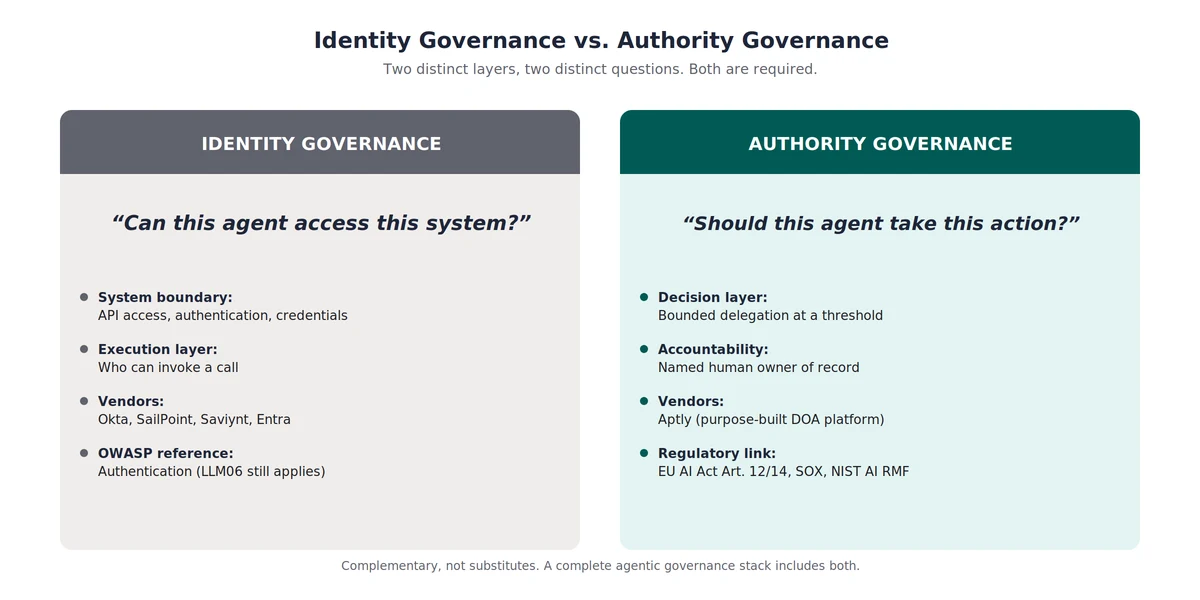
The identity-versus-authority distinction is the most important framing to internalize. Identity platforms answer whether an agent can access a system. Authority governance answers whether an agent should be permitted to take a specific action at a specific threshold. These are complementary, not substitutes. An agent can have legitimate API access (identity governance satisfied) and still lack delegated authority to approve a $500,000 commitment (authority governance unsatisfied).
A human is accountable. A governance body or an individual granted the authority, approved the bounds, and permitted the agent to operate, which means accountability traces back through that chain of delegation.
A: The governance question is never "can we blame the agent?" The question is whether the organization can prove who granted authority, under what constraints, and what evidence existed at the moment the action was taken. If that chain of accountability is documented and the delegation was current, the accountability structure worked as designed even when an individual decision turns out to be wrong. If that chain is missing or the delegation had expired, the organization has a governance failure regardless of the decision's outcome.
This is the same principle that applies to human delegation. When a procurement manager approves a contract outside her authority limit, the audit question is not whether the contract was wise. The audit question is whether she was authorized to sign it on that date, and who had delegated her that authority. Agentic authority inherits exactly this logic. A useful accountability record for an agent action includes the agent identity, the delegation granting authority for that action type, the human owner of the delegation, the effective dates and limits, and the context the agent observed at decision time.
Regulatory frameworks are converging on this accountability requirement. The EU AI Act's Article 14 on human oversight and Article 12 on record-keeping both presuppose accountability infrastructure that delegation records satisfy. Singapore's Model AI Governance Framework for Agentic AI, published in January 2026, formalizes similar requirements. Research from MIT, Google DeepMind, and Palo Alto Networks converges on the same conclusion: agentic AI governance is fundamentally a delegation-of-authority problem.
Start restrictive. Agents should not, at first, hold unrestricted spend authority, workflow-modification rights, unsupervised payment-release capability, or unconditional master-data modification rights, and those defaults should only relax as monitoring matures.
A: Most organizations that successfully deploy agentic authority adopt a graduated-trust model, starting with bright-line restrictions that can be relaxed as monitoring, evidence, and governance mature. The starting restrictions below are not permanent rules. They are sensible defaults that allow an organization to deploy agents while buying time to build the governance layer required to safely expand their authority.
When to revisit any given restriction should be evidence-driven rather than calendar-driven. Useful triggers include a minimum operational period with no material incidents, a threshold number of successful supervised decisions in the relevant authority category, an independent governance review confirming monitoring coverage, and a documented rationale for why the specific restriction no longer mitigates a risk the organization actually faces. Many of the same principles apply to human delegations during transitions, and the Authority Change Management Playbook covers the governance cadence for authority expansions and revocations in more depth.
Use a four-layer model: advisory authority with human approval on every action, bounded authority within tight limits, defined escalation rules for out-of-bounds actions, and continuous monitoring with exception review.
A: The fastest path to value for most organizations is a layered authority model that starts with advisory authority and graduates toward bounded execution as monitoring and evidence accumulate. The four layers work together: advisory authority is the starting point, bounded authority delivers operational value, escalation rules protect against unbounded decisions, and continuous monitoring provides the evidence base for expanding authority over time.
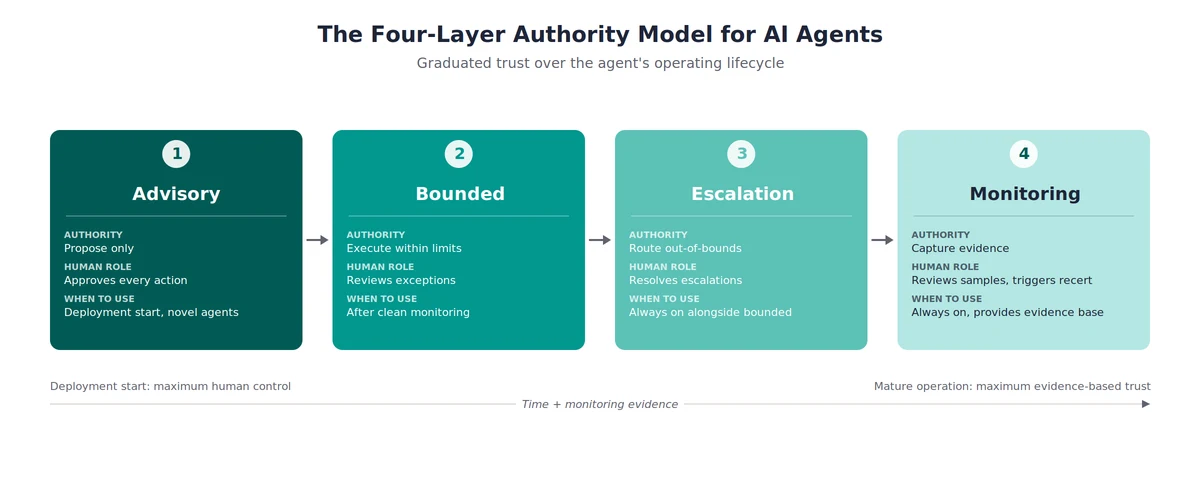
A concrete lifecycle shows how the layers work in sequence. In the first 60 days, a procurement agent runs in advisory mode: it proposes purchase orders and vendor selections, but a human approves every commitment. Monitoring captures the agent's recommendations, the human decisions, and any divergence between them. In the next 90 days, the agent receives bounded authority to approve purchase orders under a defined threshold with approved vendors only, with escalation routing everything above the threshold or outside the vendor list to a human. At six months, assuming monitoring has shown low exception rates and no material incidents, the threshold is raised and the approved-vendor list expanded, with continuous monitoring reviewing a sample of decisions weekly.
The business case for bounded agent authority is straightforward. West Monroe's 2026 Speed Wins research found that 73 percent of C-Suite leaders believe halving decision time would unlock at least five percent in additional revenue, and that each request for additional analysis adds an average of three weeks of delay. Among managers surveyed, 44 percent have accepted slow decision-making as normal or have grown apathetic toward fixing it. Bounded agent authority removes low-risk, high-volume decisions from the human queue entirely, preserving governance focus for the decisions that genuinely require human judgment.
The same fields as a human delegation record, plus identity binding to a specific deployed agent, required preconditions, documented audit-evidence expectations, and an explicit escalation path for out-of-bounds actions.
A: An agent delegation record should contain every field required for a human delegation, plus a few that are specific to non-human actors. Treating agent delegations as a separate, lighter governance artifact is a predictable failure mode: the two systems drift apart, and shadow authority accumulates faster on the lighter side because agents execute at scale.
The identity-binding field deserves particular care. A delegation attached to an agent "model" or a service name will persist across agent versions, retraining cycles, and redeployments. A delegation attached to a specific deployed agent identity will not, which is usually what the organization actually wants. Separately, the authentication layer and the authority layer are distinct. The Model Context Protocol specification now includes OAuth 2.1 for transport-level agent authentication, but MCP does not define what authority an authenticated agent holds within a specific enterprise. That is the delegation record's job.
Our recommendation: Treat agent delegation records exactly like human delegation records, with the same versioning, same effective dating, and same audit trail. Organizations that create a separate, lighter governance track for AI agents inevitably end up with shadow authority that drifts faster than human authority because agents execute at machine speed. For the underlying data model and how to structure delegations that carry across both human and non-human actors, see the guide on authorized signatory lists and delegation records.
Apply the same drift controls used for human authority: time-bound delegations by default, periodic recertification, monitoring for out-of-pattern actions, and strict change control on agent permissions.
A: Uncontrolled agent authority drifts faster than human authority for a simple reason: agents execute at scale, which means the consequences of drift compound faster. The controls that limit drift for humans are effective for agents, provided they are applied with cadences appropriate to machine-speed execution.
Time-bound delegations by default should be the design principle. A delegation without an expiry date is a delegation that will outlive its original business context. Recertification cadences should reflect the authority level: quarterly for high-authority agents, annually for advisory-only agents, and event-triggered on any material incident regardless of the calendar. Monitoring should look for actions outside the expected distribution, including volume spikes, novel action types, decisions near the authority threshold, and decisions made outside normal operating windows. Change control on agent permissions should require the same governance approval as change control on human authority, routed through the same authority change management process.
The SailPoint research underscores why these controls are non-optional. Among enterprises engaged with AI agents, 80 percent report that agents have already taken unintended actions, 72 percent consider AI agents a greater risk than traditional machine identities, and only 44 percent have governance policies specifically covering AI agents. The combination of high incident rates and low governance coverage is what makes drift a near-certainty absent active controls. For a framework of the specific metrics to track, the authority monitoring and reporting metrics guide covers the dashboards and KPIs that surface drift early.
Regulatory frameworks are converging on a common requirement: bounded, accountable delegation with evidence. SOX implicitly covers agent-initiated financial actions, while the EU AI Act and analogous frameworks in Singapore, the UK, and the United States make the requirement explicit.
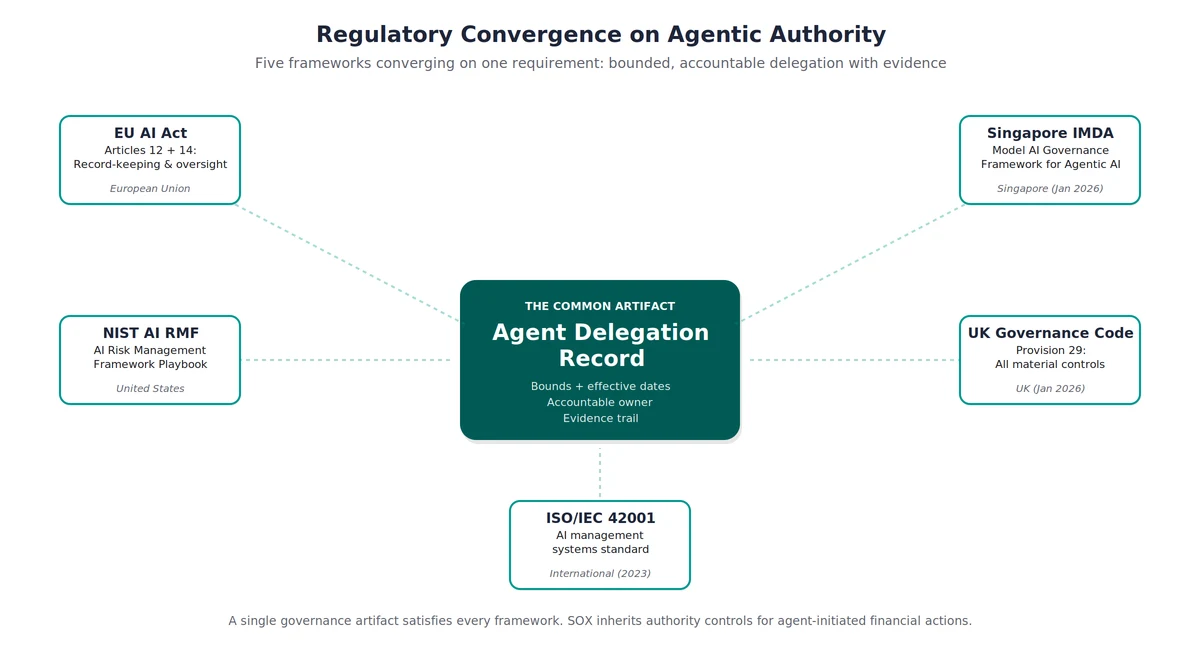
A: The regulatory landscape for agentic AI is still developing, but the direction of convergence is already clear. Multiple frameworks require or strongly imply the same underlying governance artifact: a delegation record with bounds, effective dates, accountability, and evidence. Organizations that build their agent governance on that foundation are positioned to satisfy multiple frameworks without duplicating work.
The EU AI Act's Article 14 (human oversight) and Article 12 (record-keeping) together require high-risk AI systems to operate under human oversight with documented records of their operation, which is essentially a delegation-and-evidence requirement. The Singapore IMDA Model AI Governance Framework for Agentic AI, published January 2026, formalizes the same principle. NIST's AI Risk Management Framework and the ISO/IEC 42001:2023 AI management system standard both treat delegation, oversight, and evidence as core control families.
SOX does not mention AI agents explicitly, but its requirements apply whenever an agent initiates a financial transaction that flows into the financial statements. If an agent approves a payable, records a journal entry, or moves funds, someone with delegated authority had to have granted the agent that permission. The agent action is subject to the same authorization controls and audit evidence expectations as a human action. The UK Corporate Governance Code's Provision 29, which took effect for financial years beginning January 2026, requires boards to declare the effectiveness of all material controls, covering operational and compliance controls in addition to financial reporting. Agent authority controls fall squarely within that expanded scope.
The practical takeaway is that an organization with a well-maintained agent delegation record, effective-dated limits, monitoring evidence, and documented human accountability has already done most of the work that these frameworks require. Organizations that treat agent governance as an IT concern rather than a formal governance discipline will find themselves rebuilding the same artifacts under multiple regulatory lenses.
Aptly is a system of record for delegated authority that treats AI agents as first-class actors, with the same versioned records, effective-dated limits, and audit evidence used for human delegations.
A: Aptly is purpose-built to be the authority layer for both human and non-human actors. In the context of agentic authority, that means three specific capabilities that directly address the governance gaps identified above.
First, Aptly maintains scoped delegations with effective dates, automatic expiry, and conditional limits that an agent runtime can query before taking an action. Second, every delegation binds to a specific machine identity and a specific accountable human, preserving the chain of accountability that auditors and regulators require. Third, every authority change is versioned with a clear audit trail, so reconstructing who had authority on any past date is a record lookup rather than an evidence-reconstruction exercise.
In enterprise terms, the distinction matters. GRC platforms audit whether an organization is compliant after the fact. Identity platforms govern whether an agent can access a system. Authority governance answers a different question at runtime: given this specific action at this specific threshold, is the agent currently authorized, and who is accountable. That runtime-authoritative record is the piece of infrastructure that the rest of the stack depends on. For the integration architecture that connects authority records to downstream systems, the guide on keeping delegations and signature authority in sync covers the operating model in more depth.
The most expensive governance failures in agentic AI deployments are patterns rather than one-off errors. Each of the mistakes below has appeared repeatedly in the early adoption wave.
Use this checklist to assess whether your current agent authority program meets the minimum bar.
No. IAM permissions define which systems an agent can access and which API operations it can call. Agentic authority defines which business decisions an agent is authorized to make within those systems, under what limits, and who is accountable. An agent can have legitimate IAM access to a procurement system and still lack the delegated authority to approve a specific commitment above a threshold. The two layers are complementary, not substitutes.
No, not in a meaningful sense. Accountability requires the capacity to answer for a decision, understand its consequences, and be subject to corrective action. An agent has none of these properties. The accountable party is always a human (or a governance body) that granted the authority, approved the bounds, and permitted the agent to operate. This is why every agent delegation record must name an accountable human owner.
The response follows the same pattern as an unauthorized human action. First, reverse or mitigate the action's business impact if possible. Second, review the delegation record to determine whether the action was genuinely outside the agent's authority or whether the authority was defined too broadly. Third, update the delegation, the monitoring rules, or both. Fourth, document the incident for audit evidence. The SailPoint 2025 research found that 80 percent of organizations with active AI agents have already experienced unintended agent actions, so the response pattern should be a standing process rather than an ad hoc reaction.
Cadence should track authority level. High-authority agents that can commit material spend, release payments, or modify master data should be recertified quarterly. Advisory-only agents that make recommendations for human approval can be recertified annually. Any agent involved in a material incident should be recertified immediately, regardless of where it sits in the standard calendar. The principle is that recertification is the mechanism that catches drift, so the cadence must be fast enough to catch drift before it compounds.
The EU AI Act does not use the term "delegation record" directly, but Article 14 (human oversight) and Article 12 (record-keeping) together effectively require the same artifacts: a documented accountability structure showing who oversees the AI system, and a durable record of the system's operation. For high-risk AI systems, which include many agentic applications in regulated domains, these are compliance requirements rather than best practices. Organizations that maintain proper delegation records are most of the way toward Article 12 and Article 14 compliance without additional artifacts.
Yes, with agent-specific extensions. Maintaining one integrated matrix eliminates the shadow-authority failure mode that emerges when agents are tracked in a lighter, parallel system. The extensions required for agents are the identity-binding field (which specific deployed agent instance holds the delegation), precondition fields (what must be true before the agent can act), and agent-specific evidence expectations (what the agent must log at decision time).
Agent identity governance answers "is this agent who it claims to be, and can it access this system?" Agent authority governance answers "given verified access, is this agent authorized to take this specific action at this threshold, and who is accountable?" The two layers map to different vendor categories (identity platforms versus authority platforms) and serve different governance functions, but both are required for an end-to-end agentic governance program.
Treat it like any other authorization audit: sample a transaction, identify the agent that took the action, query the delegation record that was in effect on the action date, and verify that the action fell within the delegation's scope and limits. The difference from a human authorization audit is volume: agents execute at much higher rates, so audit sampling methodology matters more. Automated testing of delegation-versus-action alignment is typically more practical than manual sample review for high-volume agents.
Connect with our team for a discovery session to learn more about how Aptly can help within your organization. If you are already a client and need support, contact us here.