The Positive Effects of Legally Compliant Delegation
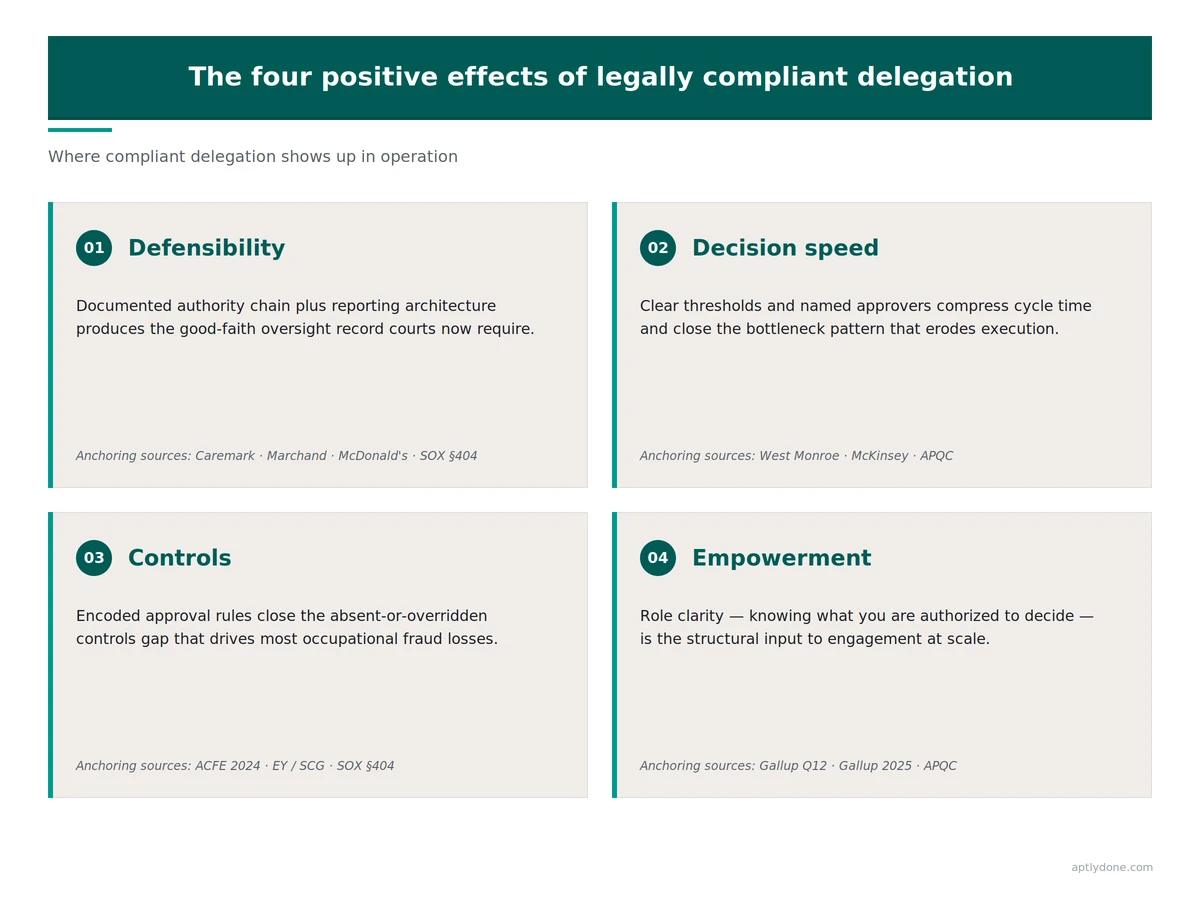
Most organizations have a delegation of authority policy. Far fewer have one that would survive a fiduciary challenge, an internal-controls audit, or a Friday-afternoon stress test on whether the right person is actually authorized to sign the deal in front of them. The difference is whether the delegation is legally compliant — grounded in corporate law, traceable to specific board action, and defensible on demand. When it is, four measurable effects show up in the business. This article walks through each one.
What “legally compliant delegation” actually means
Legally compliant delegation is decision authority that traces from corporate law and the entity’s governing documents through documented grants down to the people who exercise it — and back again, on demand.
Definition: Legally compliant delegation is the formal allocation of decision-making authority that flows from a corporation’s governing statute, charter, bylaws, and board resolutions down to the people authorized to bind the entity, in a form that can be located, interpreted, and audited at any moment.
The legal architecture is consistent across jurisdictions and unusually durable. In Delaware, where most US public companies are domiciled, Section 141(a) of the Delaware General Corporation Law provides that the corporation “shall be managed by or under the direction of a board of directors,” and Section 141(c) authorizes the board to delegate to committees that may exercise the full powers of the board subject to enumerated carve-outs. The Model Business Corporation Act — the basis of corporate law in roughly thirty-six US states — places the same management-and-oversight responsibility on the board at Section 8.01. The UK’s Companies Act 2006 sections 170–177 codifies directors’ general duties, and Chapter V of the G20/OECD Principles of Corporate Governance 2023 places responsibility for monitoring management and risk-management systems with the board. Across jurisdictions, the architecture is the same: authority resides with the board until and unless the board delegates it through a defensible chain.
That chain is the operational meaning of “legally compliant.” It runs from statute and charter, through board resolution, through bylaws and committee charters, through officer appointment, through management-level approval matrices, into the workflow systems where actual decisions get made. When any link in the chain is missing — when an approval limit in the matrix exceeds the limit set in a board resolution, when an officer signs in a capacity the bylaws don’t grant them, when a counterparty receives a signature from someone the company has not formally held out as authorized — the whole chain weakens. The recent line of Delaware decisions extending the Caremark duty of oversight from directors to officers makes this an issue with personal exposure attached, not merely an audit concern. For a deeper treatment of the legal foundation, see the difference between entity-level and management-level delegation and the delegation of authority foundation reference.
Across all four positive effects below, what makes the difference is not whether the organization has a policy on file — almost everyone does — but whether the policy can be traced, enforced, and produced as evidence on demand. The contrast between the two states is summarized in the table below.
Effect 1: Defensible oversight and reduced fiduciary liability
Compliant delegation produces the documented authority chain and reporting architecture that Caremark, Marchand, and McDonald’s now require — turning oversight from a hopeful posture into a defensible record.
The legal standard for oversight has tightened materially in the past several years. The Delaware Court of Chancery’s 1996 decision in In re Caremark International established that directors have a duty to make a good-faith effort to put in place an information-and-reporting system reasonable enough to allow them to monitor compliance and risk. That standard sat largely dormant for two decades. In 2019, the Delaware Supreme Court’s ruling in Marchand v. Barnhill, 212 A.3d 805 sharpened it: directors who fail to make even a “good faith effort” to monitor mission-critical risks face oversight liability, and the absence of an actual reporting system is enough to plead a Caremark claim past the motion-to-dismiss stage.
Then came In re McDonald’s Corp., 289 A.3d 343. In 2023, the Court of Chancery held for the first time that corporate officers — not just directors — owe a Caremark-style duty of oversight within their respective areas of responsibility. A CFO carries the duty over financial reporting; a CHRO over conduct and HR; the CEO over the entire enterprise. The legal architecture that began as a directors’ duty now reaches the entire C-suite.
What does compliant delegation produce that satisfies this standard? An authority chain that can be reconstructed at a point in time. A reporting and approval architecture that demonstrates the “good faith effort” courts now look for. And, for organizations subject to it, the internal-control evidence base that Sarbanes-Oxley Section 404 requires management to assess and auditors to attest to. None of this is achieved by a static policy in a SharePoint folder. It is achieved by a delegation system that produces evidence as a byproduct of normal operations.
Effect 2: Faster, more accountable decisions
When approval thresholds are mapped to named approvers and accessible at the moment of decision, cycle time compresses and the bottleneck pattern that erodes execution shrinks.
The cost of slow decisions is now well-quantified. West Monroe’s 2026 Speed Wins research found that 73% of C-suite leaders say cutting decision time in half would unlock at least 5% of revenue, with some respondents indicating gains above 25%. The same research found that 44% of managers have come to accept slowness as normal — the cultural fingerprint of an authority framework that has stopped being trusted as the source of truth.
The decision-quality cost is comparable. McKinsey’s research on organizational decision-making found that 72% of senior executives said bad strategic decisions were about as frequent as good ones, or were the prevailing norm in their organization — a pattern McKinsey traces back to clouded accountabilities as a primary driver. Compliant delegation is the structural counterweight: it makes accountability for any given decision unambiguous, locates the decision rights at the right organizational level, and routes around the manager who feels they shouldn’t be approving something but cannot find the rule that says who should.
The operational gains are measurable. APQC’s 2024 cross-industry research, drawn from 311 finance leaders, found that organizations rating their DOA framework as effective achieved a 49% reduction in approval bottlenecks and 67% better decision quality. Those numbers do not come from the policy document. They come from the policy being current, accurate, and embedded into the systems where work actually happens. For the practical mechanics, see how to build a delegation of authority matrix.
Effect 3: Lower fraud risk and tighter internal controls
Half of occupational fraud succeeds because controls are absent or overridden. Compliant delegation is the structural countermeasure to both failure modes.
The Association of Certified Fraud Examiners’ 2024 Report to the Nations, based on 1,921 cases across 138 countries, found that organizations lose an estimated 5% of annual revenue to occupational fraud, with a median loss of $145,000 per case. The single most important finding for delegation purposes: 51% of fraud schemes succeeded because internal controls were absent or were overridden. Both pathologies — absence and override — are exactly what a defensibly compliant delegation framework prevents.
Compliance and effectiveness are not the same thing, and the gap is wider than most organizations realize. EY’s 2025 governance study with the Society for Corporate Governance, surveying 222 governance professionals, found that almost 90% of organizations maintain a delegation of authority policy — yet 29% rate their DOA framework as less than effective. The policy on its own does not produce control. The chain that connects policy to matrix to workflow to evidence does.
For organizations within the Sarbanes-Oxley regime, the concrete connection runs through Section 404. Management’s annual assessment of internal control over financial reporting, and the auditor’s attestation that follows, both rest on whether the authorization controls operate as documented. Where the authority chain breaks — where a written approval limit and an enforced approval limit diverge — that is precisely the gap auditors flag and fraud schemes exploit.
Effect 4: Empowered teams and stronger engagement
Knowing what you are authorized to decide is the operational meaning of clarity at work — and clarity sits at the foundation of every engagement framework that matters.
The first item on Gallup’s Q12 employee engagement framework asks whether the employee knows what is expected of them at work. It is the foundational element across millions of survey responses and decades of validation work — the single most reliable predictor that a person will be engaged at all. Q1 is, in essence, a measure of role clarity. Whether a person knows what they are authorized to do, what they are accountable for, and where their decision-making boundaries lie, is the structural input that compliant delegation produces or fails to produce at scale.
The stakes are larger than most leaders treat them as. Gallup’s 2025 State of the Global Workplace report estimated that if the world’s workplace reached the engagement levels of best-practice organizations, an additional $9.6 trillion in productivity could be added to the global economy — the equivalent of 9% of global GDP. The headline number is striking, but the mechanism is mundane. People work better when they know what they can decide. Delegation that lives in policy but cannot be located in operation is, from the employee’s seat, the same as no delegation at all.
The internal-research picture lines up. APQC’s same finance-leader research found that organizations with effective DOA frameworks reported 62% productivity gains alongside the bottleneck reductions cited above. Compliance and clarity are not in tension. They are upstream of the same outcome. For the policy-design counterpart to this — how to draft a DOA policy people will actually follow — see the policy-design guide.
None of these effects are achieved by policy alone. The same EY study that found near-universal DOA-policy adoption found that only 14% of organizations use a dedicated IT system to manage authority. APQC’s research found an 11-percentage-point effectiveness gap between organizations using delegation-management technology and those still on manual processes. The market response is visible: Grand View Research projects the enterprise governance, risk, and compliance market to grow from $62.92 billion in 2024 to $134.86 billion by 2030, a 13.2% compound annual growth rate. The four effects above show up in operation only when the authority chain is enforced where work actually happens — in the systems people use, with the evidence trail produced as a byproduct.
Frequently asked questions
What makes delegation of authority “legally compliant”?
A delegation is legally compliant when the authority being exercised can be traced from a statutory or constitutional source — corporate statute, charter, bylaws, or board resolution — through a documented chain of grants, to the person actually exercising it, and back again on demand. Compliance is a property of the chain, not of the policy document.
Is a written delegation of authority policy legally required?
In most US jurisdictions, a written DOA policy is not specifically required by statute. What is required is that the corporation actually be managed by or under the direction of its board, and that authority exercised on its behalf trace to a defensible source. In practice, a written policy is the only reliable way to demonstrate that requirement is met. Some specific regulatory regimes — including the UK Corporate Governance Code’s Provision 29, effective for financial years beginning January 2026 — now require boards to formally declare on the effectiveness of material internal controls, which substantially raises the bar.
How does legally compliant delegation reduce executive liability?
Following the Delaware Court of Chancery’s 2023 decision in In re McDonald’s Corp., corporate officers — not just directors — owe a Caremark-style duty of oversight within their areas of responsibility. The defensive answer to that duty is the same as for directors: a documented information-and-reporting system reasonable enough to monitor risk in the officer’s domain. Legally compliant delegation produces exactly that record. Without it, both directors and officers are exposed to oversight liability claims that may survive a motion to dismiss.
What’s the difference between a delegation of authority policy and an authority management system?
A policy describes the rules. An authority management system enforces them. The policy says who can approve what under which conditions. The system tracks every grant of authority from issuance through acknowledgment to expiry, enforces approval routing in the workflow tools where decisions actually happen, retains version history with effective dates so historical questions can be answered without reconstruction, and produces audit evidence as a byproduct of normal operations. Most organizations have the first. Far fewer have the second — which is why the EY-and-Society research found near-universal policy adoption and only 14% IT-system adoption.
Sources
- Delaware General Corporation Law, Title 8, Chapter 1, Subchapter IV, §§141–142. delcode.delaware.gov
- American Bar Association, Model Business Corporation Act Resource Center. americanbar.org
- UK Companies Act 2006 (c. 46), §§170–177, Directors’ General Duties. legislation.gov.uk
- OECD, G20/OECD Principles of Corporate Governance 2023, Chapter V. oecd.org
- In re Caremark International Inc. Derivative Litigation, 698 A.2d 959 (Del. Ch. 1996). law.justia.com
- Marchand v. Barnhill, 212 A.3d 805 (Del. 2019). law.justia.com
- In re McDonald’s Corp. Stockholder Derivative Litigation, 289 A.3d 343 (Del. Ch. 2023). courts.delaware.gov
- Sarbanes-Oxley Act of 2002, Pub. L. 107-204, §404, codified at 15 U.S.C. §7262. govinfo.gov
- West Monroe, Speed Wins: Why Faster Decisions Unlock Revenue, 2026. westmonroe.com
- McKinsey & Company, Untangling Your Organization’s Decision Making, June 2017. mckinsey.com
- APQC, The CFO’s Guide to an Effective Delegation of Authority Policy, Kelley Pruetz, CFO.com, April 2025. cfo.com
- Association of Certified Fraud Examiners, Occupational Fraud 2024: A Report to the Nations. legacy.acfe.com
- EY and Society for Corporate Governance, The Delegation Edge: Why Boards Are Reassessing Delegation of Authority Policies, January 2025. ey.com
- Gallup, Q12 Employee Engagement Survey (methodology and Q12 framework reference). gallup.com
- Jim Harter and Ryan Pendell, Global Engagement Falls for the Second Time Since 2009, Gallup, April 2025 (summarizing State of the Global Workplace: 2025 Report). gallup.com
- Grand View Research, Enterprise Governance, Risk and Compliance Market Size, Share & Trends Analysis Report, February 2025. grandviewresearch.com