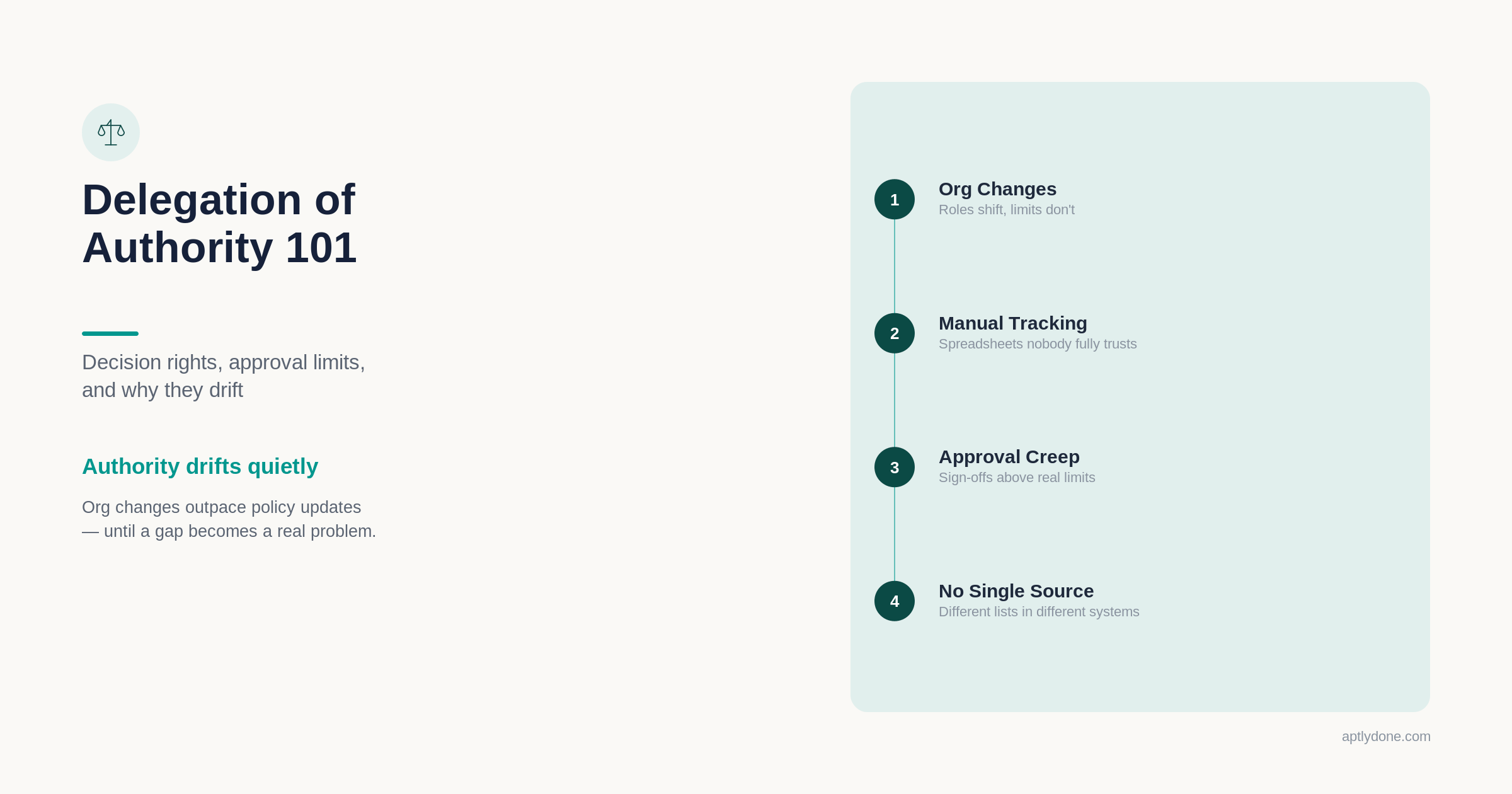
A practical primer on Delegation of Authority (DOA): what it is, where it lives, and the real-world signs your authority structure has drifted out of date.
Definition: Delegation of Authority (DOA) is the formal framework by which an organization assigns decision rights and approval limits to specific roles or individuals — defining who can approve, commit, and execute business actions, under what constraints, and with what evidence requirements.
Every organization delegates authority, deliberately or by default. The question is not whether you have a DOA framework — it's whether yours is explicit, current, and enforceable. A 2017 McKinsey survey found that 72 percent of senior executives said bad strategic decisions were about as frequent as good ones, or were the prevailing norm in their organization.[1] Much of that dysfunction traces back to unclear, outdated, or unenforced authority structures.
This guide covers what DOA actually encompasses, why authority frameworks drift even in mature organizations, the measurable business cost of that drift, and how to assess whether your own program needs attention.
DOA defines who can approve, commit, or execute business actions — spanning both financial thresholds and non-financial decisions across every organizational function.
DOA is not a finance artifact. It is your organization's permission system for high-impact actions, and it spans two core domains.
Financial authority covers spending approvals, purchase commitments, capital authorization, write-offs, credit and discount thresholds, payment releases, and investment decisions. These are the limits most organizations document first and most auditors examine most closely.
Non-financial authority covers hiring decisions, policy exceptions, contract term deviations, risk acceptance, access to sensitive systems and data, project scope changes, and regulatory submissions. These carry significant legal and operational exposure yet are far less consistently documented.
A January 2025 study by EY and the Society for Corporate Governance found that nearly 90 percent of companies have implemented a DOA policy, formal or informal.[2] The same research identified a persistent execution gap: 36 percent of respondents cited insufficient training about the policy and its usage as their top challenge.[3] Most organizations have a document. Few operate a functioning program.
The scale of investment in this problem reflects how central authority and control frameworks have become. The enterprise governance, risk, and compliance market reached $62.92 billion in 2024 and is projected to reach $134.96 billion by 2030, growing at 13.2 percent annually, according to Grand View Research.[4]
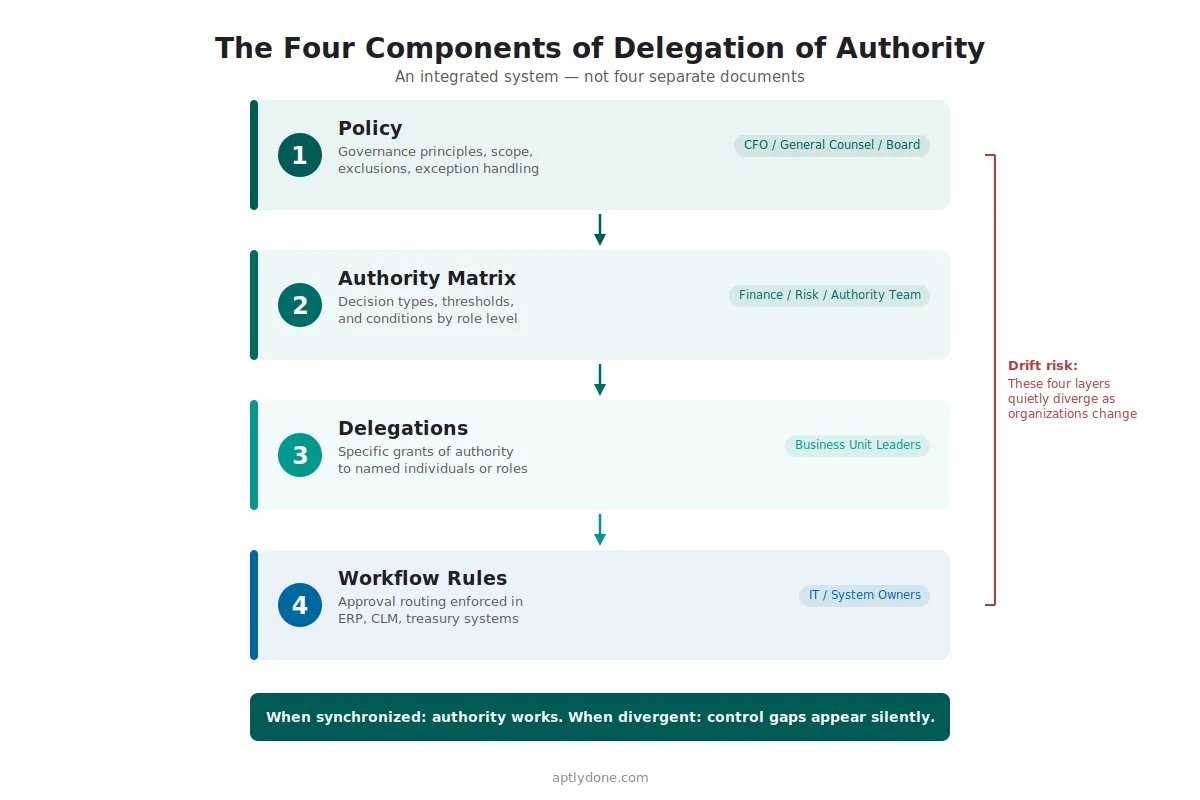
A functional DOA system has four interconnected parts — policy, authority matrix, individual delegations, and workflow rules — and breaks down silently when those parts drift out of sync.
Most organizations manage delegation through four components. When these stay synchronized, authority works. When they diverge — which is the default outcome in any organization experiencing growth, restructuring, or M&A — control gaps appear without visible warning signs.
The policy defines governance principles, scope, exclusions, and the exception-handling process. It typically runs 10 to 30 pages and is owned by the CFO, General Counsel, or a board committee. The authority matrix translates policy into specific decision types, approval thresholds, and conditions mapped to organizational role levels. Delegations are the individual grants — letters, system records, or manual entries — assigning specific authority to named individuals. And workflow rules enforce approval routing in the systems where actual work happens: ERP platforms, contract lifecycle management tools, expense management systems, and treasury platforms.
The most common failure mode is not the absence of a policy. It's that the policy, matrix, delegations, and workflow rules quietly become four different versions of the truth. Treating these as an integrated system — rather than separate documents owned by separate teams — is the single most impactful change most organizations can make. For a detailed breakdown of how to structure the matrix layer, see How to Build a Delegation of Authority Matrix.
Definition: An authority matrix is a structured table — organized by decision type, approval threshold, and organizational role level — that specifies the minimum approval authority required for each category of business decision. It is the operational core of a delegation of authority framework, translating policy principles into the specific approval rules that govern daily business activity.
Authority drift happens when organizational change — reorganizations, role transitions, new entities, and system workarounds — outpaces the governance updates that should follow.
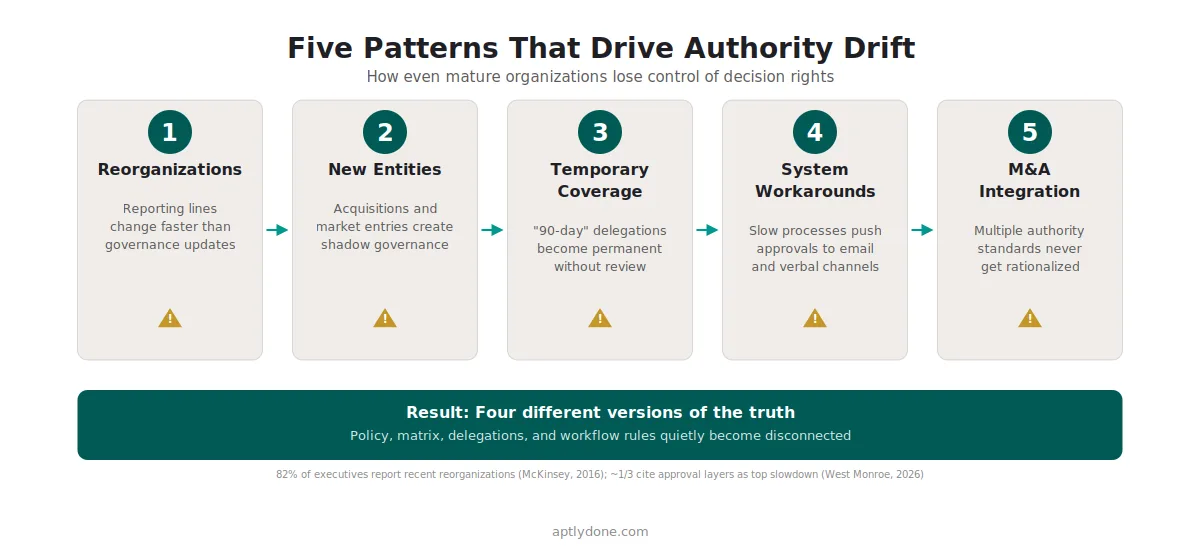
Authority drift is operational gravity. Organizations don't lose control through negligence — they lose it through the normal friction of continuous change. A 2016 McKinsey analysis found that 82 percent of executives reported experiencing a reorganization at their current company, and 70 percent said the most recent reorg occurred within the past two years.[5] Only 23 percent of those reorganizations met their objectives and improved performance — suggesting that governance systems, including authority frameworks, rarely keep pace with structural change.
Five patterns drive most authority drift in practice.
Reorganizations change reporting lines faster than governance catches up. When a VP role is eliminated and three directors now report directly to the CFO, the matrix still reflects the old structure for months. Approvals route to people without current formal authority, or stall because the approval chain is ambiguous.
New entities and bank accounts appear without being integrated into the authority model. Growth through acquisition or market entry creates shadow governance structures that operate outside the established framework — often indefinitely.
Temporary coverage becomes semi-permanent. "Just while we hire a replacement" becomes the default. Coverage intended to expire in 90 days continues without an enforced end date, creating phantom delegations that no one formally revoked.
System workarounds multiply when official processes are slow. West Monroe's 2026 Speed Wins research found that about one-third of executives and managers cite layers of management approvals as a key cause of decision delays.[6] When the legitimate path is slow, teams build parallel tracks: email approvals, verbal authorizations, and undocumented exceptions that bypass the matrix entirely.
M&A integration introduces multiple authority standards that never get rationalized. Two organizations with different approval thresholds, different matrix structures, and different enforcement systems continue operating in parallel long after the transaction closes.
Definition: Authority drift is the gradual divergence between an organization's documented delegation of authority framework and the actual decision rights exercised in practice. It occurs continuously as organizations change through restructuring, role changes, new entities, and system modifications, and is the primary mechanism by which internal control gaps develop in otherwise well-designed authority programs.
For a structured approach to managing authority through organizational change, see the Authority Change Management Playbook.
Authority drift creates measurable financial exposure through bottlenecked decisions, fraud losses, compliance failures, and contract delays — each with a documented price tag.
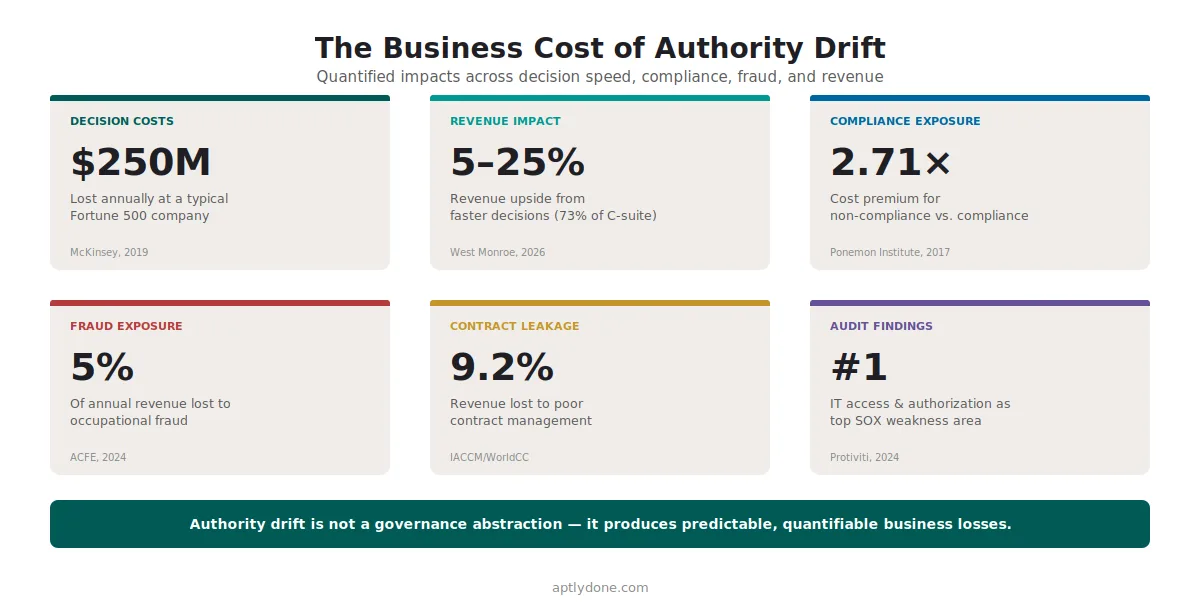
Authority drift is not a governance abstraction. It produces predictable, quantifiable business losses.
Decision costs. A 2019 McKinsey analysis estimated that ineffective decision-making could cost a typical Fortune 500 company more than 530,000 days of managers' time and roughly $250 million in wasted wages annually.[7] A related Bain and Company study published in Harvard Business Review found that one company's weekly executive committee meeting alone consumed more than 300,000 hours of organizational time each year across preparation and attendance.[8] That's not a strategy problem. It's an authority problem — decisions escalating to executives who shouldn't need to make them because the matrix is ambiguous or untrusted.
Revenue impact. West Monroe's 2026 Speed Wins research found that 73 percent of C-suite executives said cutting decision time in half would boost revenue by at least 5 percent. One-in-seven said the benefit would exceed 25 percent.[6] For a $2 billion company, that represents $100 million or more trapped in approval friction.
Compliance exposure. A 2017 Ponemon Institute study found that the average cost of non-compliance was $14.82 million annually, compared to $5.47 million for organizations that maintained effective compliance programs — a 2.7x premium for failing to control what your policy says you control.[9] Separately, Protiviti's 2024 SOX innovation research identified IT access controls and authorization deficiencies as the number one area where audit and finance executives encounter control weaknesses.[10]
Fraud exposure. The Association of Certified Fraud Examiners' 2024 Report to the Nations found that organizations lose an estimated 5 percent of annual revenue to occupational fraud. The median loss per case is $145,000. More than 50 percent of fraud cases occurred because of a lack of internal controls or management override of existing controls.[11] These are precisely the conditions created by authority drift.
Contract revenue leakage. International research across more than 700 organizations found that companies lose an estimated 9.2 percent of annual revenue due to poor contract management.[12] A significant portion traces to approval bottlenecks: contracts stall in queues, commitments get made by people without the formal authority to make them, and opportunity windows close before the right approver acts.
Regulatory pressure is increasing. The UK's revised Corporate Governance Code, effective for financial years beginning on or after January 1, 2026, introduced Provision 29 — requiring boards of premium-listed companies to formally declare the effectiveness of material internal controls at the balance sheet date and describe any controls that did not operate effectively during the period.[13] Organizations without a current, auditable DOA framework are directly exposed to this requirement.
Common warning signs include repeated escalations to a small set of senior executives, approval routing that contradicts your written policy, and audit questions that require manual reconstruction to answer.
Authority problems rarely announce themselves. They surface as operational friction before anyone recognizes the root cause.
Approvals consistently escalate to the same two or three executives — not because the issues warrant it, but because people don't trust the matrix or can't locate it. Procurement and finance enforce different approval limits than business units because each is working from a different version of the document. Auditors ask who had authority on a specific date six months ago and the answer requires a scramble through email threads and calendar records. Counterparties — banks, major vendors, regulated partners — hold signatory lists that were last updated before a predecessor left the organization. The vast majority of organizations still track authorized signatories using spreadsheets, Word documents, or SharePoint folders.
If any of these patterns feel familiar, the answer is rarely a new policy. It's a better operating model for authority — one that makes the current rules findable, enforces them in the systems people actually use, and flags drift before it becomes a control failure. For organizations with signatory-specific concerns, Authorized Signatory Lists Explained covers how to maintain accurate, auditable records at scale.
The most damaging mistakes are treating DOA as a document rather than a program, setting thresholds once without revisiting them, and relying on individual compliance instead of system enforcement.
Even organizations with well-written policies fall into the same predictable traps.
Treating DOA as a document rather than a program. A delegation of authority policy that sits in a SharePoint folder and is reviewed annually is a compliance artifact, not a functioning authority program. Effective DOA operates continuously — tracking issuance, managing changes, enforcing approval routing, and producing audit evidence without manual effort at every review cycle.
Setting thresholds once and never revisiting them. Authority limits calibrated for a $200 million company may be dangerously permissive at $2 billion and operationally strangling at $10 billion. Thresholds should reflect current risk exposure and business model, not organizational age. Regular benchmarking against similar organizations and against actual decision volume is essential. The DOA Policy guide covers how to build threshold logic that survives scale.
Conflating RACI with DOA. RACI frameworks clarify who is responsible, accountable, consulted, and informed for executing a process. DOA governs what financial and operational commitments each role can make. A project manager may be "accountable" in the RACI but have no DOA authority to approve the underlying budget. Treating these as equivalent creates gaps where accountability exists without authority, or authority exists without a clear owner. For a direct comparison, see DOA vs. Approval Matrix vs. RACI.
Leaving enforcement to individuals instead of systems. Manual compliance — where each approver is expected to remember the rules, check the matrix, and self-police — fails at scale and under time pressure. Authority is most reliably enforced when it's embedded in the systems where work happens: purchase orders routed by ERP approval limits, contracts locked by CLM workflow rules, payments released by treasury approval logic. For guidance on connecting authority frameworks to operational systems, see Embedding Authority Checks into Workflows.
Not designing for organizational change. Most DOA frameworks are built for a static organization. Deloitte's 2020 research on organizational decision-making found that companies with high organization design maturity — those that systematically maintain decision rights through change — achieved 23 percent greater revenue growth over three years and were three times more likely to develop market-disrupting products and services.[14] Building DOA for change means designing update triggers, not just update cycles.
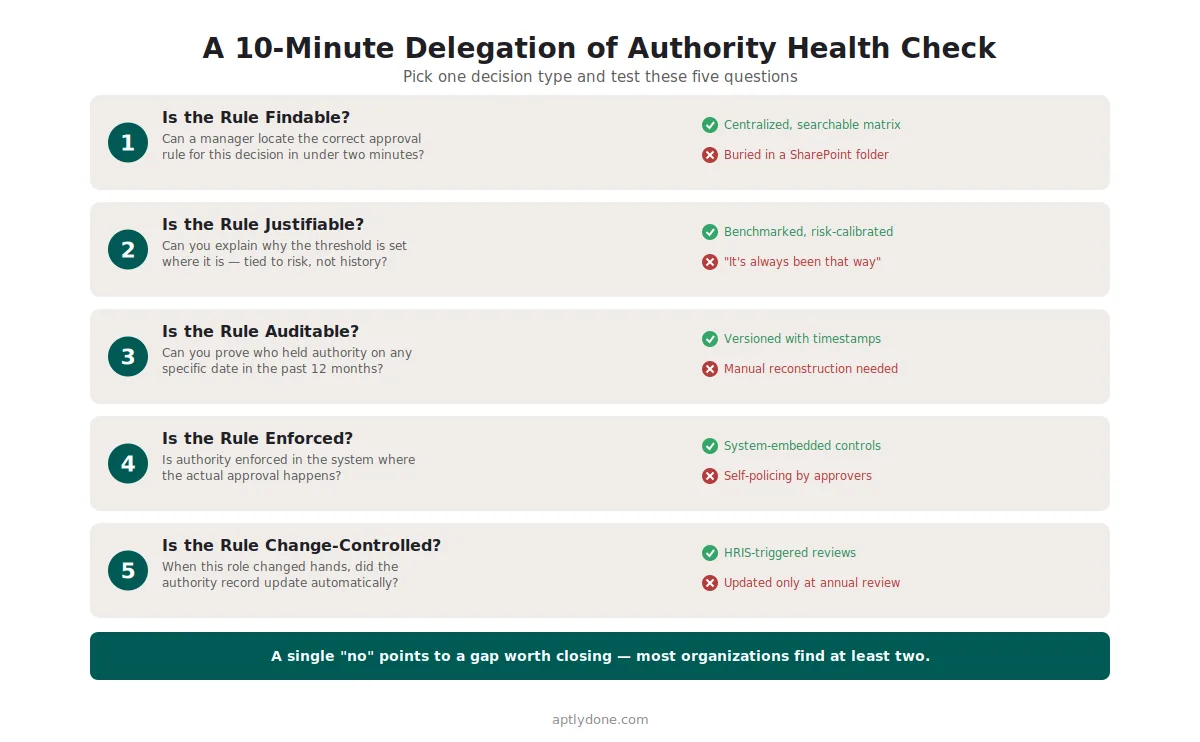
Pick one decision type and test five questions: Is the rule findable? Justifiable? Auditable? System-enforced? And change-controlled? A single "no" points to a gap worth closing.
Pick any common decision type — vendor contract approvals, capital expenditure requests, hiring offers — and test these five questions against your current framework.
A "no" on any of these is a normal finding in most organizations. The goal is to make the gaps visible and close them systematically. For a more structured assessment of alignment across policy, matrix, and system layers, see the Single Source of Truth for Authority guide.
AI agents operating in enterprise workflows need delegation of authority frameworks just as employees do — or they will execute commitments no human explicitly authorized.
Delegation of authority has always been a human problem. It's becoming a machine problem at a different order of magnitude.
Gartner predicts that by 2028, 90 percent of B2B buying decisions will be AI-agent intermediated, channeling more than $15 trillion through AI exchanges.[15] Organizations are already deploying AI agents to initiate purchases, approve invoices, manage supplier relationships, and execute contracts. Most of these agents operate without any formal authority framework — no defined approval limits, no audit trail, no escalation path for decisions that exceed established thresholds.
The governance principles behind DOA — clear authority limits, evidence of approval, defined escalation paths — apply directly to agentic workflows. The critical difference is execution velocity: AI agents can make thousands of decisions per hour, compressing drift and control-failure dynamics that typically unfold over months into days. For organizations actively exploring this space, Agentic Authority Management covers the governance requirements specific to AI-agent environments.
Definition: Agent authority refers to the defined scope of actions, commitments, and approvals that an AI agent is explicitly authorized to execute on behalf of an organization — including spending limits, transaction types, and escalation triggers when decisions exceed the agent's sanctioned authority boundaries. Agent authority frameworks apply the same structural logic as human delegation of authority programs but require automated enforcement mechanisms given the speed and volume of agent decision-making.
Aptly centralizes authority matrices, tracks delegation issuance and expiry, and maintains point-in-time audit records — without replacing your existing governance structure.
Aptly is designed to make authority operational in the real world — not to replace governance structures, but to make existing frameworks enforceable, auditable, and maintainable as organizations change.
Centralizing authority matrices in Aptly means teams can search decision rights in seconds instead of hunting through folders. Every matrix version is retained with timestamps, so you can reconstruct what the rules were on any specific date — including dates years ago during an audit investigation or litigation hold. Delegation issuance is tracked from creation through acknowledgment to expiry, with automatic notifications when temporary coverage lapses. Authority records integrate with HRIS systems, so role changes trigger delegation review rather than being missed entirely.
Organizations managing authority across multiple entities, jurisdictions, or regulatory frameworks will find the most immediate value — particularly where maintaining consistency between the policy layer, the matrix layer, and the operational delegation layer is complex. For a detailed look at how authority management connects to the evidence requirements of SOX and similar frameworks, see DOA and SOX/Internal Controls (Q&A).
Delegation of authority (DOA) is the formal system by which an organization assigns decision rights and approval limits to specific roles or individuals. It defines who can approve what — spending, hiring, contracts, policy exceptions — under what conditions, and what evidence is required to demonstrate that the right person approved the right action at the right time.
Most organizations benefit from a mixed cadence: event-based updates triggered by role changes, reorganizations, or new entity formations; monthly reconciliation of the most change-prone authority records; quarterly sample-based auditing to test matrix-to-system alignment; and an annual comprehensive policy and threshold review. Organizations subject to the UK Corporate Governance Code's Provision 29 will need to demonstrate material control effectiveness at each balance sheet date — making continuous maintenance rather than annual review the practical requirement.
Delegation of authority is an internal governance mechanism that defines decision rights within the organization — who can approve internal actions and external commitments on behalf of the company under established policy. Power of attorney is a legal instrument that grants one party the legal right to act on behalf of another in specific external dealings, typically required where legal enforceability is at stake. Organizations need both: DOA governs internal approval authority, while PoA governs external legal representation.
Effective programs separate policy ownership from operational ownership. The policy owner is typically the CFO, General Counsel, or a board committee. The matrix owner — responsible for the operational rules and their maintenance — typically sits in finance, risk, or a dedicated governance function. Process owners in business units validate that documented rules reflect operational reality. System owners ensure that approval workflows match the documented matrix. Single-owner models tend to break down because authority touches every function and every system in the organization.
RACI charts clarify who is responsible, accountable, consulted, and informed for executing a process. DOA governs what financial and operational commitments each role can make. A project manager may be "accountable" in the RACI but have no DOA authority to approve the underlying budget. Treating these as equivalent creates gaps where accountability exists without formal authority, or where authority exists without a clear accountability owner. For a detailed comparison across all three frameworks, see DOA vs. Approval Matrix vs. RACI.
Authority drift is the gradual divergence between documented decision rights and the actual authority people exercise in practice. It happens continuously as organizations change — through reorganizations, role changes, new entities, system workarounds, and temporary coverage that becomes permanent. Drift matters because it creates a measurable gap between what leadership believes is controlled and what is actually happening, exposing the organization to fraud risk, compliance failures, and audit findings it cannot defend against. The Avoiding Sync Drift article covers detection and remediation in depth.
The rules and their enforcement can be automated — and should be wherever practical. Purpose-built authority management platforms can centralize the matrix, automate delegation issuance and expiry tracking, integrate with HRIS and workflow systems, and generate audit-ready evidence without manual compilation at each review cycle. The governance decisions themselves — what thresholds to set, how to structure the matrix, who to delegate to — remain human judgments that require domain expertise and organizational context.
The most common triggers are: role changes (promotions, transfers, departures, interim coverage), organizational restructuring, new entity formations or acquisitions, material changes in business scale or risk profile, regulatory updates that affect approval requirements, and audit findings that reveal gaps between the documented matrix and practice. Effective programs build these triggers into operational processes — so authority reviews happen as a byproduct of HRIS updates and entity management workflows, not as separate manual efforts. The Authority Change Management Playbook covers the full trigger taxonomy.
SOX Section 404 requires management to assess and report on the effectiveness of internal controls over financial reporting. Authorization controls — who can initiate, approve, and record financial transactions — are among the most scrutinized elements of any SOX audit. Protiviti's 2024 SOX research identified IT access controls and authorization deficiencies as the number one source of control weaknesses identified during SOX compliance reviews. A current, auditable DOA framework is foundational to maintaining SOX compliance. For a detailed treatment of the connection, see DOA and SOX/Internal Controls (Q&A).
Definition: Sub-delegation is the act of a delegate passing some or all of their granted authority to another individual — typically at a lower organizational level. Primary delegation flows from the board or executive level to a named individual. Sub-delegation occurs when that individual grants a portion of their authority to a report or peer — for example, a CFO sub-delegating purchasing authority below $50,000 to a VP of Finance during an extended absence. Sub-delegation should always be documented, subject to the original grantor's explicit approval, capped at the limits of the primary delegation, and time-bound with a defined expiry date.
Sources
[1] McKinsey & Company. "Untangling your organization's decision making." June 2017. mckinsey.com
[2] Ernst & Young LLP and Society for Corporate Governance. "The delegation edge: A guide to successful delegation and authority." January 2025. ey.com
[3] EY. "Delegation of authority policies can be essential." January 2025. ey.com
[4] Grand View Research. "Enterprise Governance, Risk And Compliance Market Report, 2030." 2025. grandviewresearch.com
[5] McKinsey & Company via Harvard Business Review. "Getting Reorgs Right." November 2016. hbr.org
[6] West Monroe. "Speed Wins: Why Speed Matters." January 2026. westmonroe.com
[7] McKinsey & Company. "Decision making in the age of urgency." April 2019. mckinsey.com
[8] Michael Mankins, Chris Brahm, Gregory Caimi (Bain & Company). "Your Scarcest Resource." Harvard Business Review, May 2014. hbr.org
[9] Ponemon Institute and GlobalSCAPE. "The True Cost of Compliance with Data Protection Regulations." December 2017. globalscape.com
[10] Protiviti. "Empowering the Progress of SOX Innovation with Analytics and Automation." 2024. protiviti.com
[11] Association of Certified Fraud Examiners. "Occupational Fraud 2024: A Report to the Nations." 2024. acfe.com
[12] IACCM/WorldCC, cited via LawGeex. "Cost of Processing a Basic Contract Soars to $6,900." lawgeex.com
[13] Financial Reporting Council. "UK Corporate Governance Code 2024." January 2024. frc.org.uk
[14] Deloitte Insights. "Getting decision rights right." February 2020. deloitte.com
[15] Gartner. "Strategic Predictions for 2026." October 2025. Via Digital Commerce 360. digitalcommerce360.com
Connect with our team for a discovery session to learn more about how Aptly can help within your organization. If you are already a client and need support, contact us here.