Aptly is the system of record for delegation of authority (DOA), signatory management, and decision rights, for your people and your artificial intelligence (AI) agents. It sits between the systems that prove who you are and the systems where work happens, and answers the question neither one does: what are you authorized to decide?
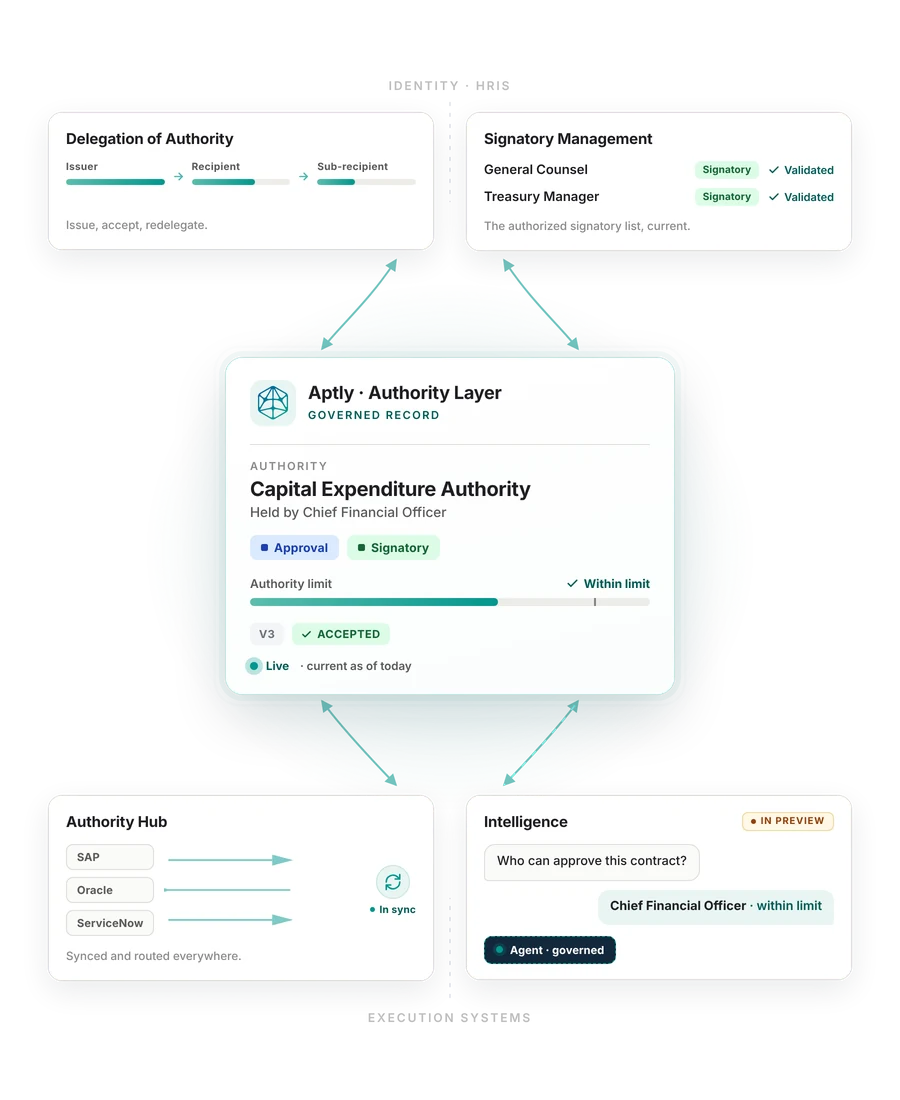
Identity systems answer who you are. Your business systems move the work. Neither one answers what each person or agent is authorized to decide. Aptly is the layer in between: Okta, Microsoft Entra ID, SailPoint, and Workday flow in from above; SAP, Oracle, NetSuite, ServiceNow, contract lifecycle management (CLM), and e-signature systems execute below. Aptly governs the decision rights that connect them, in one continuous, auditable record.
Every delegation, acceptance, redelegation, limit, condition, and authorized signatory lives in Aptly as a structured, versioned record. The shared backbone behind every product is the same: a continuous audit trail, full version history, and authority standards that apply to people and AI agents alike.
The Authority Layer is measured by what it removes: scattered records, manual reconstruction, stale permissions, and systems that disagree about who can decide. Four outcomes define the platform.
Coverage. Every authority in one place. Approval limits, signing authority, delegations, and agent permissions live in a single governed record instead of scattered spreadsheets and policy documents.
Auditability. Prove who held which authority on any date. Point-in-time recall replaces quarterly reconstruction with a continuous, audit-ready record.
Automation. Authority that keeps itself current. Personnel changes, expiring delegations, and acceptance tracking run on their own schedule, with notifications in place of manual follow-up.
Integration. In sync with the systems you already run. Bidirectional connections to your human resources information system (HRIS), identity provider, and enterprise resource planning (ERP) platform keep authority consistent everywhere work happens.
73%
In West Monroe's January 2026 Speed Wins survey of more than 1,200 leaders at United States companies with $250M+ in revenue, 73% of leaders estimate their organizations lose up to 5% of annual revenue to slow decision-making and delayed execution. Unclear decision rights and excessive approval layers are among the causes managers cite most.
Intelligence reads across everything the Authority Layer knows. Ask who can decide what in plain language, in the web application or in Microsoft Teams and Slack. Receive proactive guidance in email, contract-signing and contract lifecycle management (CLM) systems, and Chrome extensions, with analysis of documents and screen content. Detection analytics surface non-compliant transactions, segregation-of-duties (SoD) conflicts, overly centralized authority, bottlenecks, conflicting authorities, and DOA framework issues before they become audit findings.
The same standard applies to AI agents as to people. Aptly governs what an agent is authorized to decide, approve, sign, and commit, with the same delegation rules, conditions, and audit trail you apply to your teams. Identity systems ask who an agent is. Aptly answers what it may do. Human in the loop by design: review, override, and prove every authorized action.
82%
82% of organizations already use AI agents, but only 44% have policies in place to govern them. Identity vendors govern who an agent is. Aptly governs what it is authorized to decide.
In EY (Ernst & Young LLP) and the Society for Corporate Governance's survey of more than 200 Society members, fielded in September 2024, almost 90% of organizations reported having a DOA policy, formal or informal. The same survey shows where policies break down in practice: only 40% conduct regular training on policy updates, 35% cite difficulty tracking and enforcing the policy, and 49% lack a formal materiality policy. The control exists almost everywhere. The proof is what's scarce.
The General Counsel's team opens Aptly and recalls the authority record as of that date. What once took weeks of reconstruction is a single query. The stakes of weak enforcement are well documented: more than half of the 1,921 cases in the ACFE (Association of Certified Fraud Examiners) Occupational Fraud 2024: A Report to the Nations involved internal controls that were absent or overridden.
The Authority Layer holds one of the most sensitive records in the enterprise: who can decide what. The platform is built and operated accordingly.
Bring your DOA, your signatory lists, and your questions. We will show you the evidence in your environment. Already have a DOA matrix? Our team will migrate it to Aptly for a tailored preview at no cost.