Source-cited guide to preventing authority drift across HR, ERP, CLM, and banking systems with five controls and a risk-based reconciliation cadence.
Definition: Sync drift. The gradual divergence between authority rules defined in a governing system of record and the actual approval routing, signatory lists, and access controls enforced in operational systems, creating accumulating gaps between intended governance and actual enforcement that surface during audits, blocked transactions, or fraud investigations.
Definition: Canonical system of record. A single designated system that owns authority rules, delegation records, and effective-dated entitlements, with every other system consuming or validating against that source rather than maintaining independent logic. This is the architectural foundation required to make sync drift preventable rather than unavoidable.
Authority drift feels invisible until it becomes urgent: a blocked payment, a rejected bank instruction, a missed contract deadline, or an audit request you cannot answer cleanly. An employee is promoted, a workflow configuration is tweaked to unblock an urgent transaction, a new bank account is opened for a newly-formed subsidiary, and months later none of those changes have propagated into the authority matrix. The rules on paper and the rules in practice have silently diverged.
The scale is quantifiable. The EY/Society for Corporate Governance Delegation Edge study found that roughly 90 percent of companies maintain a delegation of authority policy, yet 36 percent identify training and enforcement as their single greatest challenge. West Monroe's 2026 Speed Wins research found that 44 percent of managers have accepted slow decision-making as normal, while 73 percent of C-Suite leaders believe halving decision cycle time would unlock at least five percent in additional revenue. Meanwhile the KPMG 2025 SOX Survey reports the average SOX program budget reached $2.3 million in FY24 (a 44 percent increase in two years), while only 17 percent of controls are automated (down from 21 percent) and the average number of in-scope systems more than doubled from 17 to 40. Organizations are responding to growing complexity with manual processes, which is exactly the condition in which sync drift accumulates fastest.
For the architectural foundation the controls below depend on, see Single Source of Truth for Authority. For the maintenance patterns that keep downstream approvals aligned, see Keeping Delegations and Signature Authority in Sync.
Sync drift shows up as mismatches between the authority matrix, versioned delegations, workflow routing rules, and signatory lists or bank entitlements, producing either unnecessary escalation when rules are stricter than intended or unauthorized execution when entitlements outlive the underlying delegation.
Four common patterns illustrate how this manifests. A VP promoted out of a cost center three months ago is still listed as the approver in the ERP workflow, forcing her replacement to send approvals for her signature. A bank signatory list includes a former treasurer who left two years ago, with no way for the bank to know the authority was revoked. A procurement threshold permits $250,000 transactions at a manager level, while the current matrix caps that role at $100,000. A recently-acquired subsidiary's authority records never got reconciled against the acquirer's matrix, so both systems are independently in use with no canonical view.
Each pattern produces the same artifact: an approval that cannot be defended when auditors, regulators, or counterparties ask for proof. McKinsey's research on organizational decision-making estimated that Fortune 500 companies waste approximately $250 million per year (about 530,000 working days) in management labor on ineffective decision processes, much of it traceable to stale authority configurations and the reconciliation cycles that follow drift discovery.
Drift is a systems problem, not a blame problem. It emerges from structural gaps between the cadences, owners, and integration contracts of the HR, operational, and governance systems that each hold partial views of authority, and it accumulates fastest in organizations that treat authority as a document rather than a data structure.
The table below catalogs the seven most common causes of drift, how each one originates, and the typical onset time from the triggering event to detectable mismatch.
| Drift Cause | Why It Happens | Impact | Typical Onset |
|---|---|---|---|
| HR-authority timing gap | HR updates happen daily; authority records update monthly or less often | Stale delegations for role changes, terminations, and transfers | Days to weeks |
| Local workflow fixes | ERP or procurement routing rules adjusted to unblock operations without updating the matrix | Workflow enforcement diverges from documented policy | Weeks to months |
| Permanent temporary coverage | Coverage delegations created without expiration dates or automated expiry | Authority accumulates beyond intended scope; approvers retain rights they should have lost | Weeks to years |
| Ungoverned new entities | New legal entities, bank accounts, or subsidiaries created during growth without authority model updates | Coverage gaps for new organizational structures; default-to-permissive access | Immediate |
| One-time integrations | Integrations built as project deliverables rather than living services with monitoring and SLAs | Data flows break silently over time; no one notices until audit or incident | Months to years |
| Post-M&A orphan delegations | Acquired entities carry pre-existing authority structures that never get reconciled to the acquirer's matrix | Dual governance regimes persist; audit exposure multiplies across both frameworks | Months |
| Manual cross-system updates | Authority changes propagated via email, spreadsheet export, or manual ticket rather than automated sync | Each manual step introduces delay and error; one missed update creates permanent divergence | Hours to days per change |
The common thread across all seven causes: authority rules are treated as a periodic compliance exercise rather than a continuously-governed data layer. The EY/SCG study's finding that only 54 percent of companies document authority through both a board memo and a formal matrix reflects a broader pattern in which the connection between policy, operational matrix, and enforcing systems is weak. When HR operates daily and authority review happens quarterly, the timing gap is the failure mode, not the exception.
Measurable drift begins within weeks of any significant organizational change, and in organizations with monthly or quarterly authority review cycles most structural changes produce detectable mismatches within 60 to 90 days absent event-driven automation.
Five quantitative signals surface drift before it becomes an audit finding: the percentage of delegations whose approver still matches current HRIS assignment; count of expired delegations still referenced in workflows; count of workflow thresholds that diverge from matrix thresholds; signatory list entries without matching delegations; and the average latency between HRIS role change and the corresponding authority update. Each has a risk-based target and moves fast in the wrong direction after any major organizational event. For the full KPI framework, see Authority Monitoring and Reporting Metrics.
The audit consequences are severe and accelerating. KPMG's analysis of SEC filings found that segregation-of-duties and control-design failures surged from 34 percent of material weakness disclosures in FY21 to 55 percent in FY23, making this the fastest-growing category of audit finding. Eight percent of public companies disclosed material weaknesses in FY24, with 31 percent of affected companies reporting weaknesses in multiple years. Disclosing companies face audit fee increases of approximately 150 percent and spend an estimated $7.8 million on average to remediate each weakness, much of it on evidence reconstruction that proactive reconciliation would prevent.
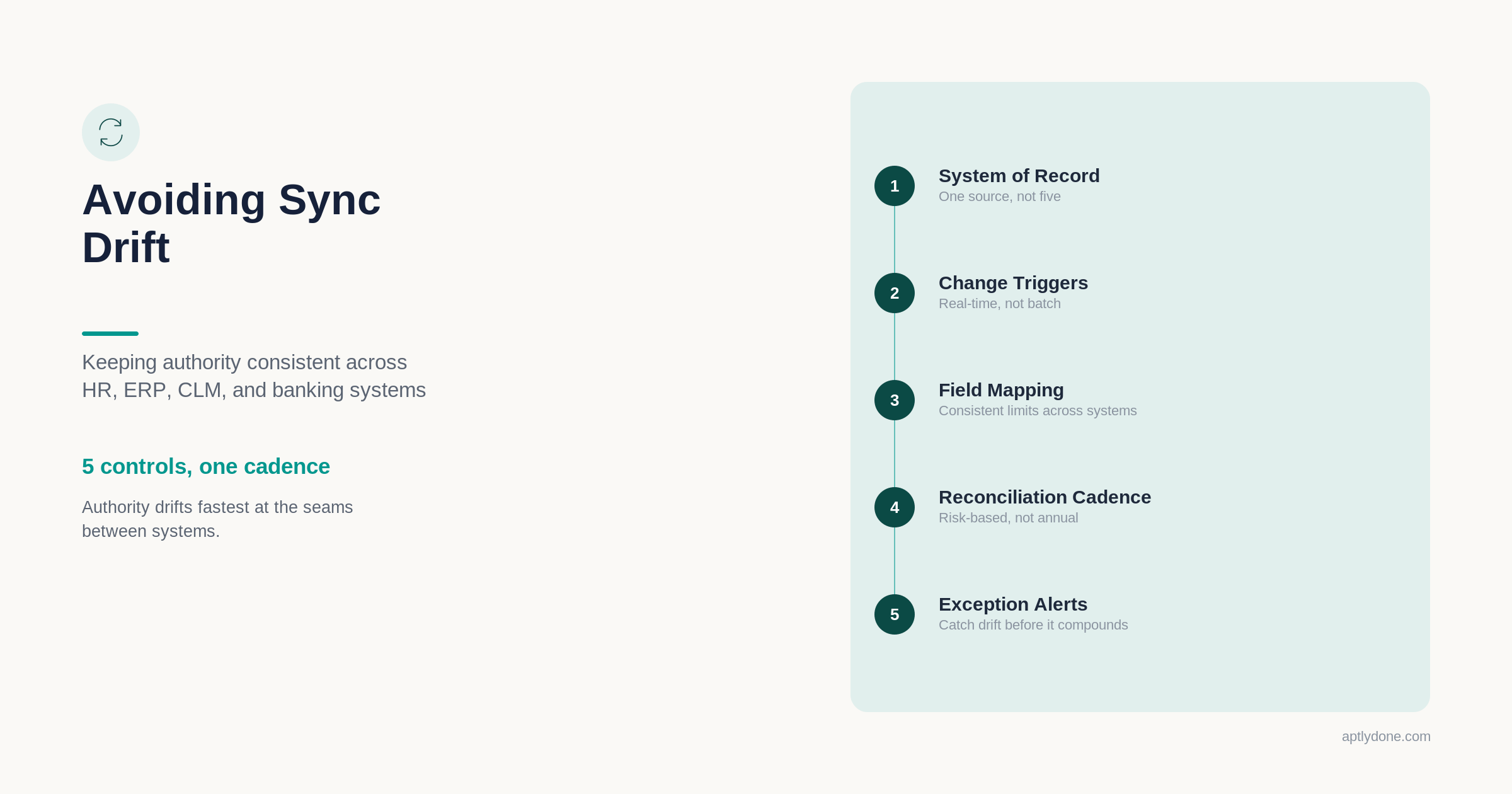
Five controls, applied together, keep sync drift at a manageable level: establishing a canonical system of record, enforcing effective dating and version history, creating event-driven updates from upstream systems, running scheduled reconciliations, and monitoring exception patterns continuously.
| Control | What It Prevents | Trigger Event | Owner |
|---|---|---|---|
| Canonical system of record | Multiple systems holding divergent versions of the same authority rules | One-time architectural decision at program launch | Authority program owner |
| Effective dating and version history | Inability to prove who held what authority on a past date | Every authority change (grant, modification, revocation) | System enforces automatically |
| Event-driven updates | Stale delegations after role changes, terminations, or entity changes | HRIS role change, termination, new entity, M&A cutover, new approval workflow | Integration layer |
| Scheduled reconciliation | Silent drift between authority matrix and enforcing system configurations | Monthly, quarterly, or annual cadence (risk-based; see next section) | Authority program + system owners |
| Exception reporting | Drift detected only during audits or incidents rather than at the time of occurrence | Every approval outside expected band, every signature without matching authority | Continuous monitoring system |
Decide where authority rules live and require every other system to reference that source rather than maintain independent approval logic. Without a canonical source, "reconciliation" becomes "pick one system as the winner each time" rather than "detect divergence from the known-correct state." For the integration contract that connects HRIS, ERP, and IAM to the authority system, see Single Source of Truth for Authority.
Every authority grant, modification, and revocation must carry a start date, an end date or auto-expiry interval, and a complete change history. Without effective dating, "what was true on March 12th" has no answer, and audit teams are forced into reconstruction from email chains. This is the structural foundation for as-of authority proof, the single most common gap in SOX internal controls audit evidence.
Certain events should automatically trigger authority review rather than wait for a calendar cycle: HRIS role changes and terminations, reorganizations, new legal entity creation, new bank account opening, M&A cutovers, and new approval workflows in downstream systems. Event-driven updates close the HR-authority timing gap that accounts for the majority of stale delegations. The authority change management playbook covers the end-to-end workflow that connects upstream events to downstream updates.
Even with integrations in place, run scheduled reconciliations on a cadence that matches the risk profile of each data flow. No integration is perfect; events are missed, schemas change, systems go offline, human overrides happen. Scheduled reconciliation catches what event-driven sync misses, and a monthly mismatch report is always better than "we will catch it in the annual audit." The specific cadence is covered in the next section.
Flag approvals executed outside the expected band, signatures executed without a matching approval record, and approvals by delegates whose authority has expired. Exception reporting creates the operational feedback loop that prevents small drifts from compounding into material weaknesses. For the full metric set, see Authority Monitoring and Reporting Metrics; for runtime patterns that catch exceptions at the moment of action, see Embedding Authority Checks into Workflows.
Our recommendation: If you have limited resources to implement these controls, start with the highest-risk reconciliation first: compare your payment approval authority in the authority matrix to the actual payment workflow routing rules in your ERP and banking systems. This single check often reveals the largest enforcement gaps because payment systems are updated frequently for operational reasons without corresponding authority model updates, and the financial exposure of a mismatch in this domain is disproportionately high.
A four-tier cadence aligned to risk: event-driven reconciliation for high-risk actions like payments and terminations, monthly reconciliation for operational drift between HRIS and authority records, quarterly reconciliation for workflow threshold alignment and high-risk signer recertification, and annual reconciliation for strategic matrix recalibration.
Over-reconciling low-risk data wastes compliance capacity; under-reconciling high-risk data produces audit exposure. The cadence must be explicit, owned, and calendared.
| Cadence | What to Reconcile | Risk Category | Typical Owner |
|---|---|---|---|
| Event-driven (real-time) | Terminations, role changes, new legal entities, payment authority, bank account changes | High risk; material financial or fiduciary exposure | Integration layer; HRIS and treasury |
| Monthly | HRIS role status vs. active delegations; expired or expiring delegations; signatory list entries without matching delegations | Moderate risk; operational drift | Authority program owner |
| Quarterly | ERP and procurement workflow thresholds vs. matrix; recertification of high-risk signers; exception volume review | Lower-frequency operational drift; audit-ready evidence | Finance, compliance, internal audit |
| Annual | Full authority matrix recalibration; threshold review against business risk tolerance; policy alignment to regulatory changes | Strategic alignment; board-level oversight | CFO, General Counsel, Audit Committee |
West Monroe's research found that each additional request for analysis adds an average of three weeks of delay, and ad hoc reconciliation triggers a new analysis cycle at every drift discovery. A standing cadence collapses that variable cost into a predictable operational rhythm. Protiviti's 2023 SOX Compliance Survey found that 58 percent of organizations reported increased compliance hours and 74 percent were actively seeking further automation, both impossible to achieve without a deterministic reconciliation cadence as the baseline.
Sync drift is the underlying mechanism behind the majority of segregation-of-duties and authorization-control material weakness findings, which now constitute the fastest-growing category of SOX control failure and the most expensive to remediate when discovered during an audit rather than prevented through continuous reconciliation.
The audit exposure follows a predictable pattern. An auditor samples a transaction, asks for the authority rule that permitted the approval, requests the delegation record showing the approver held that authority on the transaction date, and asks to reconcile the enforcement configuration with the documented matrix. All four artifacts must align. When sync drift is present, one or more is missing, stale, or inconsistent, which is exactly the condition KPMG's data flags as the leading cause of material weakness growth.
The broader reconstruction burden is substantial. The GAO's 2025 SOX study reported one audit committee member describing auditor hours ballooning from 3,000 in 2012 to 8,000 in 2024 with fees tripling, driven largely by the time required to reconstruct authorization evidence that should have been captured proactively. Proactive reconciliation reduces audit hours on the controls that remain.
AI agents that take action on behalf of the organization accumulate sync drift at machine speed rather than human speed, which means the same five controls apply but with cadences calibrated to the volume and velocity of agent-initiated decisions rather than to organizational change events.
Agent authority has the same properties as human authority (scope, limits, effective dates, accountable owner), but an agent can execute thousands of decisions in the time a human would make a handful. A drifted delegation produces disproportionate consequences: an agent with a stale $10,000 spend threshold that should have been reduced to $5,000 can commit the organization to thousands of out-of-policy transactions before quarterly reconciliation catches the gap. Event-driven updates, time-bound delegations by default, and real-time exception monitoring become non-optional. See Agentic Authority Management for the four-layer governance model (advisory, bounded, escalation, continuous monitoring) that extends these controls to AI agents.
Four weeks of focused work produces a measurable reduction in sync drift without requiring a platform overhaul: inventory the systems that enforce approvals in week one, designate a canonical authority source and publish the mapping in week two, implement basic reconciliation against HR status in week three, and add workflow validation or exception reporting to one high-risk process in week four.
This plan does not eliminate drift; it establishes the operating discipline required to manage it. Each subsequent month adds another high-risk process to the reconciliation scope and another automated integration to the event-driven update layer. Within a quarter, most organizations can move from "drift discovered during audits" to "drift managed continuously and reported monthly", which is the inflection point at which the program becomes self-reinforcing.
Aptly is purpose-built as the canonical authority system of record the five controls above depend on, with native support for effective dating, version history, event-driven updates, scheduled reconciliation, and continuous exception monitoring for both human and AI-agent delegations.
The platform maps directly to the controls above. Authority rules and delegations live in one canonical system with versioned history and effective dating, so as-of authority proof is a record lookup rather than a reconstruction exercise. Integrations with HRIS, ERP, procurement, CLM, and treasury systems provide the event-driven update layer. Built-in reconciliation reports surface mismatches on the cadence appropriate to each data flow, and continuous exception monitoring flags approvals outside the expected band at the moment they happen rather than during the next audit.
Aptly is not a replacement for ERP, IAM, or GRC systems. It sits between them as the canonical source for who can approve and execute what, reducing the manual reconciliation work that typically causes drift. For the foundational governance model, see Delegation of Authority 101; for the integration architecture, see Single Source of Truth for Authority.
The governance failures below appear repeatedly in authority programs that attempt drift remediation. Each one is predictable once the underlying architectural principles are clear.
Measurable drift begins within weeks of any significant organizational change (reorganization, M&A, rapid hiring, new entity creation). Without event-driven updates, most organizations have detectable mismatches within 60 to 90 days. High-velocity functions like procurement and treasury accumulate drift faster because operational configuration changes happen continuously.
The HR-authority timing gap. People change roles, get promoted, transfer, or leave far more frequently than authority records are updated. This single pattern accounts for the majority of stale delegations and is the highest-priority integration to automate, an HRIS-to-authority event-driven connection typically eliminates 70 to 80 percent of drift volume.
Practically, no. Some divergence is inherent: integrations aren't instantaneous, not every business event maps cleanly to an authority change, and human overrides are legitimate governance. The realistic goal is to detect drift quickly, keep the divergence window short, and ensure high-risk actions have real-time validation. Zero drift is the wrong target; bounded, observable drift is the right one.
Five core metrics: delegations whose approver matches current HRIS assignment; count of expired delegations still referenced in workflows; workflow thresholds that diverge from matrix thresholds; signatory list entries without matching delegations; and the average latency between HRIS role change and authority update. The full KPI framework is covered in Authority Monitoring and Reporting Metrics.
An event-driven update is real-time or near-real-time propagation from an upstream system, triggered by a specific business event rather than a calendar schedule. When HRIS records a termination, an event fires that flags that person's delegations for immediate review or automatic revocation. When Finance creates a new legal entity, an event triggers an authority model review. When a new bank account is opened, an event triggers a signatory list update. Events must be instrumented at the source and consumed reliably by the authority system, which is why the integration layer is a first-class part of the architecture.
Sync drift directly undermines SoD enforcement. An SoD control says "the person who creates a purchase order cannot approve payment for it," but enforcement depends on the authority system knowing which role each person currently holds. If a role change has not propagated, a person can be promoted into a role that creates an SoD conflict without the system detecting it. KPMG's finding that SoD failures are now the fastest-growing material weakness category is directly connected to drift as the underlying mechanism. Effective SoD controls require event-driven authority updates as a precondition.
Next: For the architectural pattern that makes sync drift preventable, see Single Source of Truth for Authority. For the dashboard and KPI framework that surfaces drift signals continuously, see Authority Monitoring and Reporting Metrics.
Connect with our team for a discovery session to learn more about how Aptly can help within your organization. If you are already a client and need support, contact us here.