Delegation of Authority for CFOs: A Strategic Guide to Decision-Making and Risk Management
For CFOs navigating the pressures of fast-moving organizations, one governance tool consistently separates high-performing finance functions from reactive ones: a structured delegation of authority (DOA) framework. Companies that get decision rights right move faster, reduce financial risk, and build the compliance infrastructure that regulators and boards increasingly expect.
According to Deloitte's research on organizational decision-making, companies that streamline decision rights and clearly delineate authority are 1.3× more likely to meet their financial targets. That single data point captures what CFOs already sense: clarity of authority isn't just good governance. It's a financial performance driver.
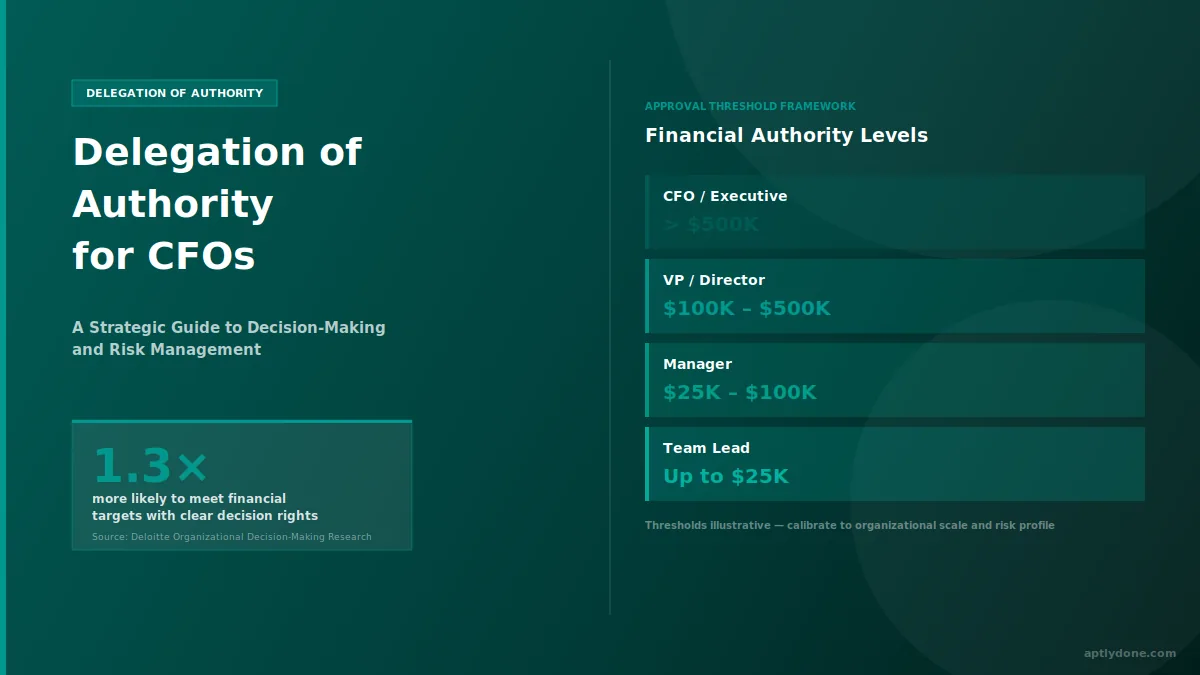
What delegation of authority means for the CFO function
A delegation of authority framework is a governance structure that defines who is authorized to approve what, at what financial threshold, and under what conditions, giving CFOs a systematic way to extend decision-making capability without losing control.
DOA is more than a list of approval limits. It's the infrastructure that makes organizational agility possible. Without it, decisions escalate unnecessarily, approvals stall at bottlenecks, and informal workarounds quietly replace formal controls. For CFOs overseeing financial risk, compliance, and resource allocation, the absence of a structured DOA framework is itself a risk exposure.
Research from APQC, summarized in The CFO's Guide to an Effective Delegation of Authority Policy, found that 67% of organizations report better decision-making after adopting a formal DOA policy, and 49% say a structured framework reduced approval bottlenecks across the business. Those are operational numbers, but they read as financial ones for any CFO trying to convert governance investment into measurable performance.
A well-designed DOA framework does three things simultaneously: it enables speed (teams act within defined limits without waiting for executive approval), it manages risk (financial and operational controls are embedded in the approval structure), and it creates the audit trail that compliance functions require. For a deeper look at how these elements fit together, see Aptly's guide to Delegation of Authority 101.
The business case: decision-making speed as a financial metric
CFOs are familiar with measuring cycle times in supply chains and operations. Fewer apply the same rigor to decision-making speed, even though the financial stakes are comparable. Organizations with slow or unclear approval processes lose measurable revenue to delayed projects, missed market windows, and deferred capital deployment.
Where decision-making delay shows up financially
Harvard Business Review research on strategic delegation shows that organizations with clearly defined decision-making boundaries consistently outperform peers on execution metrics. The bottleneck isn't usually talent or resources. It's ambiguity about who has authority to move.
West Monroe's 2026 Speed Wins research quantifies the upside potential: 73% of C-suite leaders say cutting decision-making time in half would unlock between 5% and 25% in additional annual revenue. That is revenue currently locked behind approval queues, escalation chains, and ambiguity about who can sign off.
The cost of decision drag is large enough to model at the enterprise level. McKinsey's research on decision-making in the age of urgency estimates that ineffective decision-making at a typical Fortune 500 company consumes more than 530,000 days of managers' time annually, equivalent to roughly $250 million in lost productivity per year. For CFOs, that is a real budget line being absorbed by structural ambiguity.
A practical example: a global manufacturing company implementing structured financial thresholds across its procurement and contract functions reduced approval cycle times by 30%, enabling faster project initiation and more responsive vendor management. The DOA framework didn't eliminate oversight; it moved oversight to the right level, freeing executive capacity for genuinely strategic decisions.
DOA and regulatory compliance: what CFOs need to know
Regulatory frameworks increasingly treat delegation of authority as a compliance requirement, not just an operational preference. Two frameworks are particularly relevant for CFOs of public and mid-market companies.
Sarbanes-Oxley: where DOA evidence becomes a control
Sarbanes-Oxley (SOX) mandates documented, enforceable internal controls over financial reporting. A well-maintained DOA policy provides much of that documentation structure: mapping who approved what, when, and under what authority. Without a DOA framework, organizations are typically reconstructing authority evidence reactively during audits, which is costly and unreliable. For context on how DOA maps to SOX requirements, see the Sarbanes-Oxley Act explained and Aptly's resource on DOA and SOX/Internal Controls.
The financial stakes of weak controls are not abstract. The Association of Certified Fraud Examiners' 2024 Report to the Nations found that 51% of occupational fraud cases trace to either a lack of internal controls (32%) or override of existing controls (19%). When fraud is committed by owners or executives, exactly the level where DOA-defined approval authority operates, the median loss reaches $500,000, roughly seven times the median loss for fraud committed by ordinary employees. A functioning DOA framework is what makes the difference between a control on paper and a control that actually catches the override.
COSO: authority matrices as foundational control evidence
The COSO Internal Control framework explicitly emphasizes that control activities must include authorization policies linked to accountability structures. The COSO Internal Control guidance treats authority matrices as foundational control evidence: the kind regulators and auditors look for first when assessing an organization's control environment. For CFOs, an unstructured DOA process creates a compounding risk: not just the operational cost of slow decisions, but the compliance exposure from gaps in documented authorization evidence.
Where most DOA frameworks break down
The majority of organizations have some form of DOA policy. A 2025 EY and Society for Corporate Governance study found that almost 90% of public companies maintain a DOA policy (79% formal, 11% informal), but only 14% operate it through a dedicated IT system. The common failure isn't absence; it's implementation drift. Frameworks become disconnected from the organization, thresholds become stale, and the matrix lives in a shared drive that employees can't find. For CFOs, this creates a false sense of control coverage.
Three patterns that drive DOA breakdown
- Stale thresholds. Approval limits set during a previous scale of operations become disconnected from current revenue, headcount, and risk profile, but the matrix continues to govern as if nothing changed.
- Inaccessible documentation. The matrix lives in a shared drive or document management system that employees can't find at the moment of decision. EY's research found that 35% of organizations cite difficulty tracking who has what authority, and 28% cite time-consuming updates as the top frustrations with their current approach.
- No enforcement at the point of approval. The framework exists on paper, but actual approvals happen in email threads, ticketing systems, and contract workflows that don't reference it. Without enforcement at the moment of decision, the matrix becomes a compliance artifact rather than an operating control.
For a structured look at building a DOA policy that teams actually use, see Aptly's guide to writing a delegation of authority policy people will follow.
A five-step framework for CFOs implementing or refreshing DOA
Whether building a DOA framework from scratch or restructuring one that's grown outdated, CFOs benefit from a structured implementation sequence that connects policy design to operational reality.
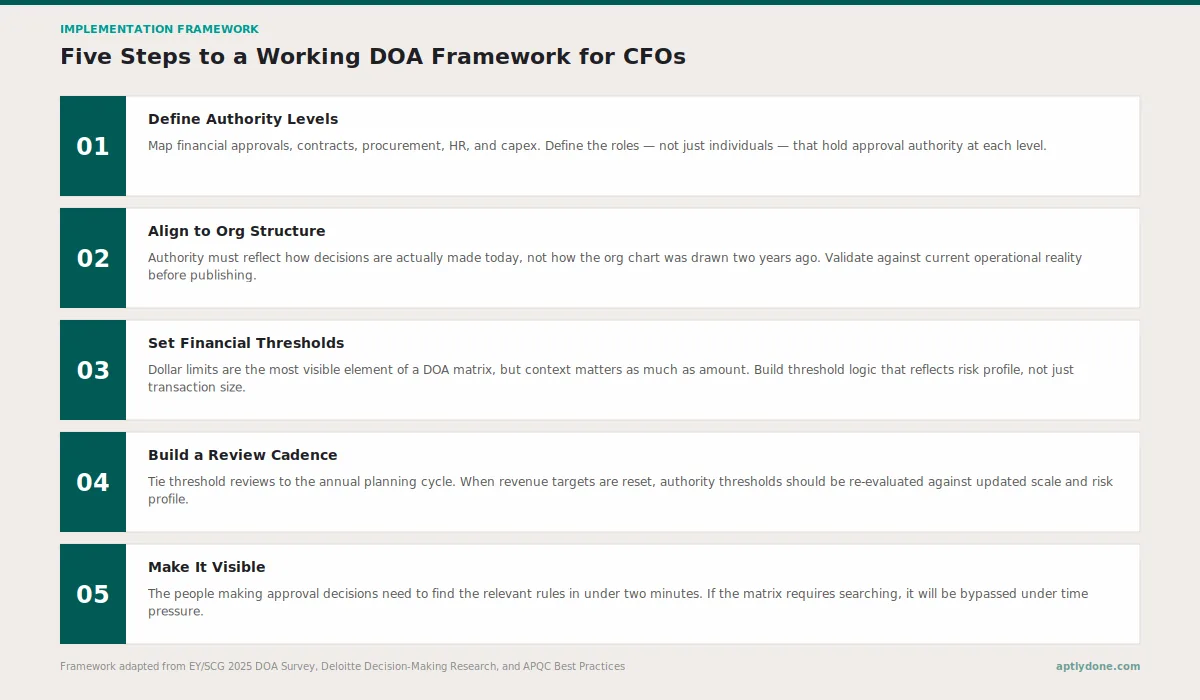
Step 01: Define authority levels. Map the decisions that need governance: financial approvals, contract commitments, procurement thresholds, HR actions, capital expenditures. For each category, define the organizational levels that should hold approval authority and under what conditions escalation is required.
Step 02: Align to organizational structure. Authority levels must reflect how the organization actually makes decisions, not how the org chart was drawn two years ago. Identify the roles (not just the individuals) that carry authority in practice, and validate alignment with current operational reality.
Step 03: Set financial thresholds with context. Dollar limits are the most visible element of a DOA matrix, but context matters as much as amount. A $500K contract renewal with a 10-year vendor carries different risk than a $500K new vendor commitment. Build threshold logic that reflects risk, not just size. For a detailed guide, see how to build a delegation of authority matrix.
Step 04: Build a review cadence. A DOA framework without a review cycle is a governance artifact in decay. Tie reviews to the annual planning cycle: when organizational structure and financial targets are reset, authority thresholds should be evaluated against updated scale and risk profile.
Step 05: Make it visible and accessible. The people making approval decisions need to find the relevant rules in under two minutes. If the matrix requires executive navigation, it won't be used consistently. Modern DOA platforms surface the right rules in context, at the point of decision, not after a spreadsheet search.
How Aptly supports modern DOA management
Spreadsheets and static documents were the DOA infrastructure of a previous era. They work for organizations that make a small number of high-value decisions in stable structures. For organizations managing hundreds of delegations across complex hierarchies, geographies, and regulatory environments, static tools create the visibility gaps and maintenance debt that become audit and compliance exposure.
Aptly is purpose-built as the authority layer for enterprise organizations: the system of record that sits between identity management and business operations, answering the question those systems don't: what is this person authorized to decide?
Where spreadsheet-based DOA management requires manual threshold updates, reconciliation across multiple documents, and offline processes to validate current authority, Aptly maintains a live, auditable authority record. Delegations cascade through the organization automatically. Threshold changes propagate in real time. Audit evidence is generated continuously, not reconstructed before a review.
For CFOs specifically, Aptly provides the real-time visibility into decision authority that financial risk management requires, without the administrative overhead that makes traditional DOA frameworks difficult to sustain. See how organizations are using Aptly to replace spreadsheet-based delegation management on the Delegation of Authority platform page.
The CFO's strategic case for investing in authority infrastructure
DOA frameworks have historically been treated as compliance infrastructure: something to have, not something to invest in. That framing undervalues the operational returns. Organizations with clear, enforced, accessible authority frameworks make decisions faster, onboard new leaders more efficiently, navigate M&A integration with fewer control failures, and present cleaner governance narratives to auditors and boards.
For CFOs managing organizations where decision speed, financial control, and compliance credibility all matter, delegation of authority isn't administrative overhead. It's competitive infrastructure.
The question isn't whether to have a DOA framework. Most organizations already do. The question is whether it's working: whether the people who need to use it can find it, whether the thresholds reflect current risk, and whether the audit trail it generates would hold up under scrutiny. If the answer to any of those is uncertain, the framework isn't functioning as governance. It's functioning as documentation.
Aptly makes modern delegation of authority seamless: live authority records, automated cascades, and built-in audit evidence for the decisions that matter most. Talk to the Aptly team to see how it works in practice.
Sources
- Deloitte. "Getting Organizational Decision Making Right." deloitte.com
- APQC, via CFO.com. "The CFO's Guide to an Effective Delegation of Authority Policy." 2025. cfo.com
- Harvard Business Review. "Research: How to Delegate Decision-Making Strategically." 2024. hbr.org
- West Monroe. "Speed Wins." 2026. westmonroe.com
- McKinsey & Company. "Decision Making in the Age of Urgency." 2019. mckinsey.com
- Association of Certified Fraud Examiners. "Occupational Fraud 2024: A Report to the Nations." acfe.com
- CSO Online. "The Sarbanes-Oxley Act Explained." csoonline.com
- COSO. "Internal Control Guidance." coso.org
- EY / Society for Corporate Governance. "The Delegation Edge: A Guide to Successful Delegation and Authority." January 2025. ey.com