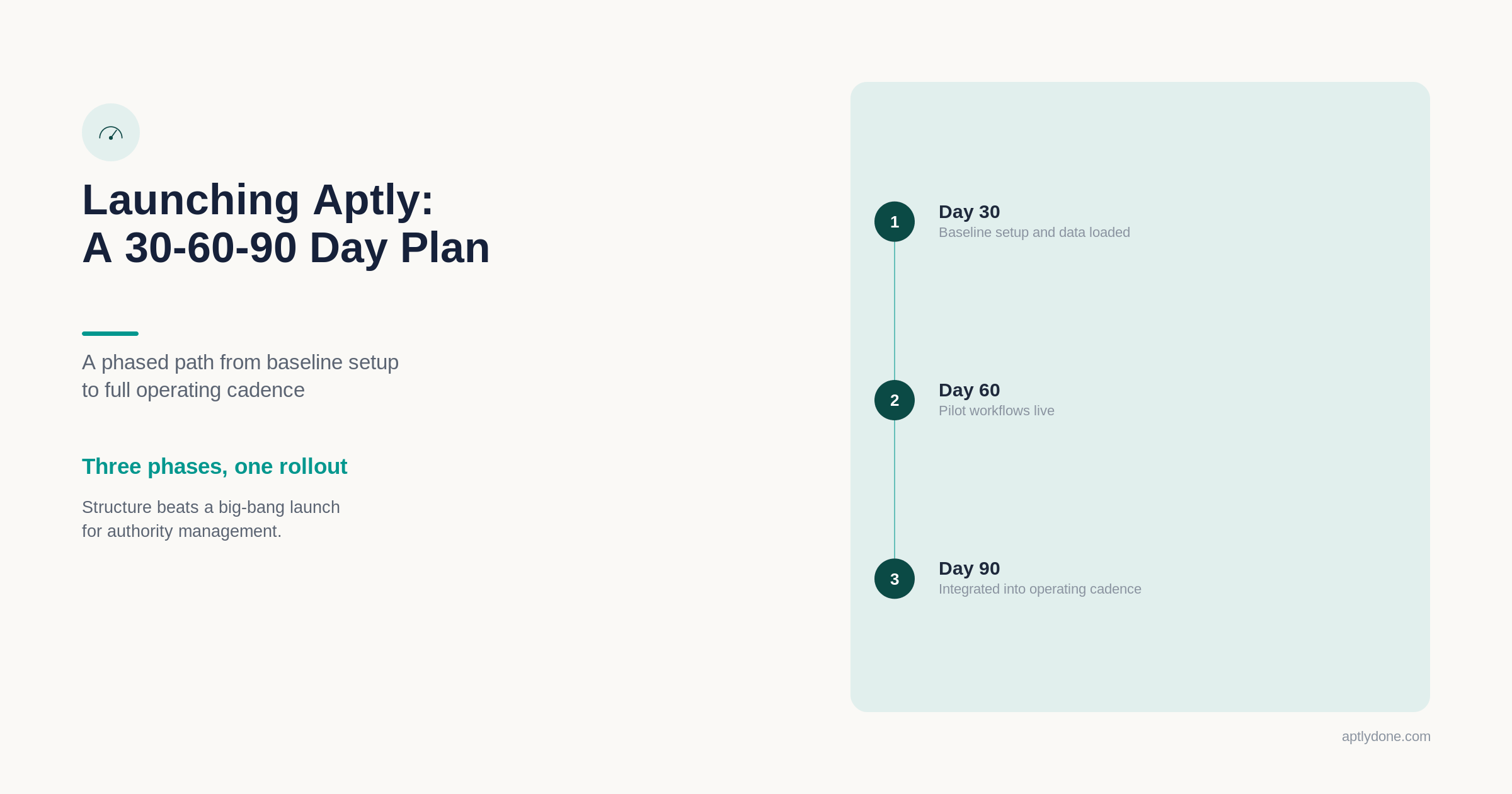
A phased implementation plan for rolling out Aptly: baseline setup in 30 days, pilot workflows in 60, and integration with operating cadence by 90.
Definition: A 30-60-90 day authority management implementation plan is a phased rollout that moves an organization from scattered authority artifacts (spreadsheets, PDFs, email approvals) to a governed, searchable, enforceable system. Aptly's plan layers five white-glove onboarding phases onto those familiar timing buckets, with three client approval gates and a dedicated implementation manager guiding every step.
Authority management improvements stall when they're treated as big governance. The fastest implementations start small, get real usage, and then expand. EY and the Society for Corporate Governance found that almost 90 percent of companies have implemented a DOA policy, but only 14 percent have it embedded in an IT system. The other 86 percent rely on intranet pages, shared drives, and document management systems that are not designed for live decision-making. West Monroe's 2026 research quantifies the cost of that gap: 73 percent of C-suite executives believe cutting decision time in half would unlock 5 to 25 percent of revenue as upside. The 30-60-90 plan is how Aptly closes the gap quickly, without a year-long governance project.
This article walks through what happens during each of those phases, what Aptly does, what your team owns, and what daily life looks like once you are live.
A typical Aptly rollout takes 60 to 90 days across five white-glove onboarding phases mapped onto familiar 30, 60, and 90-day timing buckets, with three client approval gates and a dedicated implementation manager.
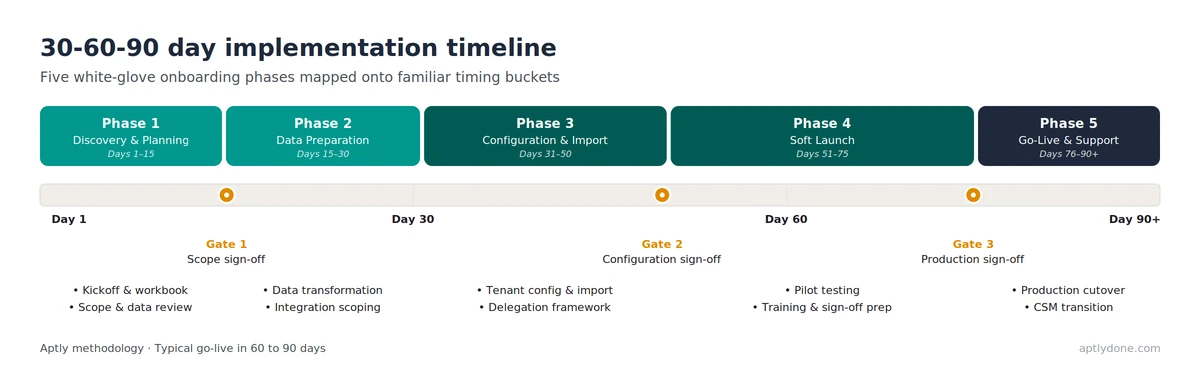
Aptly's white-glove onboarding is structured for rapid time-to-value without surrendering client control. A dedicated implementation manager hosts every working session, three approval gates (after Discovery, after Configuration, and before Go-Live) ensure your team signs off before each next step, and the pace flexes around your organization's review cycles. The five phases below are the standard sequence; the days within each bucket are illustrative ranges that compress or expand depending on the complexity of your authority data and the integrations in scope.
The table below summarizes who does what and when:
In the first 30 days, Aptly hosts kickoff, provisions sandbox and production tenants, and transforms your authority data while your team approves scope, completes the onboarding workbook, and aligns integration touchpoints.
The first 30 days cover Phase 1 (Discovery and Planning) and Phase 2 (Data Preparation). The goal is a clean, validated authority baseline ready to import into your Aptly tenant.
Phase 1: Discovery and Planning (typically Days 1–15). Your Aptly implementation manager hosts a working kickoff with your project sponsor, authority owner, and any integration stakeholders. Together you complete an onboarding workbook covering current-state authority artifacts (your DOA policy, signatory lists, approval matrices, and exception patterns), entity and organizational scope, integration intent (HRIS, ERP, CLM, treasury), and target go-live date. Aptly provisions a sandbox tenant so your team can see real configuration during the next sessions. The first approval gate closes Phase 1: you sign off on scope, sequencing, and the project plan before data work begins.
Phase 2: Data Preparation (typically Days 15–30). Aptly transforms your existing authority data into the format the platform expects. If you already have a structured matrix (most organizations have one in some form), Aptly's team reshapes it into the Decisions upload workbook structure: decision sections, categories, decision types, conditions, and roles. If you do not have a formal matrix yet, Phase 2 is where it gets built for the first time, drawing on existing artifacts and stakeholder input. Your team attends data migration and integration planning meetings, approves the upload templates Aptly produces, and surfaces any decision domains the current artifacts miss.
Recommended actions for your team during Days 1–30
Phase 1 and 2 deliverables
Our recommendation: Start with the decision domain that causes the most operational pain. Organizations that try to cover everything in phase one typically stall in committee review; a narrow launch adopted by real users within 30 days is worth more than a comprehensive design that takes six months to approve.
Days 31 to 60 cover tenant configuration, decision data import, integration setup, and the start of soft launch, with Aptly building your delegation framework and your team validating it through admin user acceptance.
Days 31 to 60 cover Phase 3 (Configuration and Import) and the start of Phase 4 (Soft Launch). The goal is a fully configured Aptly tenant with imported decision data, working integrations where in scope, and an admin user group actively testing it.
Phase 3: Configuration and Import (typically Days 31–50). Aptly configures your tenant settings (entities, organizations, decision sections, categories, custom decision types, and custom roles on Professional or Enterprise), sets up integrations using the credentials your IT team provided, imports the prepared decision data into sandbox and production, and builds your delegation framework. The Decisions Register becomes the single source of truth for who can approve or sign what, with conditions (dollar thresholds, decision types, geographies, entities) attached to each rule. Your team validates the imported data and confirms the delegation framework matches how decisions actually work. This is where most "wait, that condition should also apply to..." moments happen, which is exactly what this phase is for.
Phase 4: Soft Launch begins (typically Days 51–60). Once Phase 3 closes (this is the second approval gate), Aptly issues role-based delegations to a defined pilot group. The pilot is typically 10 to 25 users spanning approvers, finance ops, procurement ops, and legal ops, large enough to test real workflows but small enough to iterate quickly. Aptly provides admin training and end-user documentation; your team starts admin user acceptance testing.
McKinsey's research on decision-making found that organizations making decisions quickly are 1.98 times as likely to also make high-quality decisions, directly rebutting the assumption that speed trades off against quality. The pilot phase is where that pattern shows up: the tested workflow surfaces conflicts and ambiguities that no policy review could catch, and resolving them before full rollout is what makes the live system trustworthy.
Recommended actions for your team during Days 31–60
Phase 3 and Phase 4 (begin) deliverables
Days 61 to 90 complete soft launch, end-user training, and final production sign-off, then transition you from white-glove implementation to ongoing customer success management with a named CSM on Professional and Enterprise.
Days 61 to 90 complete Phase 4 (Soft Launch) and start Phase 5 (Go-Live and Support). The goal is full production cutover, end-user adoption, and a clean transition from implementation to ongoing operations.
Phase 4: Soft Launch completion (typically Days 51–75). The pilot group works through real approval scenarios, surfacing the gaps between policy and reality that no document review can catch. Aptly hosts walkthrough sessions, refines configuration based on pilot feedback, and prepares end-user training materials. Training matters more than most organizations expect: EY and SCG found that only 40 percent of organizations conduct regular training on their DOA policies. Without ongoing training, the gap between written policy and actual practice grows wider over time. Soft launch is your structured opportunity to close that gap before going live, not a step to compress.
Phase 5: Go-Live and Support (typically Days 76–90, then ongoing). Production deployment, end-user onboarding and training, support portal access, and the third and final approval gate (production sign-off) all happen in this window. Your project sponsor signs off on go-live; Aptly transitions you from implementation to ongoing customer success. On the Professional and Enterprise plans, a named Customer Success Manager takes over the relationship with semi-annual or quarterly business reviews on the calendar.
Recommended actions for your team during Days 61–90
Phase 4 and 5 deliverables
After go-live, authority management becomes a living system: Aptly provides ongoing support, business reviews, and platform updates while your team operates the cadence of changes, exception handling, and periodic recertification.
Implementation does not end at go-live. Authority management only delivers full value when operated as a living system, not as a one-time project. The ongoing cadence separates organizations that capture the productivity benefits from those that watch a fresh implementation drift back into the spreadsheet status quo.
The benefits show up in the metrics that matter to operations leaders. APQC's 2024 research with 311 finance professionals found that 49 percent of organizations with effective DOA policies report a reduction in approval bottlenecks, and 62 percent report increased productivity. Those gains compound over time, but only when the policy stays current and the tooling stays trusted.
What ongoing operations look like. Your CSM (on Professional and Enterprise) hosts regular business reviews, walks you through new platform capabilities as they ship, and helps you plan the next wave of scope expansion. On the platform side, Aptly delivers continuous updates, security patches, and new features under the 99.9 percent uptime SLA. Your team's side of the relationship is the operating cadence:
For the operating model around governance and roles after go-live, the operating model for authority management article covers steady-state ownership in detail.
Both prospects and newly-signed clients ask the same question early: who needs to be involved, and how much of their time will it take? The table below answers it. The roles are the standard cast for an Aptly implementation; specific titles vary by organization, and a single person sometimes wears two hats on smaller deployments.
The largest commitment of customer time falls in Phase 1 (kickoff and onboarding workbook) and Phase 4 (admin testing and end-user training). Phases 2 and 3 are mostly Aptly-side work with periodic customer review sessions.
Pick the decision domain with the highest combination of operational pain and visibility. Contract approvals, procurement commitments, and payment authorizations are the most common starting points because they touch multiple teams, have clear thresholds, and create audit evidence that leadership cares about. Avoid starting with low-risk, low-visibility domains. Early wins need organizational attention to build momentum, and a phase one that nobody notices is harder to expand than one that visibly removes a daily headache.
That is actually a common starting condition. Phase 1 includes documenting how decisions are actually made today, even if those rules exist only informally in people's heads or in scattered emails. Aptly becomes the place where those rules are formalized for the first time. Organizations without a formal matrix often see the fastest time to value because they are solving a visible pain point rather than migrating from one tool to another.
Typically 10 to 25 users spanning approvers, process owners, and one system owner. The group should be large enough to test real workflows but small enough to iterate quickly. Include at least one frequent approver from each decision domain in scope, one finance or risk stakeholder, and one person responsible for system enforcement. They will surface the gaps between policy and reality.
Committee review. When organizations try to get every stakeholder to approve the full authority matrix before launching, the project enters an indefinite review cycle. The fix is scoping phase one narrowly enough that it can be approved by the matrix owner and one business sponsor, then expanding scope after demonstrating value with real usage data.
Aptly hosts the kickoff, prepares the onboarding workbook, provisions both sandbox and production tenants, transforms your existing authority data into Aptly's structure, configures the tenant and integrations, imports the data, issues delegations, provides admin training, and assigns a Customer Success Manager at go-live (Professional and Enterprise). Your team attends the working sessions, completes the onboarding workbook, provides the source data and policies, approves the data upload templates, supplies integration credentials, performs admin testing, runs end-user communications and training, and signs off at the three approval gates. The implementation manager guides the sequence and removes blockers; the customer controls the pace.
The three approval gates are structured stop-and-confirm points. Gate 1, end of Phase 1 Discovery and Planning: you sign off on phase-one scope, the project plan, the data approach, and the integration plan before any configuration begins. Gate 2, end of Phase 3 Configuration and Import: you sign off on the imported decision data and the configured delegation framework before the pilot starts. Gate 3, end of Phase 4 Soft Launch: you sign off on production readiness before go-live. Each gate ensures you control the pace; if a gate's criteria are not yet met, the implementation pauses rather than proceeds. There are no surprises and no irreversible steps without your written approval.
Connect with our team for a discovery session to learn more about how Aptly can help within your organization. If you are already a client and need support, contact us here.