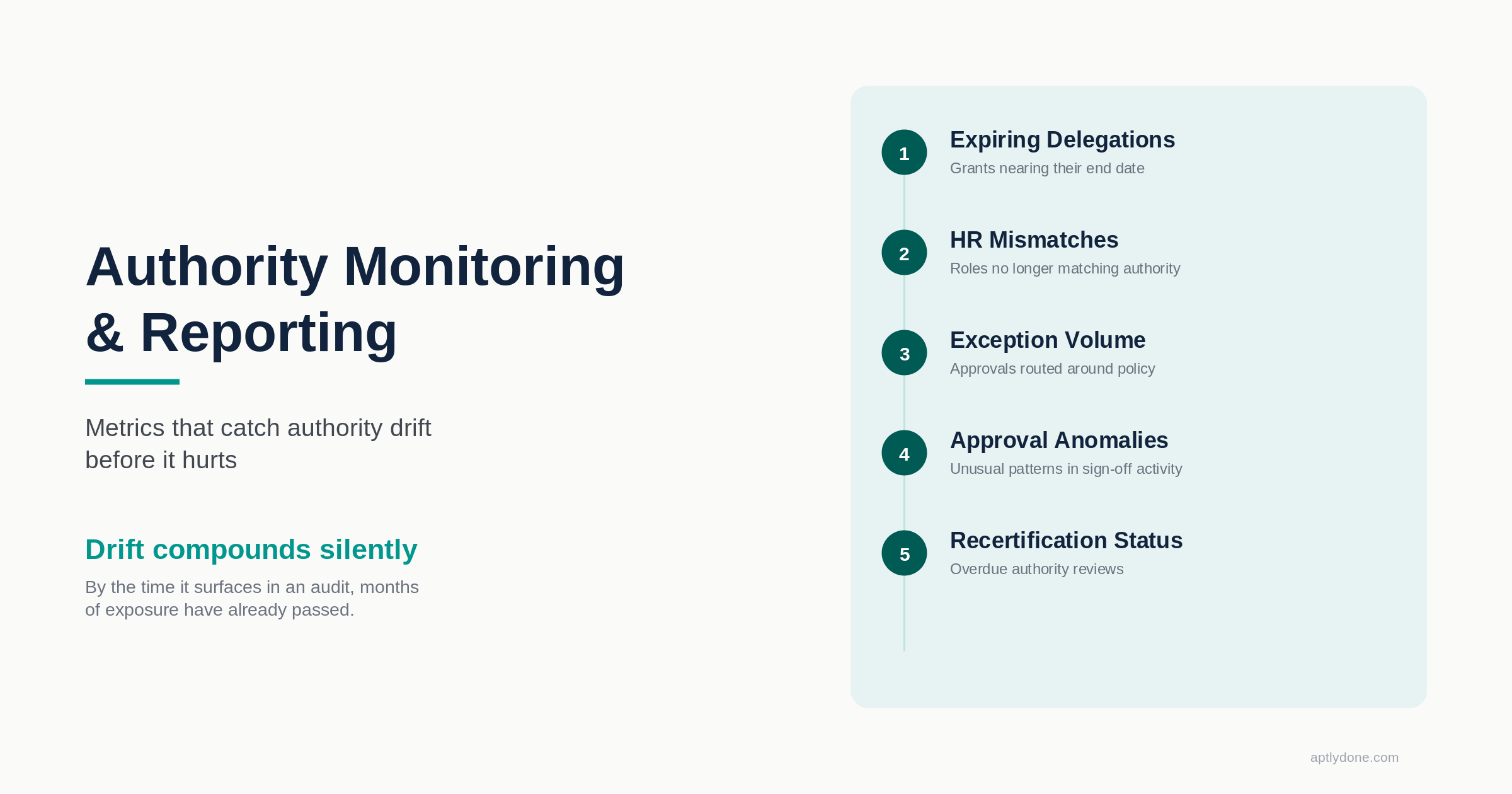
The key metrics for tracking authority drift: expiring delegations, HR mismatches, exception volume, approval anomalies, and recertification status.
This article pairs with the Authority Change Management Playbook for managing authority updates, and with Avoiding Sync Drift for system reconciliation patterns.
Authority programs rarely fail all at once. They degrade gradually: a few expired delegations here, an out-of-date signatory list there, a workaround that becomes standard practice. By the time an auditor or regulator flags the problem, the drift has been compounding for months.
Definition: Authority monitoring is the practice of tracking key metrics, such as expiring delegations, HR status mismatches, exception volume, and recertification status, to detect governance drift before it results in operational incidents or audit findings. It is the measurement layer that tells organizations whether their delegation of authority (DOA) framework is working as designed or quietly breaking down.
The stakes are real. A 2025 EY and Society for Corporate Governance survey found that 35 percent of organizations report difficulty tracking and enforcing their DOA policy, while 27 percent cite difficulties maintaining an updated version due to rapid organizational changes. West Monroe's 2026 Speed Wins research found that 73 percent of C-suite executives believe cutting decision time in half could unlock 5 to 25 percent of revenue. Authority monitoring directly supports this: by catching drift early, organizations prevent the stalled approvals, manual workarounds, and audit reconstruction that erode decision speed.
Authority monitoring transforms governance from a periodic compliance exercise into a continuous operational discipline, catching drift weeks or months before it surfaces as an audit finding or unauthorized approval.
Without active monitoring, organizations discover authority problems reactively: during an audit, after a fraud event, or when a critical approval stalls because no one knows who holds the delegation. The cost of reactive discovery is high. The ACFE's 2024 Report to the Nations found that 51 percent of occupational fraud cases stem from weak or overridden internal controls. Many of these control failures trace back to authority structures that drifted out of alignment with organizational reality.
The EY/SCG survey reinforces this pattern from the governance side: 36 percent of organizations cite training shortcomings as their top DOA challenge, and 33 percent report difficulties understanding roles and responsibilities due to complex organizational structures. These are not technology problems. They are visibility problems that monitoring solves.
McKinsey research found that 72 percent of senior executives believe bad strategic decisions are as frequent as, or more common than, good ones. Authority monitoring provides an early warning system: when approval patterns, exception volumes, and delegation currency start trending in the wrong direction, leadership has the data to intervene before decision quality degrades further.
Proactive monitoring also directly supports audit readiness. The EY/SCG survey found that 58 percent of organizations rely on internal audit monitoring as their primary DOA compliance mechanism. When authority data is continuously tracked and timestamped, audit evidence is a query, not a reconstruction project. This matters for organizations navigating SOX compliance requirements where point-in-time authority records are essential.
Six metric categories, tracked consistently, provide comprehensive visibility into authority program health: expiring delegations, HR status mismatches, exception volume, approval band anomalies, signatory recertification status, and change velocity.
The best authority metrics are actionable. Each one should answer a specific question about program health and trigger a defined response when thresholds are crossed. The six categories below, drawn from operational governance best practices and validated by enterprise survey data, cover the full lifecycle of authority management.
Why it matters: Temporary authority that never expires is a top driver of governance drift. When an employee receives a temporary delegation to cover parental leave or a secondment, and that delegation is never formally revoked, the organization accumulates shadow authority that exists outside its documented framework. West Monroe's research found that most organizations lose 1 to 5 percent of annual revenue to slow decisions. Expired delegations contribute directly to this slowness by creating ambiguity about who can actually approve what.
Why it matters: HR churn is constant, and authority records must keep pace. The EY/SCG survey found that almost 90 percent of organizations maintain a DOA policy, but 28 percent report that time-consuming update processes are a significant challenge. The gap between when an employee changes roles and when their authority records are updated is the most frequent source of stale delegations. Organizations that integrate HRIS data with their authority management system, as described in Keeping Delegations and Signature Authority in Sync, close this gap automatically.
Why it matters: Exceptions are either healthy governance signals or shadow governance indicators, depending on how they are managed. A low, steady exception rate suggests the authority framework covers most operational scenarios. A rising exception rate, particularly concentrated in specific decision types, signals that the DOA matrix has gaps or that thresholds need recalibration. The ACFE's data shows that control weaknesses and overrides are the most common conditions present in fraud cases, making exception monitoring one of the most effective early detection mechanisms.
Why it matters: Both under-approval and over-escalation signal authority misalignment. McKinsey's research found that 72 percent of senior executives consider bad strategic decisions at least as frequent as good ones. Approval band anomalies are often an early indicator of authority structures that no longer match operational reality. Over-escalation is particularly costly: West Monroe found that 44 percent of C-suite executives cite bureaucratic processes as the top cause of slow decisions. When approvals consistently route higher than necessary, the authority framework is creating the bureaucracy it was designed to prevent.
Why it matters: Execution authority is where financial and fraud risk concentrates. Unlike approval authority, which governs internal decision-making, signatory authority governs who can legally commit the organization to external obligations. The EY/SCG survey found that 65 percent of organizations combine signatory authority with their DOA policy, while 28 percent manage it separately. In either case, recertification status is a critical health indicator. Organizations that fail to recertify signatory lists after personnel changes risk unauthorized commitments, as detailed in Preventing Unauthorized Signatures.
Why it matters: If change management is slow, teams route around the formal authority framework. West Monroe's research found that nearly half of leaders spend 10 to 25 percent of their week on rework, excessive approvals, and process friction. A growing change backlog is an early warning that the authority program is becoming the bottleneck it was designed to prevent. The Authority Change Management Playbook provides a structured approach to keeping change velocity high while maintaining governance rigor.
Effective authority monitoring requires specific, measurable thresholds for each metric that trigger defined responses when crossed, rather than subjective assessments that depend on who happens to be reviewing the data.
A metric without a threshold is just a number. The value of authority monitoring comes from defining what normal looks like for your organization, then flagging deviations that require investigation or action. Thresholds should be calibrated to your organization's risk appetite, regulatory environment, and operational tempo.
Definition: An authority monitoring threshold is a predefined limit or benchmark for a specific governance metric that, when crossed, triggers a required investigation, escalation, or corrective action. Thresholds convert passive reporting into active governance.
The table below provides recommended starting thresholds for each metric category. These should be treated as baselines and adjusted based on your organization's experience over the first two to three review cycles.
When setting thresholds, apply the so-what test: if a metric crosses the threshold, is there a clear next action? If the answer is no, the threshold is either too sensitive (generating noise) or too vague (lacking a defined response). The DOA policy should formally document threshold values and escalation paths so they persist through personnel changes.
The APQC's 2024 cross-industry benchmarking on DOA practices provides additional context for calibrating thresholds. Organizations that review their DOA policy at least annually, as APQC recommends, accumulate enough data to shift from generic benchmarks to organization-specific baselines within 12 to 18 months.
A structured review cadence, starting with weekly operational checks and expanding to monthly trend analysis and quarterly program assessments, ensures authority metrics drive action rather than accumulate in unread dashboards.
The most common failure in authority monitoring is not choosing the wrong metrics. It is building a dashboard that no one reviews on a consistent schedule. Cadence is what separates monitoring from measurement.
Weekly operational review (30 minutes): Cover the two highest-frequency indicators: expiring delegations and HR status mismatches. These are the metrics most likely to create immediate operational problems if left unaddressed. The review should produce a short action list: delegations to renew, terminated-employee delegations to revoke, role changes to process.
Monthly trend analysis (60 minutes): Review exception volume and approval band patterns for the preceding period. Look for trends rather than individual data points. A single high-value exception is an operational event. Three months of rising exception volume in the same decision category is a structural gap. The EY/SCG survey found that only 42 percent of organizations have electronic approval and tracking requirements for their DOA. Organizations without electronic tracking will need to build manual reporting processes for monthly analysis.
Quarterly program assessment (90 minutes): Conduct signatory recertification reviews and change velocity assessments. These metrics benefit from longer observation windows because they reflect structural program health rather than day-to-day operations. Quarterly reviews should also recalibrate thresholds based on the preceding period's data.
Annual governance review: Present authority monitoring trends to the audit committee or board governance committee. This review should cover year-over-year improvements, persistent problem areas, and recommendations for threshold or process adjustments. The EY/SCG survey found that 60 percent of organizations do not conduct periodic training on DOA policy updates. The annual governance review is an opportunity to address this gap by incorporating monitoring findings into the training agenda.
An effective authority monitoring dashboard consolidates all six metric categories into a single view, with color-coded status indicators showing which metrics are within acceptable thresholds and which require attention.
The dashboard below summarizes the six-metric framework with recommended monitoring cadences and the operational questions each metric answers. This is not a product screenshot. It is a reference architecture for what your monitoring practice should cover, whether built in a purpose-designed platform or assembled from existing reporting tools.
Five recurring mistakes undermine authority monitoring programs, from trying to measure everything at once to confusing dashboard coverage with actual governance maturity.
Monitoring everything from day one. Organizations that attempt to track all six metric categories simultaneously in their first month typically build dashboards that generate more noise than signal. Start with two metrics (expiring delegations and HR mismatches), build confidence in the review process, and add complexity gradually.
Tracking metrics without assigned owners. A metric without an owner is a metric without accountability. Every metric category needs a named individual responsible for reviewing it on cadence, investigating threshold breaches, and reporting findings. The EY/SCG survey found that 73 percent of organizations manage their DOA centrally, typically through Legal or Finance. The monitoring owner should align with the DOA custodian.
Treating exceptions as failures rather than governance signals. A healthy authority framework generates exceptions. They indicate that the framework is catching decisions that fall outside predefined parameters. The problem is not the existence of exceptions but the absence of a structured process for resolving them. Every exception should end with one of three outcomes: accept the risk, create a new rule, or change a process.
Ignoring change velocity. Change backlog is the silent killer of authority programs. When teams cannot get authority changes processed quickly, they find workarounds: informal approvals, borrowed delegations, or simply proceeding without proper authorization. West Monroe found that 44 percent of managers have accepted slowness as normal or feel apathetic about it. A growing change backlog is the authority equivalent of this organizational resignation.
Confusing dashboard coverage with governance maturity. Having a dashboard that displays all six metrics does not mean the organization is monitoring effectively. Maturity is measured by whether threshold breaches consistently trigger investigation and resolution, not by whether the data is visible. Ponemon Institute research found that the average cost of non-compliance ($14.82 million) is 2.71 times the cost of maintaining compliance. Monitoring without follow-through provides visibility without protection.
A three-phase, 90-day rollout builds monitoring capability progressively: core metrics in month one, pattern metrics in month two, and lifecycle metrics in month three, with each phase adding complexity only after the previous one is operating consistently.
Month 1: Core metrics. Implement tracking for expiring delegations and HR status mismatches. Establish a weekly 30-minute review meeting with the authority program owner. Define initial thresholds and document the escalation path for breaches. Success criteria: zero expired delegations referenced in active workflows by the end of month one.
Month 2: Pattern metrics. Add exception volume tracking and approval band analysis. Begin the monthly trend review meeting. Adjust thresholds from month one based on actual data. Success criteria: exception classification by decision type is operational, and the first monthly trend report has been reviewed by leadership.
Month 3: Lifecycle metrics. Activate signatory recertification tracking and change velocity monitoring. Conduct the first quarterly program assessment. Calibrate all six metrics against the initial 90 days of data. Success criteria: all six metric categories are being tracked, reviewed on cadence, and generating action items when thresholds are crossed.
The table below provides a detailed timeline with specific actions and success criteria for each phase. Organizations that follow this phased approach report faster adoption and fewer abandoned dashboards than those that attempt a full monitoring program from day one.
Aptly provides the structured data foundation that makes authority monitoring practical: delegation records with effective dates, HRIS sync, a change log with full audit trails, and reporting views that surface drift indicators automatically.
Aptly's Delegations Register maintains every delegation with start dates, expiry dates, and ownership records, making expired-delegation tracking a standard query rather than a manual spreadsheet scan. The HRIS integration layer automatically flags HR status mismatches by comparing active delegations against employee status changes from connected systems like Workday, SAP SuccessFactors, and Oracle HCM.
The Change Log captures every authority modification with timestamps, approval records, and before-and-after states, providing the data foundation for change velocity metrics. Pathway View shows delegation lineage across organizational hierarchies, making approval band analysis visual rather than requiring cross-referencing multiple spreadsheets.
For organizations building their monitoring practice, Aptly's structured data model means that the six metric categories described in this article can be tracked from day one without building custom reporting infrastructure. The data is already structured, timestamped, and audit-ready.
Authority drift is the gradual divergence between an organization's documented authority framework and its actual decision-making practices. It occurs when delegations expire without renewal, employees change roles without authority updates, or informal workarounds become standard practice. Detection requires tracking the six metric categories described above: expiring delegations, HR mismatches, exception volume, approval band anomalies, signatory recertification status, and change velocity. Without active monitoring, drift is typically discovered during audits or after incidents.
HR status mismatches. Specifically, delegations assigned to people who have changed roles or left the organization. This single metric catches the most common source of authority drift and is the easiest to automate through HRIS integration. If you can only track one thing, track this.
Program effectiveness is measured across three dimensions: currency (what percentage of delegations are current and assigned to active employees), coverage (what percentage of decision types have defined authority thresholds), and velocity (how quickly can authority changes be processed from request to publication). Tracking these three dimensions over time reveals whether the program is improving, stable, or degrading. The EY/SCG survey found that 35 percent of organizations report difficulty tracking and enforcing their DOA policy, which suggests that most organizations have significant room to improve on the currency dimension alone.
Frame metrics in terms of risk and speed, not governance process. Report 12 expired delegations are blocking payment approvals this week rather than delegation recertification is at 85 percent. Leadership responds to operational impact and business risk, not compliance percentages.
The highest-risk metrics (expiring delegations, HR mismatches) should be reviewed weekly. Exception patterns and approval anomalies benefit from monthly analysis to identify trends. Recertification status is typically tracked quarterly. A single 30-minute monthly meeting covering all categories is sufficient for most organizations. The key is consistency, not duration.
At minimum, you need a system of record that maintains delegation records with effective dates and an HR feed that flags role changes and terminations. Purpose-built authority management platforms like Aptly provide these capabilities natively, along with reporting dashboards that surface drift indicators automatically. Organizations using spreadsheets for authority management typically cannot implement meaningful monitoring because the data is not structured or timestamped.
Audit committees need quarterly reporting on four areas: delegation currency rates (percentage of delegations that are current), exception trends (volume and resolution rates by category), signatory recertification completion status, and any material threshold breaches since the last reporting period. The reporting should include year-over-year trend data so the committee can assess whether governance is improving or degrading. This aligns with the quarterly and annual review cadences described in the monitoring cadence section above.
Signatory lists should be recertified at least quarterly for high-risk banking relationships (payment authorization, wire transfers, credit facilities) and at least annually for lower-risk signatory authority. Any personnel change affecting a signer should trigger an immediate review regardless of the scheduled recertification cycle. The EY/SCG survey found that 65 percent of organizations manage signatory authority within their DOA policy, which means recertification should be integrated with the broader authority monitoring cadence rather than treated as a standalone process.
Connect with our team for a discovery session to learn more about how Aptly can help within your organization. If you are already a client and need support, contact us here.